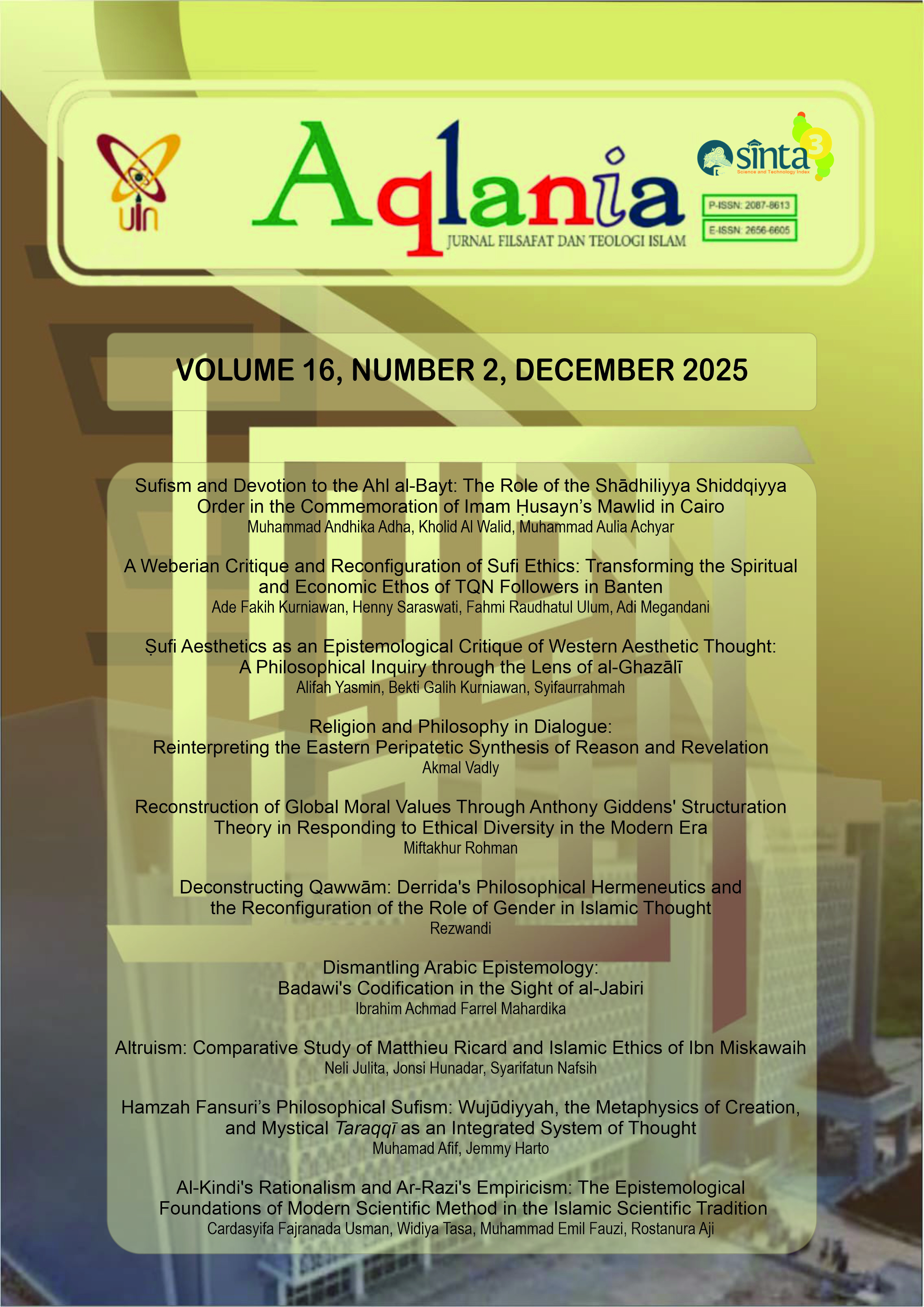
Sufi Aesthetics as an Epistemological Critique of Western Aesthetic Thought: A Philosophical Inquiry through the Lens of al-Ghazālī
DOI:
https://doi.org/10.32678/aqlania.v16i2.20Abstract
Contemporary discussions on aesthetics are still largely framed by Western secular-rationalist assumptions that detach beauty from moral vision, spiritual cultivation, and theocentric meaning. This tendency contrasts sharply with Islamic intellectual traditions, especially Sufi thought, which views aesthetic experience as part of the holistic formation of the human soul (tazkiyat al-nafs) and as a pathway to recognizing divine perfection. The absence of a comparative framework that brings these two epistemic worlds into conversation has left a conceptual gap in understanding how beauty functions within Islamic thought and how it diverges from dominant Western models. Using a library-based method that integrates philosophical analysis with hermeneutic interpretation, the research explores how Islamic thought roots beauty in the harmony of body, character, and spirit, and how spiritual taste (dzawq) functions as an epistemic mode that surpasses the limits of rational cognition. The findings show that while Western aesthetics prioritizes artistic autonomy and sensory judgment, Sufi aesthetics anchors beauty in ethical refinement, ontological purpose, and the pursuit of human perfection (kamāl). This contrast reveals that Sufi aesthetics offers a value-laden and spiritually grounded understanding of beauty that is deeply embedded in the Islamic worldview. The study argues that Sufi aesthetics can serve as a constructive corrective to contemporary aesthetic discourse, which often suffers from moral fragmentation, commodification of art, and the loss of transcendent meaning. By restoring the centrality of the Divine and the moral-spiritual orientation of the human self, Sufi aesthetics provides an integrated framework that enriches both Islamic studies and broader discussions about the place of beauty in human life.
Downloads
Downloads
Published
Issue
Section
License
Copyright (c) 2025 Alifah Yasmin (Author)

This work is licensed under a Creative Commons Attribution 4.0 International License.