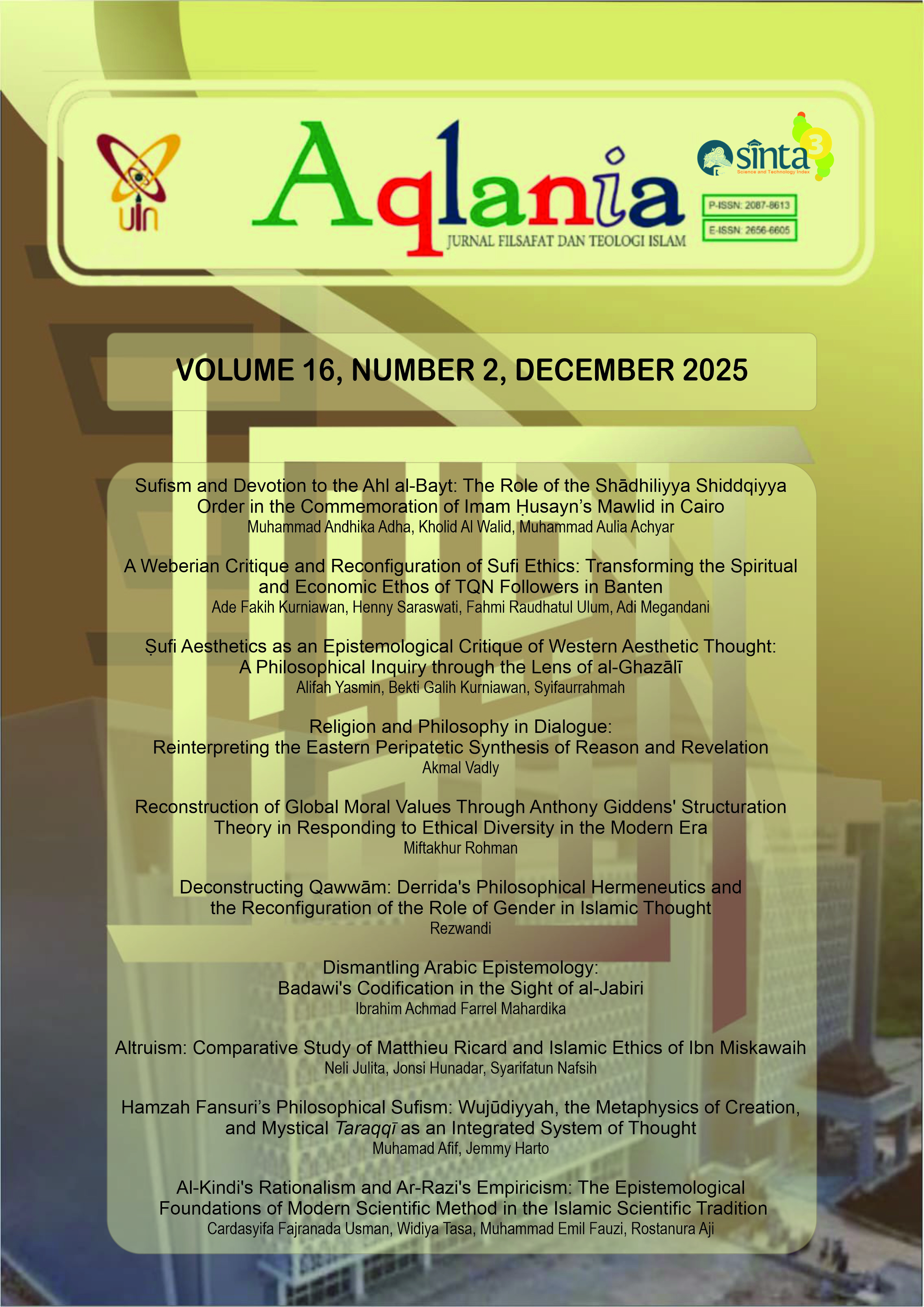
A Weberian Critique and Reconfiguration of Sufi Ethics: Transforming the Spiritual and Economic Ethos of TQN Followers in Banten
DOI:
https://doi.org/10.32678/aqlania.v16i2.80Abstract
This article examines the reconfiguration of Sufi teachings and economic ethos among followers of the Qadiriyah and Naqshabandiyah Orders (TQN) in Banten, Indonesia. Challenging Max Weber’s thesis in The Protestant Ethic and the Spirit of Capitalism, which dismisses Islamic spirituality—particularly Sufism—as economically irrational and fatalistic, this study demonstrates how local Sufi practices can generate a productive and ethical economic habitus. Drawing on ethnographic data collected through interviews and participant observation, the study reveals how values such as zuhd (asceticism), sabr (patience), faqir (spiritual poverty), and tawakkul (trust in God) are reinterpreted by TQN followers not as a retreat from the world but as a form of disciplined spirituality that enhances resilience, responsibility, and ethical entrepreneurship. The findings contribute to a broader theoretical dialogue on religion and capitalism, offering an alternative model of economic rationality grounded in spiritual commitment and communal solidarity. This research not only critiques Weber’s Eurocentric assumptions but also expands the horizon of Islamic economic ethics by highlighting how Sufi traditions can cultivate inclusive and sustainable economic behaviors.
Downloads
Downloads
Published
Issue
Section
License
Copyright (c) 2025 Ade Fakih Kurniawan, Henny Saraswati, Fahmi Raudhatul Ulum, Adi Megandani (Author)

This work is licensed under a Creative Commons Attribution 4.0 International License.