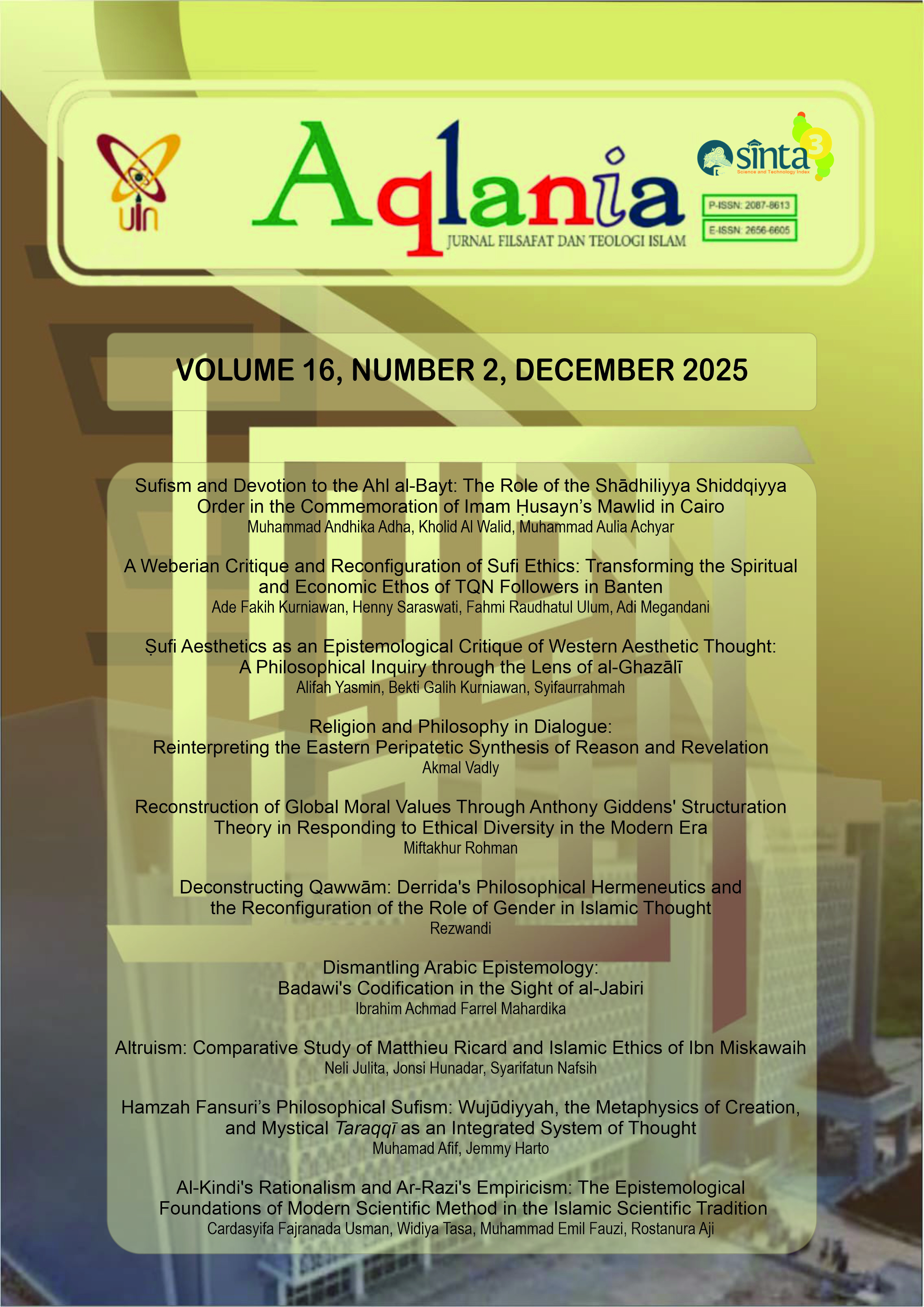
Altruism: Comparative Study of Matthieu Ricard and Islamic Ethics of Ibn Miskawaih
DOI:
https://doi.org/10.32678/aqlania.v16i2.88Abstract
This article examines Matthieu Ricard's concept of altruism and Ibn Miskawaih's Islamic ethics. The main issue discussed is how these two different philosophical traditions view altruism and whether the integration of the two can provide a more comprehensive understanding of universal moral values. The main research question is how the spiritual compassion emphasized by Ricard and the rational virtues proposed by Ibn Miskawaih can be synthesized into a whole framework of altruism. The method used is a comparative philosophical approach with the data analysis techniques applied in this study are interpretive descriptive analysis, analyzing primary suber and literature related to the discussion being studied and the ethical principles of the two thinkers to find similarities and differences. The findings of the study suggest that Ricard highlights enlightenment and universal happiness through compassion, while Ibn Miskawaih emphasizes happiness and rational virtue as the basis of moral behavior. This article introduces the concept of transcendental altruism, a synthesis that combines compassion with rational virtue, offering a holistic approach to the ethics of altruism that transcends cultural and religious boundaries. This perspective enriches the theoretical discourse on altruism while also providing practical implications for fostering moral universality in diverse societies. This study contributes to contemporary ethics by showing how cross-cultural philosophical dialogue can deepen our understanding of altruism as a fundamental value of humanity.
Downloads
Downloads
Published
Issue
Section
License
Copyright (c) 2025 Neli Julita, Jonsi Hunadar, Syarifatun Nafsih (Author)

This work is licensed under a Creative Commons Attribution 4.0 International License.