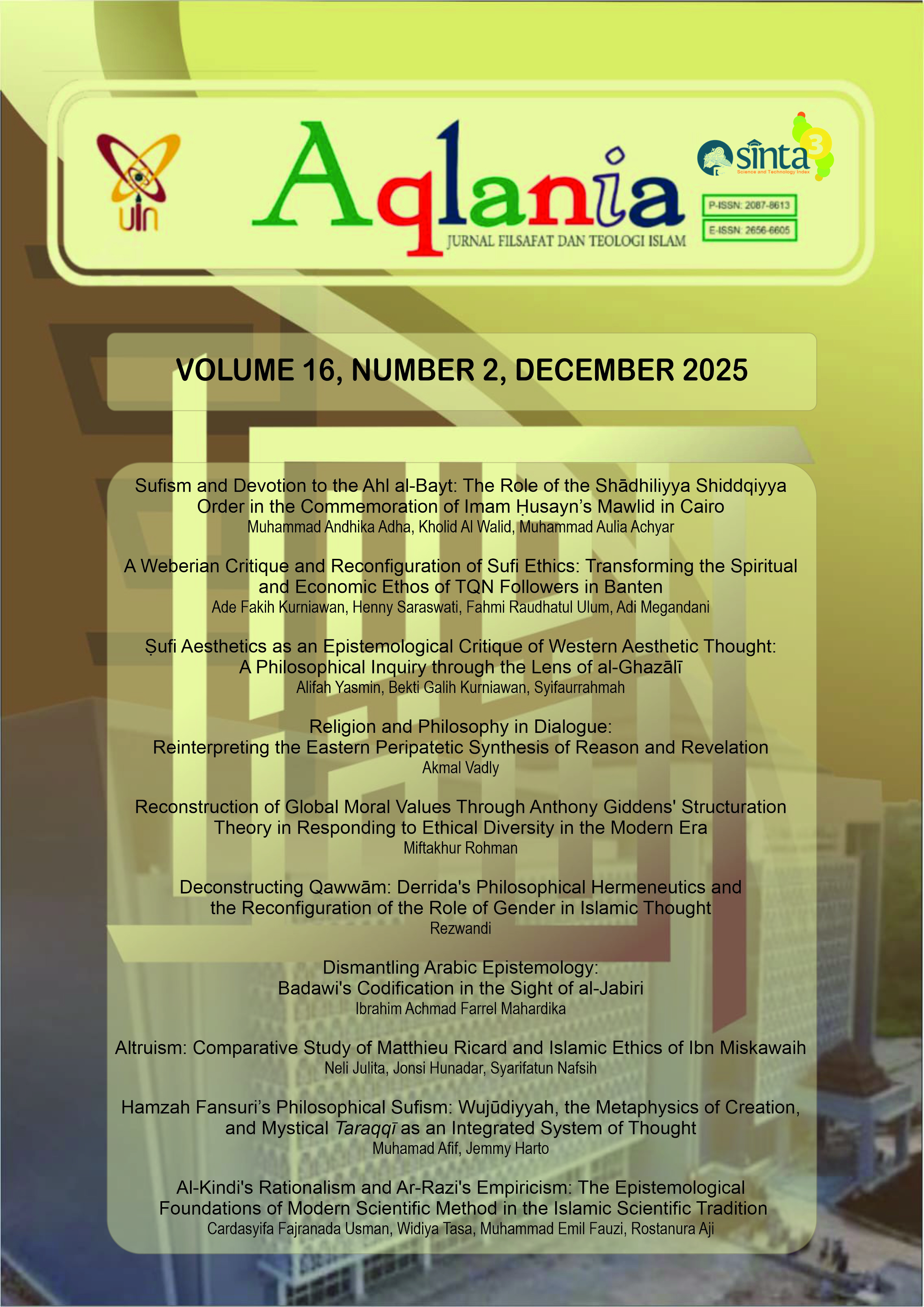
Religion and Philosophy in Dialogue: Reinterpreting the Eastern Peripatetic Synthesis of Reason and Revelation
DOI:
https://doi.org/10.32678/aqlania.v16i2.86Keywords:
Islamic philosophy, ParipateticAbstract
This article departs from a fundamental problem in the study of Islamic philosophy: the tendency to interpret the Eastern Peripatetic tradition, especially as a continuation of Aristotelian rationalism, which is derivative. This view often obscures the reflective and creative process of Muslim philosophers in formulating the relationship between reason and revelation. Based on these issues, this research aims to reinterpret the Eastern Peripatetic tradition as a dynamic philosophical dialogue space between religion and philosophy within the framework of Islamic intellectuals. The study focuses on the thought of al-Kindī, al-Fārābī, and Ibn Sīnā, who systematically developed a rational framework for understanding reality while maintaining a focus on revelation. This research employs a philosophical-historical approach, examining the classical texts of Peripatetics and critical readings by later thinkers. Through this approach, the study traces the formation of epistemological synthesis in the development of Eastern Peripatetics with special attention to key concepts such as active intelligence, emanation, and hierarchical structures of existence. In addition, the study also considers how these concepts were re-understood and debated by figures such as al-Ghazālī, Ibn Rushd, and Suhrawardī as part of the internal dynamics of Islamic philosophy. The results of the study show that Eastern Peripatetics does not stop at adopting Aristotelian rationalism but cultivates it into a typical Islamic epistemology. For this reason, metaphysics and revelation are complementary. This transformation played an essential role in shaping the philosophical foundation of classical Islamic thought and opened up conceptual possibilities for formulating the relationship between science and religion in modern Islamic philosophy. Thus, this study confirms that the Eastern Peripatetic tradition is a dynamic and dialogical system of thought whose influence continues to shape the development of contemporary Islamic epistemology and educational philosophy.
Downloads
Downloads
Published
Issue
Section
License
Copyright (c) 2025 Akmal Vadly (Author)

This work is licensed under a Creative Commons Attribution 4.0 International License.