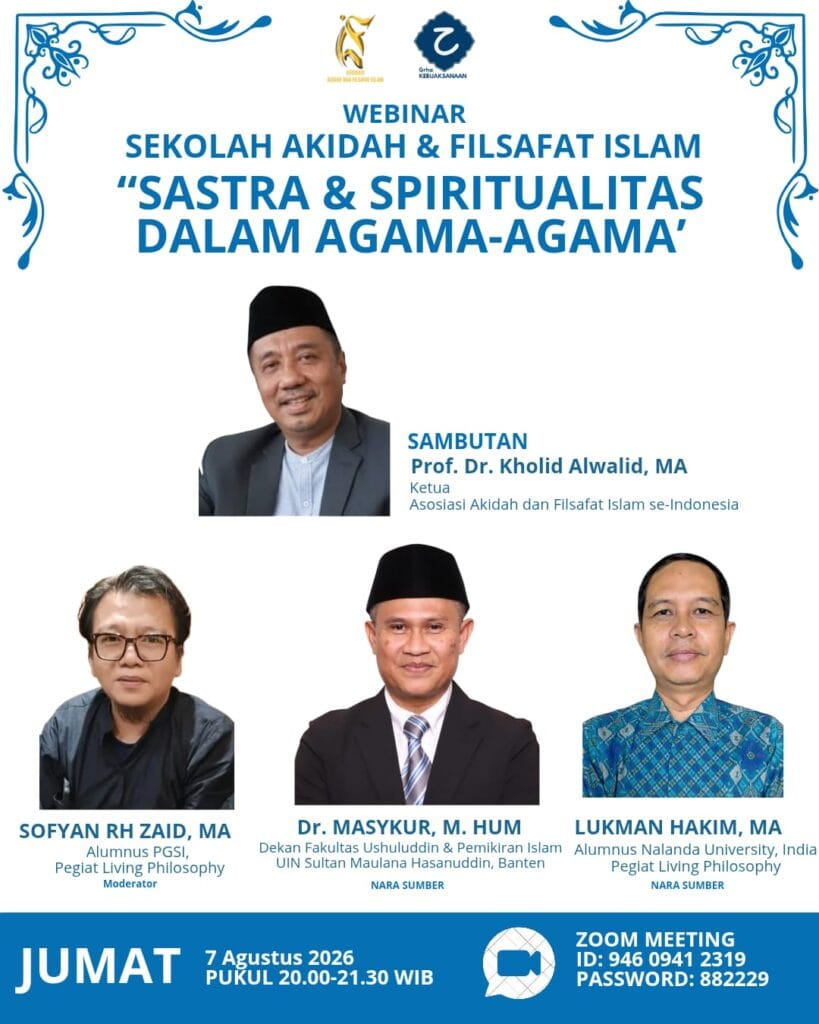
Jakarta, August 10, 2026 – The Indonesian Association of Islamic Creed and Philosophy (ASAFI), through its School of Islamic Creed and Philosophy program, successfully held a webinar titled ‘Literature and Spirituality in Religions’ on Friday, August 7, 2026. The event took place virtually via Zoom Meeting and featured two main speakers: Dr. Masykur, M.Hum (Dean of the Faculty of Ushuluddin and Islamic Thought at UIN Sultan Maulana Hasanuddin Banten) and Lukman Hakim, MA (alumnus of Nalanda University, India, and an activist with Living Philosophy), with Sofyan RH Zaid, MA, serving as moderator.
The webinar was officially opened by Prof. Dr. Kholid Alwalid, MA, Chair of ASAFI. In his opening remarks, Kholid emphasized the importance of viewing literature not merely as a form of entertainment, but as a reflection of the spiritual experiences of religious communities living within socio-cultural dynamics.
Appearing as the first speaker, Masykur put forward an interesting thesis in his presentation: that Banten spirituality manifests as an experience, not merely a doctrine about God. He defined literature as ‘spiritual and social technology’ that helps shape the way a community remembers, experiences the sacred, maintains the boundaries of identity, and encounters others. Spirituality itself is experienced through language, ancestral stories, sound, the body, space, agriculture, pilgrimages, performances, and collective memory.
Aesthetics as the Key to Reading
In an effort to explore the depth of meaning, Masykur employs Michael Hauskeller’s aesthetic philosophy as an analytical framework, which maps out sixteen positions on art from Plato to Danto—demonstrating that the definition of art has evolved beyond mimesis (imitation) toward art as meaning, symbol, critique, and context. He also integrates the perspectives of Mudji Sutrisno and Christ Verhaak, who assert that aesthetic experience is grounded, embodied, and culturally embedded.
The beauty of Banten literature, he continued, lies not merely in its form, but in its ability to reveal the sacred through rhythm, sound, and symbols.
Three Forms of Banten Spiritual Literature
Masykur categorizes Banten’s literary heritage into three major modes. First, the Cosmological mode, as depicted in the Baduy Pantun and Sajarah Banten, where literature establishes a harmonious relationship between humans, nature, ancestors, and the Almighty. Second, the Hagiographic-Metaphysical mode, found in *Wawacan Seh* and *Mashāhid al-Nāsik*, where the texts serve to draw readers closer to the blessings of the saints and spiritual experiences (tajallī) through poetry and evocative imagery. Third, the Prophetic-Ethical tradition, represented in *Max Havelaar*, *Balada Si Roy*, and the works of Toto ST Radik, where literature serves as a social critique that sharply condemns colonial injustice, poverty, and ecological destruction.
Complex Interfaith Relations
Regarding interfaith relations, Masykur points out that the Banten literary corpus reveals relationships that go beyond a simple narrative of harmony. It encompasses translation, assimilation, boundaries of identity, tensions, and even negotiations regarding the sacred. Without straying from the Islamic creed rooted in tawhid, literature expands the ethical imagination to understand how others experience holiness and suffering. This aligns with the ethical foundation of Quran 49:13 regarding ta’āruf (getting to know one another), as well as Quran 5:48 and 2:256, which contain the principles of freedom and diversity.
Meanwhile, the second speaker, Lukman Hakim, MA, enriched the discussion with perspectives on comparative religion and living philosophy, encouraging participants to read classical texts from the Nusantara region as a bridge for interfaith dialogue that is alive in everyday practice, rather than merely theological discourse on paper.
This interactive webinar was also attended by dozens of participants from various backgrounds, including academics, students, and cultural activists. ASAFI hopes that similar events will continue to strengthen an inclusive yet critical understanding of Islam, making literature a fertile ground for the development of spirituality and philosophical thought in Indonesia.
You can watch a replay of this event on the ASAFI & Graha Kebijaksanaan YouTube channels.