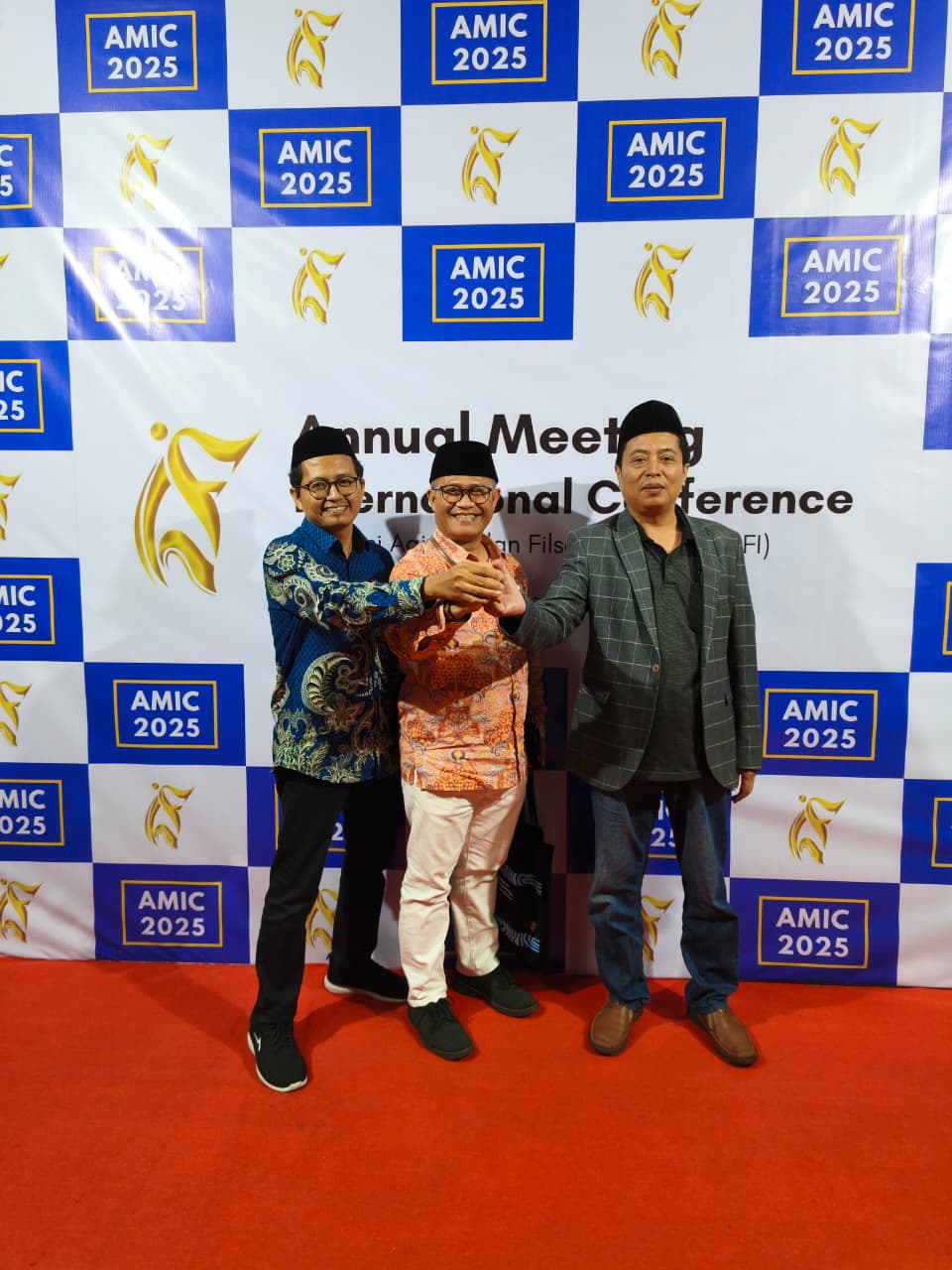
SERANG - Sultan Maulana Hasanuddin State Islamic University (SMH) Banten again showed its commitment in strengthening the science of Aqidah and Islamic Philosophy by following Annual Meeting and International Conference ASAFI (Association of Aqidah and Islamic Philosophy) 2025. This activity took place over three days, on November 27-29, 2025, located in South Jakarta.
This prestigious agenda compiled by ASAFI was attended by various Islamic Universities throughout Indonesia. From UIN SMH Banten, a number of leaders and academicians were present, including:
Dr. Masykur, M.Hum - Dean of the Faculty of Ushuluddin and Adab
Mus'idul Millah, S.Th.I, M.Ag - Head of the Aqidah and Islamic Philosophy Study Program
Dr. Ali Agus Dzawafi, M.Fil.I - Lecturer at the Faculty of Ushuluddin and Adab
Anton Sutompul - Students of Aqidah and Islamic Philosophy Study Program
Big Theme: Curriculum Synergy and Global Challenges
This year's ASAFI Annual Meeting has a big theme “Curriculum Synergy and Activity Design of Tri Dharma Perguruan Tinggi Study Program of Aqidah and Islamic Philosophy to Face the Challenges of Internationalization and Global Complexity.”
In addition to the annual meeting, this activity is also coupled with International Conference on “Discourse on Islamic Philosophy.” This conference is a scientific space for academics, researchers, and students to share thoughts and enrich the scientific treasures of Islamic philosophy in the national and international realms.
Dr. Masykur's presentation: Integration of Ecotheology and the Role of Ulama in the Public Sphere
In the parallel presentation session, Dr. Masykur, M.Hum presented his paper entitled:
“Revitalizing Ulama Authority in Multicultural Public Spaces: Integration of Islamic Ecotheology and Communicative Action Theory.”
In his presentation, he highlighted the issue of ecological damage, one of which was presented through a case study Pantai Indah Kapuk (PIK) 2 project, It is considered to contain the practice of massive exploitation of nature.
“Mining is a symbol of exploitation of the natural environment, which results in natural disasters, environmental damage, and ecosystem imbalance,” said Masykur, Friday, November 28, 2025.
He emphasized that scholars, intellectuals and academics has a strategic role as a guardian of environmental sustainability, part of the principle of hifdzun nafs in maqāṣid al-sharī'ah.
Masykur also offered a number of solutions:
Integration of Islamic ecotheological perspective in environmental policy,
The use of Habermas' communicative action paradigm in development governance,
Involving ulama in multicultural public forums to prevent ecological damage.
Dr. Ali Agus Dzawafi's Contribution: Interpreting the Concept of Insan Kamil
In the next scientific session, Dr. Ali Agus Dzawafi, M.Fil.I also delivered a paper titled:
“The Concept of Insan Kamil Kiai Muhammad Santri.”
He reviewed the concept of insan kamil as a creature who is able to undergo the process of taraqqī (spiritual ascent) and tanazzul (decrease of divine value in behavior). According to him, the peak quality of insan kamil is embodied in the Prophet Muhammad as a figure who achieves a meeting between the human dimension and the divine dimension perfectly.
Student Participation: Muhammad Iqbal's Human Ego Study
At the student level, Anton Sutompul presented a paper titled:
“Muhammad Iqbal's Human Ego: A Case Study of Radioactivity in Cikande District.”
This paper highlights the importance of the formation of ego (self) according to Iqbal, which requires humans to have awareness, ability to act, and responsible freedom. The radioactive case study in Cikande is used as a reflective example of how humans should manage their will in the face of moral and ecological problems.
National Ideas Exchange Forum
The event, which was attended by hundreds of academics from all over Indonesia, became an important forum for the development of research in the field of faith and philosophy. Intense discussions took place, ranging from the relationship between Islamic philosophy and humanitarian issues, ecological crises, to curriculum transformation in the midst of global challenges.
The Importance of Strengthening the API Curriculum
Mus'idul Millah, S.Th.I, M.Ag, as the Head of Aqidah and Islamic Philosophy at UIN SMH Banten, emphasized that this year's ASAFI Annual Meeting is a momentum to unite the vision between campuses in building a more adaptive and competitive curriculum standard.
“This Annual Meeting aims to improve the institutional quality of universities and strengthen the development of the Aqidah and Islamic Philosophy curriculum to be more responsive to global challenges,” he said.