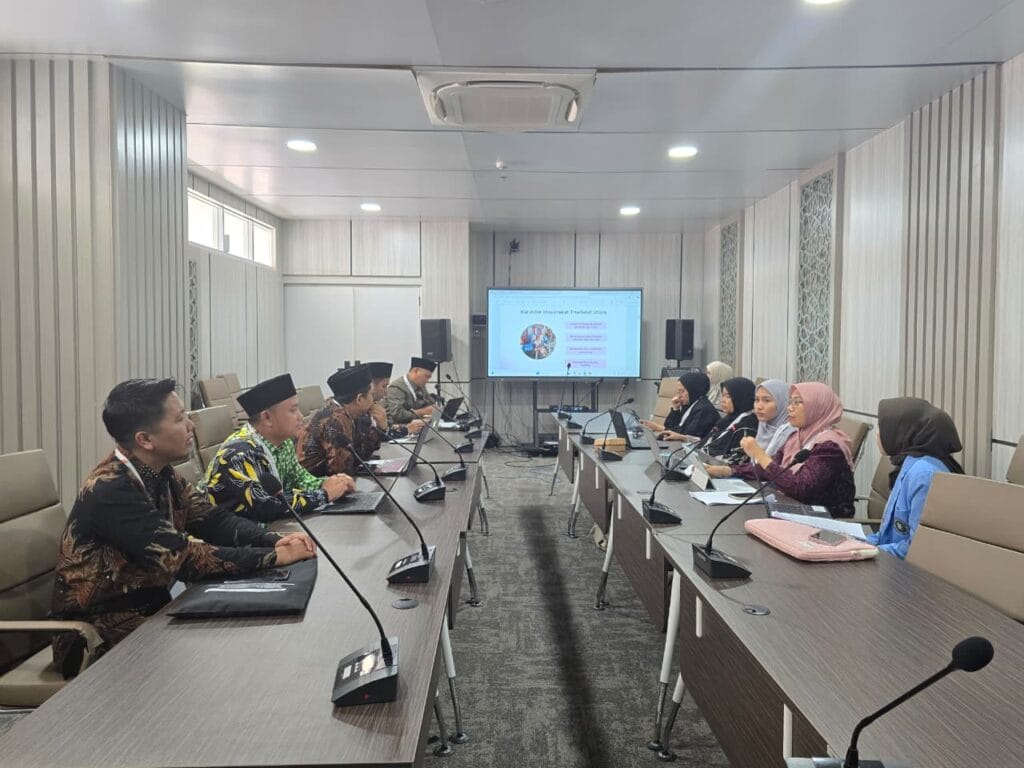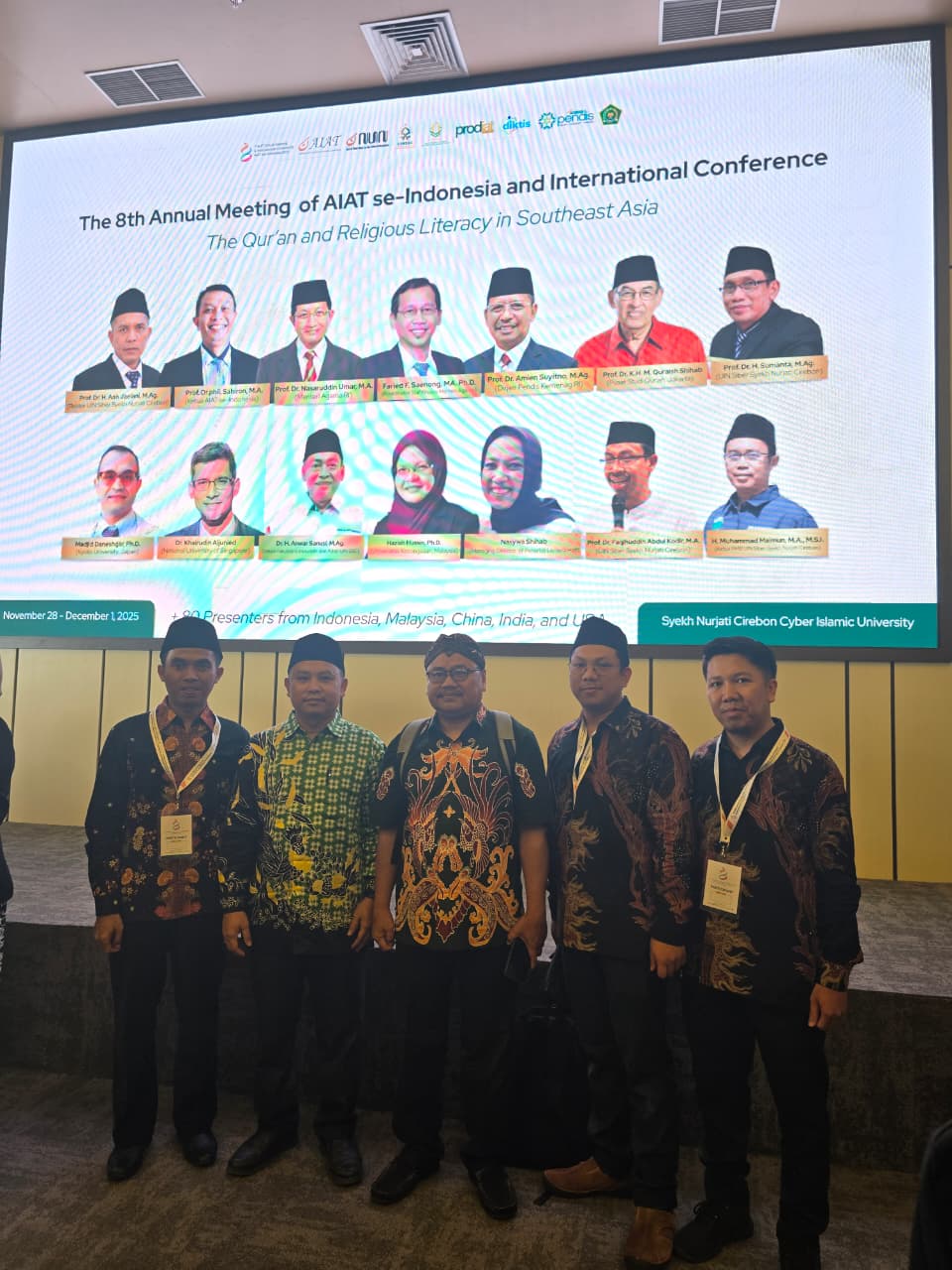
Cirebon, November 30, 2025 - Four lecturers from the Department of Al-Qur'an and Tafsir (IAT), Faculty of Ushuluddin and Adab (FUDA) UIN Sultan Maulana Hasanuddin Banten became academic delegates at The 8th Annual Meeting of Association of Indonesian Al-Qur'an and Tafsir Studies (AIAT) which was coupled with the International Conference on Qur'anic Studies and Islamic Civilization. This activity took place on November 28 - December 1, 2025 on the campus of UIN Siber Syekh Nurjati Cirebon.
The event was attended by Prof. Dr. Amien Suyitno, M. Ag. (Director General of Islamic Education, Indonesian Ministry of Religious Affairs), Prof. Dr. Phil. Sahiron, M.A. (Director of Islamic Higher Education, Directorate General of Islamic Education, Indonesian Ministry of Religious Affairs / President of AIAT throughout Indonesia) and Prof. Dr. H. Aan Jaelani, M.Ag. (Rector of UIN Sheikh Nurjati Cirebon), Vice Rector III of UIN SSC, Prof. Dr. Hajam, M.Ag., Dr. Anwar Sanusi, Dean of Faculty of Ushuluddin and Adab UIN SSC and a number of guests from abroad, Malaysia, Singapore and Japan.
The FUDA UIN SMH Banten delegation consisted of: Dr. Endang Saeful Anwar, Lc., M.A. (Vice Dean III FUDA), Hikmatul Luthfi, M.A.Hum., (Head of IAT Department) Salim Rosyadi, M.Ag., (Head of RMB Center UIN SMH Banten) and Zulkifli Reza Fahmi, M.S.. (Secretary of IAT). In a prestigious academic forum that presented hundreds of Qur'an and Tafsir researchers from all over Indonesia and participants from abroad, FUDA UIN Banten lecturers presented two papers entitled: “Mistification of Qur'anic Orthography (Construction of Takwil Khurufi Syaikh Ahmad bin Ali al-Buni in Sufistic Tafsir Discourse)” submitted by Endang Saeful Anwar and Salim Rosyadi, and a paper entitled “The Impact of Algorithms on the Development of Tafsir in Indonesia: Epistemological, Hermeneutical, and Socio-Digital Studies” presented by Hikmatul Luthfi and Zulkifli Reza Fahmi.
In their presentation, Endang and Salim discuss the epistemological and mystical approach to Qur'anic orthography developed by the classical Sufistic figure, Shaykh Ahmad bin Ali al-Buni, especially in the perspective of the Qur'an's orthography. takwil hurufi as part of the Sufistic tradition of interpretation. This research highlights the relationship between Islamic mysticism, the letters of the Qur'ān, and the role of the sacred text as a spiritual and hermeneutical object. The study of letter orthography in the tradition of Qur'anic exegesis has so far only developed in linguistic text-based exegesis. Yet there are several books that study the symbolism of letters beyond linguistics, understanding the study of letters metaphysically and spiritual power. One of those who pay attention to this study is Shaykh Ahmad bin Ali Al-Buni (d.622 AH), a Sufi scholar and philosopher also known as a wisdom expert from Algeria. On the other hand, in the Indonesian pesantren tradition, the kitab Syamsul Ma'ārif and Manba'Uṣūl al-Hikmah has a great influence. Even in certain pesantren, this book is often read, studied, and even practiced, because its contents are related to occultism or recitation of prayers, dhikr, wirid to spiritual practices such as hizib, azimat, rajah and wafaq. However, this book is often accused of containing elements of magic or clairvoyant practices, mainly because of the presence of rajah, Khalid al-Juraisy mentions numerical symbols and prayers that do not have a clear source of authority in terms of the sanad of transmission, and he even refers to them as practices of polytheism.
In another session, Hikmatul Luthfi and Zulkifli Reza explained that digitalization in the last two decades has reconstructed the way Indonesian Muslims access, understand, and distribute religious knowledge, including Qur'anic interpretation. One of the most dominant elements in the digital era is the algorithm that works as a new epistemic mediator in regulating the flow of information. This paper analyzes the impact of algorithms on the development of tafsir in Indonesia through three main perspectives: epistemological, hermeneutical, and socio-digital. It is found that algorithms not only affect the distribution of tafsir content, but also shape new authority structures, new styles of interpretation, and patterns of religious consumption that are strongly influenced by the algorithm. engagement logic. The findings emphasize the need for an epistemological framework of interpretation that is more adaptive to the digital ecosystem and the need for religious digital literacy to prevent distortion of religious knowledge.
The head of the delegation, Dr. Endang Saeful Anwar, M.A., said that the participation of FUDA lecturers in national and international scientific forums is a form of institutional commitment to strengthen UIN Banten's contribution in the academic study of the Qur'an and tafsir.
“This participation is not only a representation of the institution, but also a form of our commitment to developing a Qur'anic academic tradition that is dialogical, progressive, and research-based.” he said.
Meanwhile, the Dean of the Faculty of Ushuluddin and Adab UIN SMH Banten, Dr. Masykur, M.Hum. gave appreciation to the contribution of the delegates. According to him, the involvement of lecturers in national and international scientific forums will further expand academic networks, improve institutional reputation, and strengthen the culture of research on campus.
The 8th Annual Meeting of AIATs and International Conference featured various thematic discussions such as Interpreting the Qur'an in the Digital Era, History and Intellectual Legacy of Tafsir in Southeast Asia (Pre-Modern), Intellectual Dynamics of Modern Contemporary Tafsir in Southeast Asia (20th-21st Century). History, Legacy, and Qur'an Manuscripts in Southeast Asia, Religious Literacy and Social Identity in Southeast Asia, Qur'an, Technology, and Digital Media and Qur'an and Popular Literature.
In addition to the presentation session, FUDA UIN Banten delegates also followed several important agendas in order to strengthen the quality of IAT Study Programs throughout Indonesia, including: Review of Graduate Learning Outcomes (CPL) of IAT Study Programs and Mandatory AIAT Courses throughout Indonesia which aims to harmonize the competency standards of IAT graduates to be in accordance with scientific developments, community needs, and the direction of national and international education policies. Also discussed was the Standardization of the IAT Study Program Curriculum at the S-1, S-2, and S-3 levels.
This agenda is a strategic step towards national academic integration while still providing space for the distinctiveness of each institution based on Qur'anic science, as well as the preparation of Religious Literacy Policy Recommendations. This recommendation is expected to be a national reference in strengthening moderate religious literacy based on the study of the Qur'an and Tafsir as a response to the social dynamics of religion in Indonesia and the world.
With the active contribution of FUDA IAT UIN SMH Banten lecturers, it is hoped that research and scientific publications in the field of Qur'anic studies will grow and have a positive impact on advancing the Islamic scientific tradition in Indonesia. (Esafa)