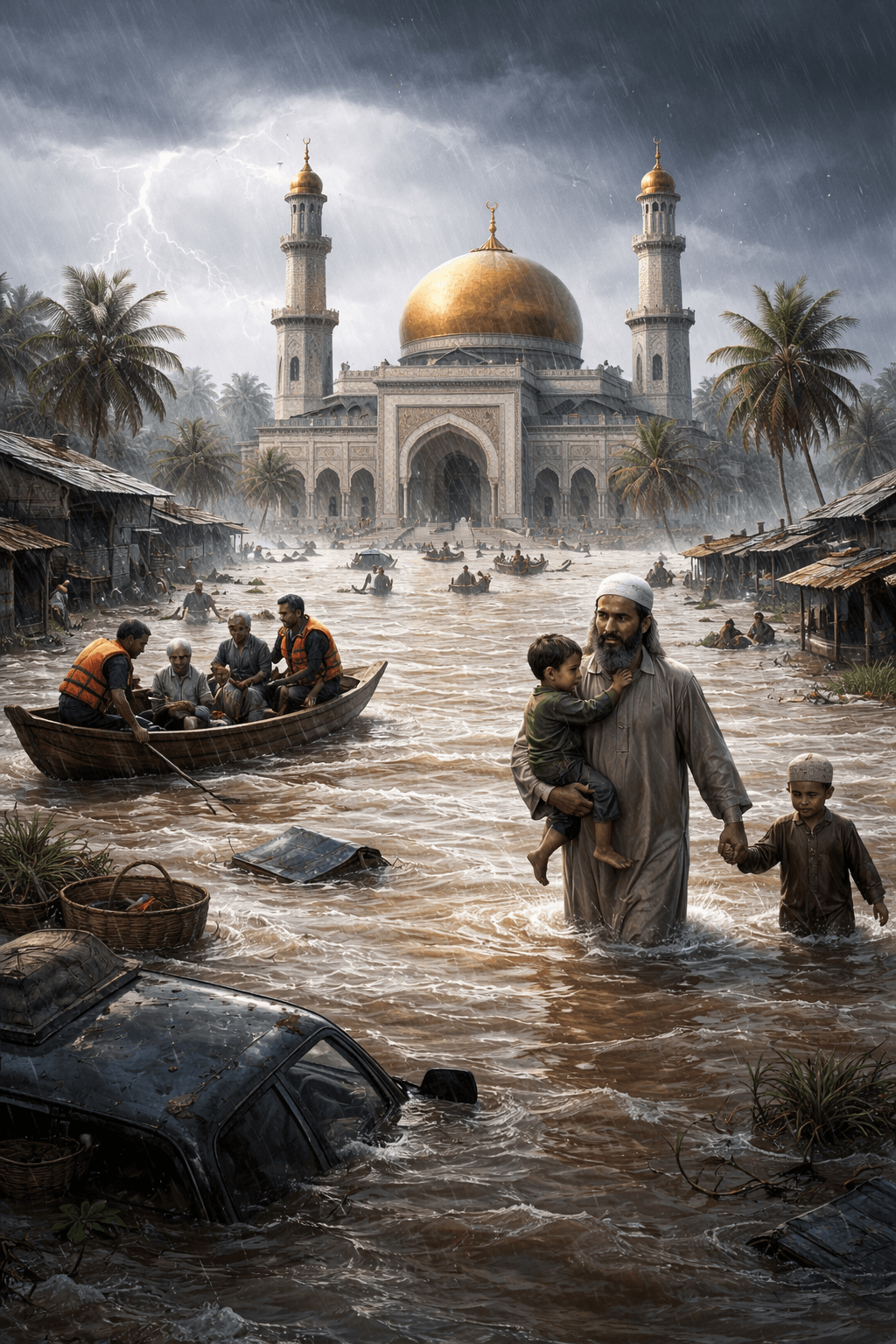
During the rainy season, flooding has become a frequent phenomenon in Indonesia, especially in big cities such as Jakarta, Semarang and Bandung. Is flooding an unavoidable tradition or a spatial error that can be corrected? As an academic of Ushuluddin and Adab, this issue deserves to be studied from the perspective of Islamic science and philosophy.
Proper Layout
In Islam, spatial planning is an important aspect in maintaining the balance between humans and the environment. Muslim philosophers such as Ibn Khaldun and Al-Farabi have discussed the importance of good spatial planning in maintaining a stable society. Al-Farabi, in his work “Al-Madinah Al-Fadilah”, emphasized the importance of urban space planning that is balanced between human needs and the environment.
Spatial planning in Indonesia is regulated by several government regulations. There are at least three, first, Law No. 26/2007 on Spatial Planning. This law regulates spatial planning, including spatial planning, spatial utilization, and control of spatial utilization. Second, Government Regulation Number 21 of 2021 concerning the Implementation of Spatial Planning. This regulation regulates the implementation of spatial planning, including spatial planning, spatial utilization, and control of spatial utilization. Third, Regulation of the Minister of Agrarian and Spatial Planning/Head of the National Land Agency Number 11 of 2021 concerning Guidelines for Preparing Spatial Plans. This is a clear regulation that regulates the guidelines for preparing spatial plans, including national, provincial and district / city spatial plans. With this regulation, spatial planning for both cities and villages should only be used for the fulfillment of human life, not for the exploitation of the natural environment which results in natural damage and even floods.
Causes of Flooding
Data from the Ministry of Maritime Affairs and Fisheries shows that some coastal areas in Indonesia experience land subsidence of up to 10-15 cm per year, while sea levels rise by about 4-8 mm per year. The combination of these two phenomena makes tidal floods a routine disaster that threatens millions of residents in coastal areas. In addition, drainage systems that are unable to accommodate excess water volume also worsen the situation.
Flooding can be caused by several factors, including spatial errors. Here are some scientific explanations of the causes of flooding from spatial errors. First, land use change. Changes in land use from green areas to built-up areas can increase the risk of flooding. Green areas, such as forests, rice fields, and parks can absorb rainwater, while built-up areas, such as buildings, roads, and parking lots can increase the flow of surface water. Second, the reduction of river capacity. Reduction in river capacity can occur due to sedimentation, narrowing, or changes in river flow. This can cause river water to overflow and cause flooding.
Third, hydrological imbalances. Hydrological imbalances may result from climate change, land use change or other human activities. This can lead to increased rainfall intensity, increased surface water flow, and increased flood risk. Fourth, lack of green open space. Lack of green open space can lead to increased surface water flow and increased flood risk. Green open spaces such as parks, rice fields, and forests can absorb rainwater and reduce surface water flow. Fifth, poor spatial planning. Poor spatial planning can lead to increased flood risk. Spatial planning that does not consider hydrological, geological and environmental aspects can lead to increased flood risk.
Solution
Addressing flooding requires changes in urban planning and environmental management. Several solutions are possible. First, the development of green infrastructure. Infiltration parks, urban forests and green open spaces can help absorb rainwater naturally. Second, spatial planning. Areas that have a high risk of flooding should be zoned as non-residential or green zones. Third, improving the drainage system. The drainage system must be improved to accommodate excess water volume.
In the context of Islamic studies, we can take lessons from the concept of resources and resource utilization. Humans must use natural resources wisely and not excessively, so as to maintain environmental balance.
Conceptually, the Indonesian government has issued several policies to protect protected forests, such as Community Based Forest Management (CBFM). This scheme gives rights to villagers around forests to legally manage protected and production forest areas. Social Forestry Program. This program grants legal management rights of state forest areas to communities, with the aim of improving community welfare and maintaining forest sustainability. Protected Forest Areas where these areas are maintained as forest areas with the main function as protection of life support systems to regulate water systems, prevent flooding, control erosion, prevent seawater intrusion, and maintain soil fertility.
Academia Activities for Ecotheology
Academics can play a role in developing and applying the concept of ecotheology in urban and rural areas with three dharma. First, the dharma of research that conducts research on ecotheology and develops new concepts that can be applied in urban and rural areas. Second, the dharma of education that conducts education and training on ecotheology to the community and government. Third, the dharma of cooperation with the government. Working with the government to develop policies and programs that support ecotheology.
The campus environment as an ecotourism concept that implements infiltration gardens, urban forests, and urban agriculture. Infiltration gardens are designed to absorb rainwater and reduce the risk of flooding. Urban forests are planted in cities to improve air quality and reduce pollution. Urban agriculture practiced in cities to increase food availability and reduce environmental impact.
Thus, we can conclude that flooding is not an unavoidable tradition, but a spatial error that can be corrected. The government and academics must work together to develop and apply the concept of ecotheology that can maintain environmental balance and improve people's quality of life.