

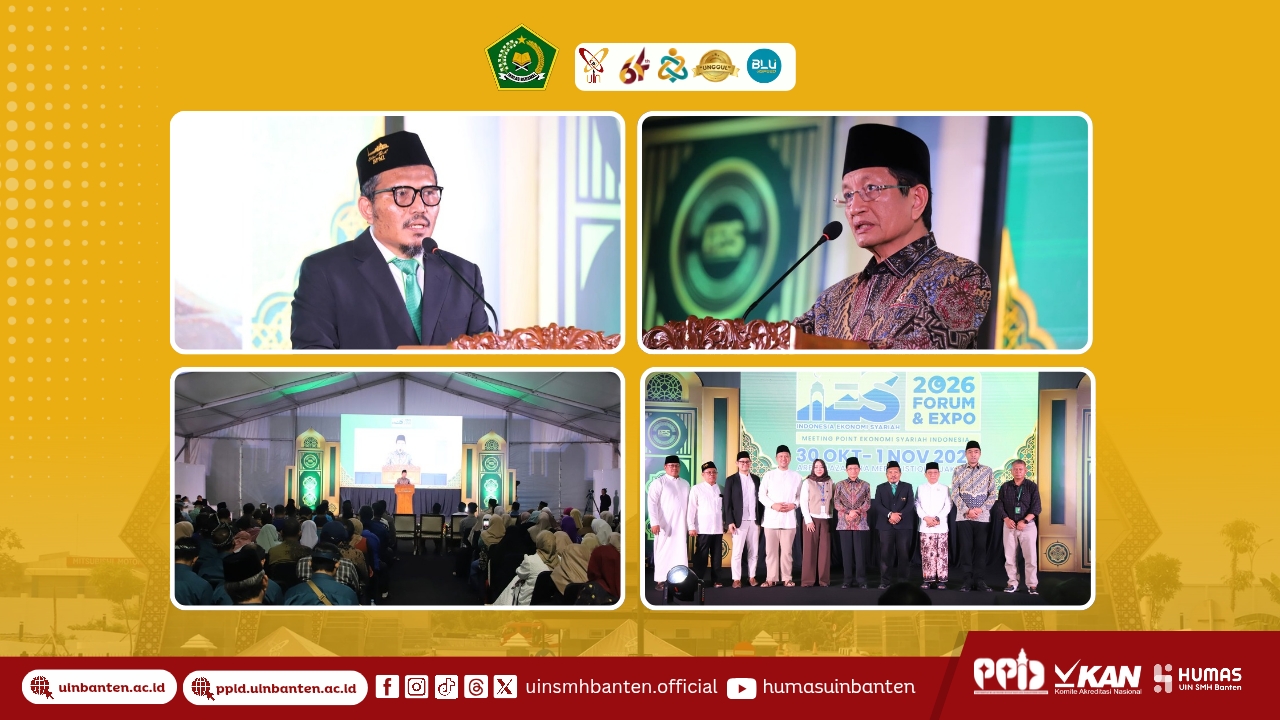

UIN Public Relations – Minister of Religious Affairs Nasaruddin Umar stated that the Islamic finance sector in Indonesia holds great potential that has not yet been fully tapped, given the large Muslim population and the presence of hundreds of thousands of mosques scattered throughout the country.
The Minister of Religious Affairs made this statement while opening the Indonesia Sharia Economy Forum and Expo 2026 at the Istiqlal Mosque in Jakarta.
The Minister of Religious Affairs likened Indonesia’s Islamic economy to a sleeping giant with a very robust domestic market, supported by a population of approximately 250 million Muslims.
“If we consider the various potentials we have as a nation, the first is the potential of the Muslim community. The approximately 250 million Muslims in Indonesia represent an extraordinary market. Second, all the resources necessary for our survival are found within our own country,” the Minister of Religious Affairs emphasized on Friday (October 29, 2026).
The Minister of Religious Affairs explained that Indonesia has strong economic resilience amid global uncertainty because it is supported by its abundance of food, seafood, and diverse natural resources.
In particular, the Minister of Religious Affairs highlighted the significant opportunities for harnessing the potential of Indonesia’s mosque ecosystem. According to him, if managed professionally, the mosque network could serve as a driving force for the people’s economy—from operating minimarkets to managing productive waqf assets.
“If all mosques had their own businesses or convenience stores, the profits could be reinvested for the prosperity of the mosques and their congregations. The economic strength of the Muslim community—especially mothers and small business owners—is immense if we provide them with access to sharia-compliant financing,” the Minister of Religious Affairs continued.
The Minister of Religious Affairs also urged universities and faculties of Islamic economics to produce graduates who not only master the theory of muamalah fiqh but also possess technical expertise compatible with the Islamic banking industry and the global market.
Budi Utomo, Director of Zakat and Waqf at the Istiqlal Mosque Management Agency, stated in his report that this forum and exhibition are part of an effort to establish Istiqlal as the hub of the national sharia economic ecosystem.
“This initiative is our effort to bring to life the Grand Imam of Istiqlal’s vision of establishing Istiqlal as a hub for the development of Islamic economics, while also fostering extraordinary synergy among the Regional Office of the Ministry of Religious Affairs, Islamic universities, the banking sector, and private companies,” said Budi.
Budi also reported that the exhibition, which featured 46 booths, promoted the vision of Istiqlal Ecotourism within the Green Economy, and it is hoped that this event will lead to the emergence of a model for mosque-based ecotourism development.
The post At the Opening of IESF 2026, the Minister of Religious Affairs Notes That the Vast Potential of the Islamic Economy Has Not Yet Been Fully Tapped first appeared on Spirituality, Intellectuality, Professionalism.