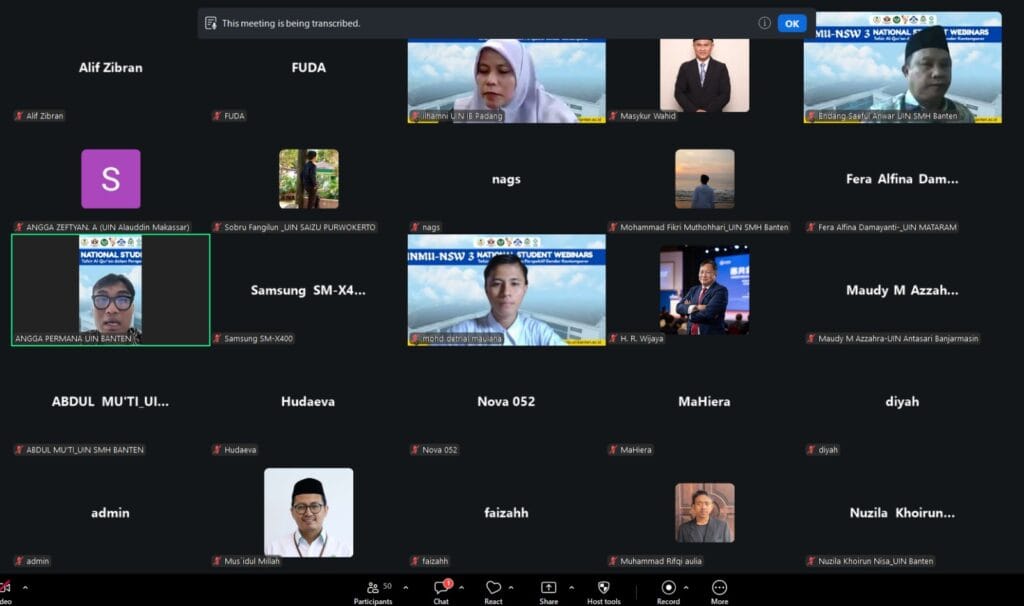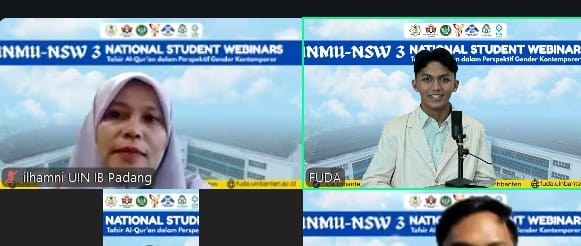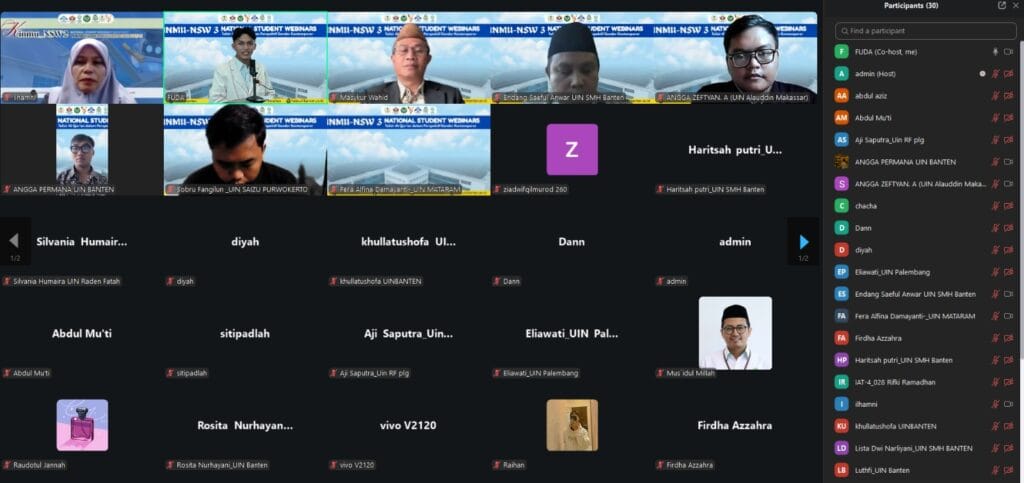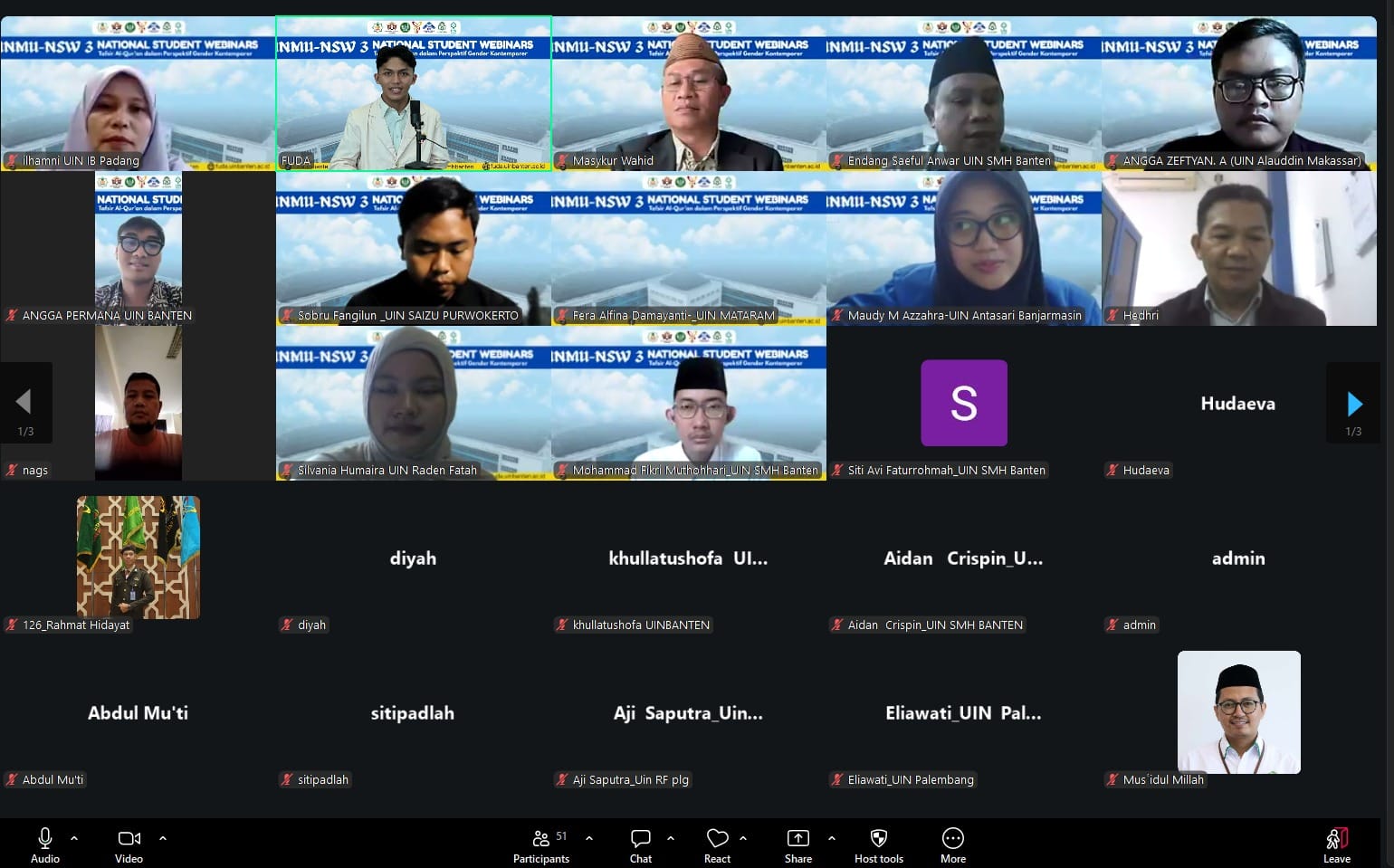
SERANG – The Faculty of Ushuluddin and Adab (FUDA) at UIN Sultan Maulana Hasanuddin (SMH) Banten successfully hosted a national academic event titled “KINMU—3rd National Student Webinars.” Held virtually, this event served as a platform for students from the Faculty of Ushuluddin at various State Islamic Religious Universities (PTKIN) across Indonesia to showcase their talents and engage in intellectual collaboration.
This national webinar features Dr. Munawir, M.SI, an academic from UIN Prof. K.H. Saifuddin Zuhri (Saizu) Purwokerto, as Keynote Speaker. In his presentation, Dr. Munawir highlighted how to view gender issues through the lens of muhkam and mutasyabbih. According to him, gender issues are often understood and even legitimized through verses of the Qur’an. Debates have arisen regarding the interpretation of verses perceived as having misogynistic undertones, such as the verse on inheritance (2:1), women’s testimony, and male leadership. A new paradigm in Quranic studies is needed to interpret these verses perceived as having misogynistic undertones; one such paradigm is the new “muhkam-mutasyabbih” framework. It is this new “muhkam and mutasyabbih” paradigm that he refers to as a lens for analyzing issues of gender (injustice) based on verses perceived as having misogynistic undertones.
In addition to featuring experts, the main attraction of this webinar was the participation of seven speakers—selected students from seven Ushuluddin faculties across Indonesia. They presented their ideas and research findings to participants from various universities. The event was moderated by Angga Permana, a student in the IAT program at the Faculty of Ushuluddin and Adab, UIN SMH Banten.
The first speaker was Mohammad Fikri Muthohhari, a student in the IAT program at FUDA, UIN Sultan Maulana Hasanuddin Banten, who presented on the topic “A Challenge to Patriarchal Fiqh.” Fikri explained that the dominance of patriarchal fiqh—which prohibits women from becoming public leaders—stems largely from classical interpretations that are biologically and sociologically biased. Scholars in the past tended to interpret Surah An-Nisa verse 34 based on the assumption that men are absolutely superior physically and intellectually, thereby forcibly extending rules of leadership in the domestic sphere (the household) into a universal prohibition in the public sphere. According to her, the premise that men are inherently more intelligent and stronger is a sociological construct of the past, when women were denied access to education. Modern empirical evidence proves that intellectual ability and managerial skills are not gender-specific.
The second speaker was Angga Zeftyan A., a student from UIN Alauddin Makassar, who discussed the phenomenon of gender inequality still found in society today, such as discrimination, stereotypes, violence against women, and limited access to various social opportunities, indicating that the Qur’an’s values regarding gender justice have not yet been fully realized in daily life. In fact, the teachings of the Qur’an explicitly position men and women as partners who support one another in promoting goodness and building a harmonious life. Therefore, an understanding of the verses addressing gender issues must continue to be developed so that relevant solutions can be provided for the various social problems emerging in the contemporary era.
Next, Fera Alfina Damayanti, a student from UIN Mataram, focused on the discussion of contemporary gender exegesis as an effort to reinterpret Qur’anic verses related to the relationship between men and women, with the aim of correcting the patriarchal biases believed to have influenced some classical exegetical works. Through figures such as Amina Wadud, Fatima Mernissi, Asma Barlas, Riffat Hassan, Muhammad Syahrur, and Nasaruddin Umar, this discourse has evolved using methodologies that emphasize historical contextualization, intratextual reading, criticism of interpretive authority, and the maqasidi approach. Applying this approach to verses concerning leadership, inheritance, testimony, and polygamy reveals the possibility of more contextual interpretations without undermining the Qur’an’s authority as divine revelation. However, this approach is not without its critics, particularly regarding the influence of external frameworks of thought and the risk of interpretive relativism; therefore, a critical and balanced academic stance is necessary when examining it.
Silvania Humaira, from UIN Raden Fatah Palembang, served as the third speaker. Silvania presented a talk titled ‘The Dialectic of Text and Reality: Qur’anic Exegesis Amid the Global Gender Struggle.” According to her, the Qur’an contains universal values of justice that transcend its historical context, allowing for a dynamic response to contemporary gender issues. Contemporary exegetes offer methodologies capable of bridging the text and reality without compromising the authority of the Qur’an. The dialectic between text and reality is not a threat, but rather a necessity for Islam to remain relevant as a source of mercy for all creation (rahmatan lil ‘alamin) amid the global gender struggle.
Meanwhile, Sobru Fangilun from UIN Prof. K.H. Saifuddin Zuhri Purwokerto addressed the topic of “Gender Interpretation in the Qur’an: Between Text, Context, and Social Justice.” Sobru stated that gender-based exegesis serves as an effort to understand the Qur’an in a fair and contextual manner. Since social and cultural contexts influence the interpretation of gender-related verses, gender-based exegesis holds significant relevance to modern social justice. According to him, gender-based interpretation seeks to foster a more humane understanding of religion that does not lead to social inequality.
Next, Mohd Detrial Maulana from UIN Imam Bonjol Padang addressed the topic “The Discourse on Incest from the Perspective of the Qur’an: An Analysis of Thematic Exegesis and the Revitalization of Ushuluddin Values in the Modern Era.” According to him, incest is a deeply troubling phenomenon. Family members who should be protecting one another are instead trapped in a web of falsehoods and illusory lies—actions that can lead to an undesirable and tragic fate. The combination of digital advancements and moral decline has created opportunities for the spread of the atrocity of incest on a larger scale. The concept of revitalizing religious values—which seeks to reinvigorate moral and religious principles—is hoped to provide a solution to this problem. By putting the concepts discussed into practice, we can create a society that is morally grounded and wise in all its actions.
The final speaker was Maudy Muzaliah Azzahra from UIN Antasari Banjarmasin, who addressed the topic “Gender Bias in the Interpretation of Surah Yusuf, Verse 28: A Critical Analysis of”
Generalization of Meaning Indeed, You are Great. Phrase Indeed, that is a great matter In Surah Yusuf, verse 28, this is often understood as a general portrayal of women as inherently deceitful. This interpretation has led to a tendency to generalize, portraying women as a group that is by nature cunning and manipulative. Contemporary interpretive perspectives, represented by Amina Wadud and M. Quraish Shihab, offer a more contextual reading of this verse. This reading emphasizes that the phrase *inna kaidakunna ‘azhim* cannot be used as a basis for judging all women. The narrative context of the verse, the use of the pronoun ‘kunnā” referring to specific women in the event, and the fact that the sentence is spoken by al-‘Aziz all indicate that the verse’s meaning is not universal. Generalizing this to all women has the potential to create gender bias that is inconsistent with the Qur’an’s principle of justice. This study demonstrates that the deceit mentioned in Surah Yusuf is a critique of the behavior of specific individuals, not an inherent trait of all women.
The presence of representatives from across the islands—from Sumatra, Java, Kalimantan, Nusa Tenggara, to Sulawesi—demonstrates the breadth of the network and the strong synergy among the Ushuluddin faculties at UINs throughout Indonesia.
In response to the event’s success, the Dean of FUDA at UIN SMH Banten, Dr. Masykur, M.Hum., expressed his deep appreciation for the collaboration.
“We are very proud that FUDA UIN SMH Banten was able to host this national-scale academic forum. KINMU-National Student Webinars are not merely a platform for presentations, but a space for intellectual exchange. The ideas generated by these seven students prove that the scholarly discourse on Ushuluddin in Indonesia is highly dynamic and ready to address the challenges of civilization,” said the Dean of FUDA.
In line with this, Dr. Endang Saeful Anwar, Lc., M.A., Associate Dean III for Student Affairs and Cooperation at FUDA UIN SMH Banten and Chair of the KINMU-NSW 3 Organizing Committee, also highlighted the importance of students’ mindset and courage in public forums.
“As the host, we view this event as a major step forward in developing students” capabilities. Serving as a speaker at the national level certainly requires mental fortitude, thorough research, and strong communication skills. “Moving forward, we hope that inter-campus student forums like this can continue to be enhanced to hone the leadership skills and critical thinking of Ushuluddin students across the archipelago,” he emphasized.
The third KINMU-National Student Webinars event concluded with an interactive discussion session that was enthusiastically received by hundreds of online and in-person webinar participants. Through this event, it is hoped that a future generation of Islamic thinkers will emerge—one that is not only firmly rooted in tradition but also adaptable to global discourse.