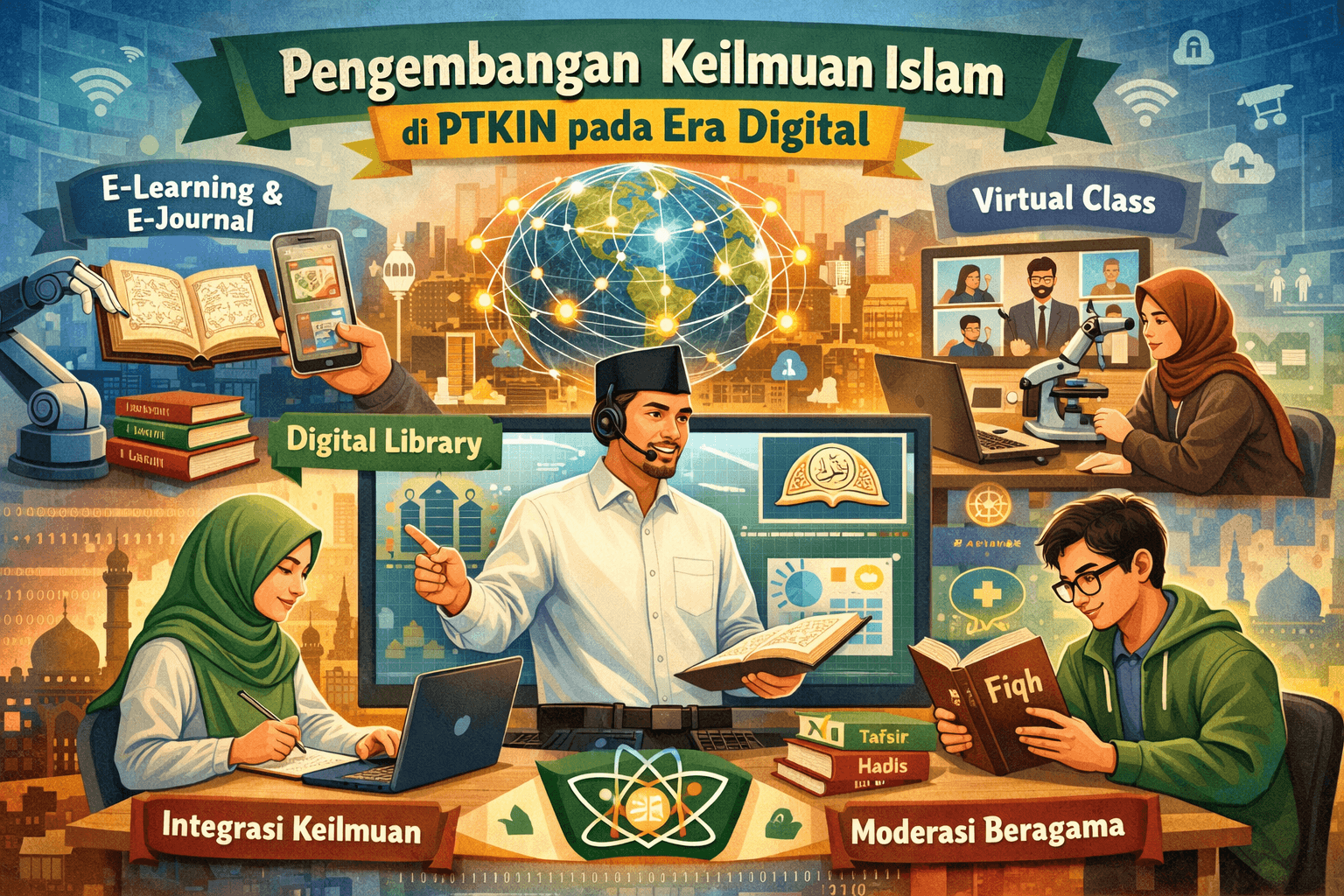
This paper is the result of critical reflection on the vision of the Faculty of Ushuluddin and Adab UIN Sultan Maulana Hasanuddin for the period 2025-2029, namely “to become a Faculty of Ushuluddin and Adab that excels in the development of Islamic science and humanities based on Banten's local wisdom with impact”. FUDA's vision (which stands for Faculty of Ushuluddin and Adab) is contextualized in the midst of State Islamic Religious Universities (PTKIN) in the digital era where we live together in two worlds, namely the “world of books” and the “world of clicks”. One demands adab talaqqiqi and diligent reading, the other rewards unlimited speed of access and collaboration. The challenge is clear, how classical wisdom still leads digital logic, not the other way around. Imam al-Ghazali reminded that knowledge must have an impact on charity (action), “Verily, deeds depend on their intentions” (HR. Bukhari, the first hadith in Sahih Bukhari). The Prophet's Hadith is a principle that is relevant when we teach, research, even when scrolling through layers, because its value returns to its intention and benefits for humans.
Clarifying Terms: Islamic Studies and Islamic Scholarship
Islamic Studies (دراسة إسلامية) is an umbrella study of Islam across history, texts, peoples, cultures, using a variety of approaches, including philosophy, philology, anthropology, history, and sociology. Islamic studies focus on analytical descriptions, often across traditions, and do not always depart from normative commitments. Meanwhile, Islamic sciences (العُلُومُ الإِسْلَامِيَّة) is an ecosystem of knowledge constructed from within the Islamic tradition, including ‘ulum al-Qur'an, mushthalaḥa al-ḥadith, uṣhul al-fiqh, kalam, philosophy, and methodological tools rooted in revelation, reason, and scientific consensus. The orientation of Islamic science is to seek both truth and benefit (maqaṣhid), not just to map phenomena. The two are not contradictory; rather, they reinforce each other in the curriculum of education, research, and community service. Islamic studies provide reach, and Islamic scholarship provides depth and value orientation. Next, we will discuss Islamic scholarship in the digital era.
Philosophical Framework: Popular and Solid
Ontologically, there is the question of what “exists” in digital Islamic scholarship? Digitization increases the mode of presence of sources from sheets of paper to data corpus, from linear to hyperlinked. However, the nature of formal objects (meaning, sanad, argument structure) still demands traditional measuring instruments. Ibn Khaldun taught that history and knowledge should be tested with critical reasoning, rejecting blind allegiance to sources, and reading the social laws underlying the data. In the science of history, which considers the reasons behind events, not just quoting news. Historical records are prone to errors such as fanaticism, over-reliance on sources, and the inability to place events in context, hence the need for sociology to understand change. In practice, manuscript images are representations, not the truth itself. Therefore, what is real for us is the structure of meaning verified by valid methodology.
Epistemologically in the platform era Imam al-Ghazali explained the chapter al-‘Ilm in Kitab Ihya ‘Ulumuddin that knowledge is a way to rise in degrees, as Allah says in Surah al-Mujadilah verse 11: “Allah elevates those who believe among you and those who are given knowledge several degrees”, and binds it to the manners of obtaining knowledge so that the benefits are real. In the current context, quick access must be supported by strict verification. For that, we really need practical working principles in the classroom and research, namely source clarification in critical editions and online summaries, layered methods e.g. sanad-matan, linguistic, Historical context; and digital tools, e.g. Arabic Optical Character Recognitio (OCR), Neuro Linguistic Programming (NLP), and graphs; and process transparency in data trails, codes, and versions, so that they can be replicated.
Axiologically, Islamic scholarship is directed towards the maqaṣhid of sharia, namely protecting religion, soul, mind, property, offspring, as well as contemporary extensions such as the environment and digital dignity. In classrooms and social media, we remember the Prophet's saying that the value of charity depends on the intention, such as the intention to educate, enlighten, and prosper. Al-Syatibi systematically formulated maqaṣhid sharia as a principle of reasoning, i.e. laws and fatwas move for the sake of the benefit while remaining grounded in the evidence. This is the ethical foundation when we utilize AI and digital platforms.
Bringing Classics to Life in the Age of Clicks
Thus, Imam Al-Ghazali in Ihya ‘Ulumuddin explains that
“Useful knowledge is that which fosters fear (khushu’) of Allah.” This explanation generally means that knowledge is not a display, but rather organizes the heart and charity. For this reason, in the midst of AI (artificial intelligence), al-Ghazali returned science to intention and benefit, Ibn Khaldun taught critical reasoning of data; and al-Syatibi linked everything to maqaṣhid. It is time for PTKIN, including the Faculty of Ushuluddin and Adab, to produce scholars who are fluent in the book and capable of clicking to maintain scientific sanad, care for adab, and spread benefits for mankind.