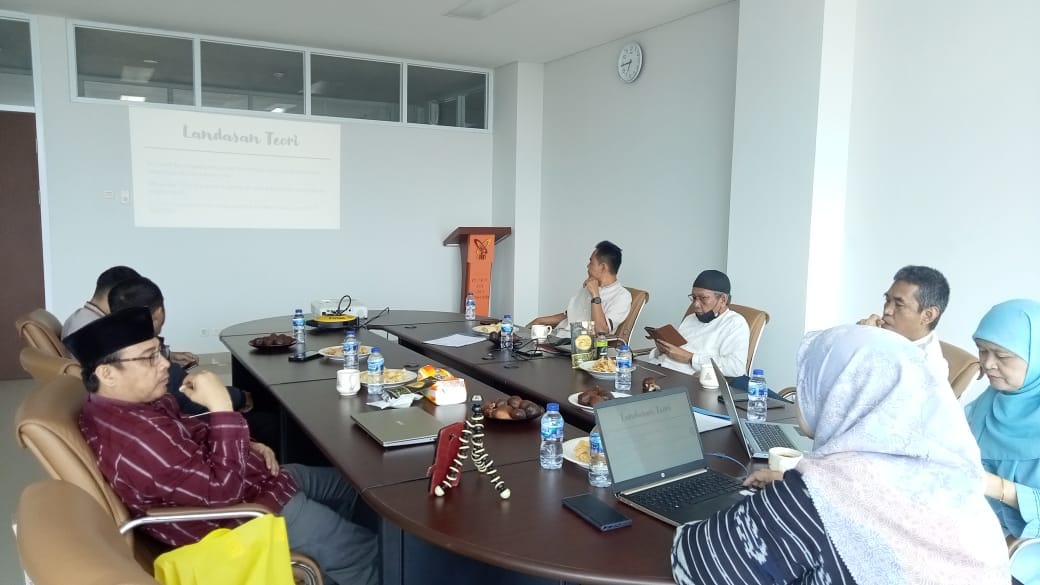
FUDA | Friday (26/05/2023) - The Faculty of Ushuluddin and Adab Lecturer Discussion resumed after tawakuf during Ramadan and Eid al-Fitr 1444 Hijriyah. The FUDA Conference Room, began to be enlivened again by lecturers and students who were enthusiastic about gaining interesting knowledge in this discussion.
Dr. Mohamad Ali Fadhilah, D.A., Ph.D. (SPI Archaeology lecturer), Dr. Hj. Ida Nursida, M.A. (BSA lecturer), and Dr. Hj. Eva Syarifah Wardah, M.Hum. (SPI lecturer) became speakers in this lecturer discussion. Each speaker discussed one theme in the discussion, with a duration of 20 minutes to convey the discussion of the theme.
Dr. Hj. Ida Nursida, M.A. became the first speaker to deliver material to the audience. The theme raised by Dr. Hj. Ida was “Song Lyrics by Noe Letto: Between Sufistic Symbolism and Popular Music.” The theme attracted the attention of the audience.
“There are two Letto songs that contain Sufistic values in the lyrics. The two song titles are ‘Sebelum Cahaya’ and ‘Sandaran Hati’. I used the theory of Semiotic Science which can reveal the deepest and hidden meaning in a text, because semiotics treats text as a collection of signs. In the lyrics of Letto's song ‘Sebelum Cahaya’, Sabrang (the songwriter) wrote several symbols that have meaning, namely the use of capital and non-capital letters at the beginning of the words ”I, you, and others'. So this shows the meaning that the word is to distinguish the use of humans from creatures." Dr. Hj Ida explained.
The next speaker was Dr. Hj. Eva Syarifah Wardah, M.Hum. As a lecturer in the History of Islamic Civilization (SPI) FUDA UIN SMH Banten, Dr. Eva delivered material with the theme “Cultural Acculturation in Banten Traditional Culinary.” Dr. Hj Eva, explained that some of the traditional foods that we often find and consume in Banten are the result of modifications from other countries' foods.
“First, I would like to say that since ancient times, Banten has been famous for its natural resources, especially spices that are much sought after by other countries. These spices are often used by the people of Banten as medicinal ingredients, such as pepper, ginger, turmeric, and so on because they have great properties for the health of the body. In addition, these spices are also used as food ingredients. Furthermore, many traders from other countries came to Banten. Especially from Europe, China and Arabia. This influenced some cultures in Banten, especially the traditional Banten culinary that we know today. For example, nasi samin or nasi kebuli. Nasi samin or nasi kebuli is processed rice that is similar to bukhori rice from Arabia or briyani rice from India.” Dr. Hj Eva explained.
Furthermore, Dr. Hj Eva explained the Chinese influence on traditional culinary in Tangerang, and the influence of European countries such as Portugal, Spain, and the Netherlands.
Mohamad Ali Fadhilah, D.E.A., Ph.D. was the last speaker who delivered the lecturer discussion material this time. As an Archaeology lecturer, he delivered material with the theme “Reflection of Pre-Islamic Culture in Southern Banten: Historical and Archaeological Perspectives.” This very weighty material provides a lot of new knowledge about the life of Banten people in the past.
“In the pre-Islamic period or before Islam became the religion adopted by the majority of Bantenese people, some historical evidence has been found about the beliefs or religions adopted by the Bantenese people. Based on analogies with megalithic traditions in other places: Indonesia and Southeast Asia, theoretically it can be said, that the series of megalithic objects in the interior of Banten is also evidence of the spread of Austronesian culture. However, to determine the starting point of migration, no authentic evidence has been found, except for the proto-type theory of migration, that elements of megalithic culture grew before the arrival of Indian culture. The Hindu elements promoted by the political economic power on the north coast, hardly touched the cultural base of the interior. Likewise, when Islamic rule developed on the north coast, megalithic cultural elements became the basis for cultural adaptation. Thus, if it cannot be said to be a ‘historical product’, the acceptance of Islam in the interior is part of the dynamics of Banten's history.” Said Ali Fadhilah, Ph.D.
After all the speakers presented their material, Dr. Maftuh Ajmain, M.Pd. who became the moderator in this discussion gave the audience the opportunity to respond to the material presented by the three speakers. Some of the audience raised their hands to respond to the material from the speakers. Among them were Dr. Badruddin, M.A., Hadian Rizani, M.Hum., and Mr. Haris, a student. Furthermore, Dr. Maftuh closed the lecturer discussion at 11.15 WIB, after approximately two hours in the FUDA courtroom.