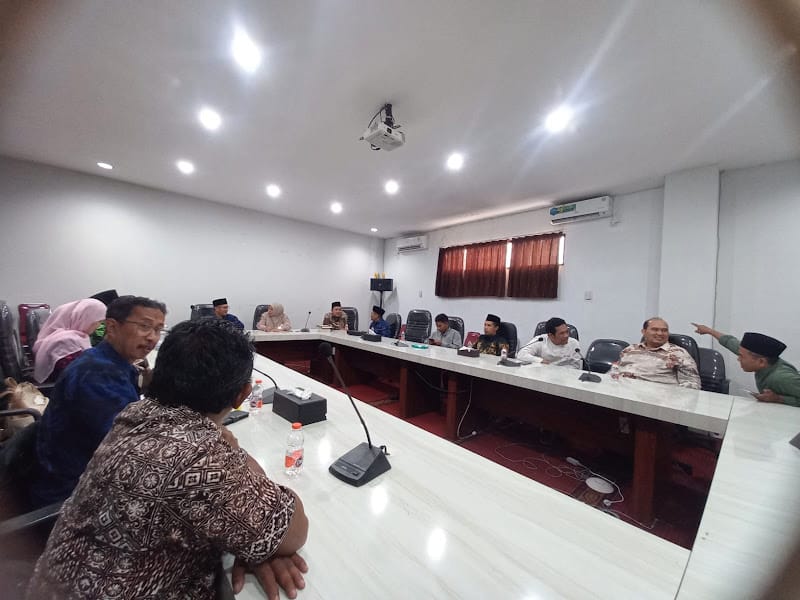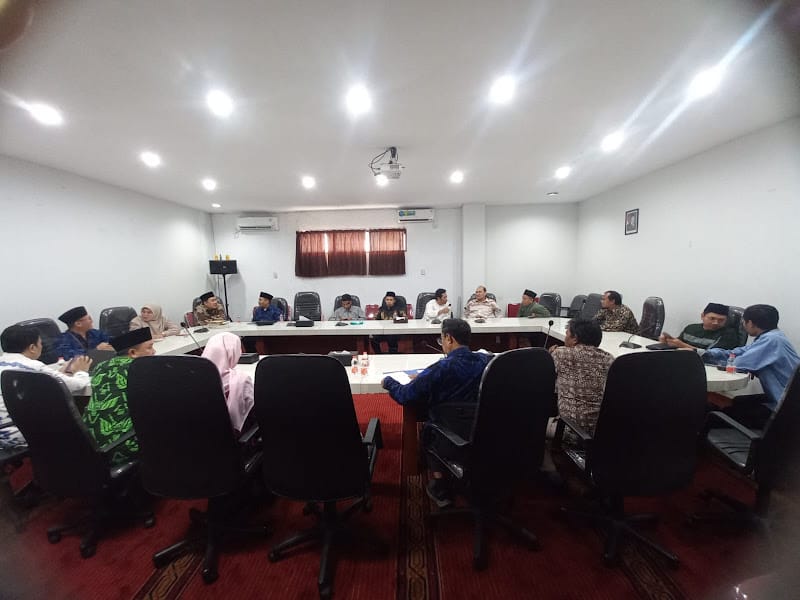
Jakarta - The Faculty of Ushuluddin and Adab (FUDA) UIN Sultan Maulana Hasanuddin Banten again shows its seriousness in building a strong academic culture and global standards. After inaugurating Saung Jurnal, FUDA, an integrated workspace specifically for the management of scientific journals, immediately stepped on the gas by performing mock study to PTIQ University Jakarta on December 8-9, 2025. This visit is a strategic step to strengthen the governance of scientific publications that are more organized and professional.
Journal Saung: More than Just a Workspace
Saung Jurnal comes as an answer to a long-standing need: centralizing all journal management activities that were previously scattered and running alone. All this time, editors worked in their own spaces and rhythms. With Saung Jurnal, all editorial activities - from editing, OJS management, to reviewer discussions - are consolidated in one command center.
This idea was born from FUDA's internal evaluation which concluded the need for a space that is able to build collaboration, uniform standards, and accelerated publication process. With one coordinated space, it is expected that the editorial process will be more organized, adaptive, and in line with international standards.
Learning from PTIQ: A Peek into the Kitchen of Mature Journal Management
During the visit to PTIQ Jakarta, the FUDA group received a warm welcome from the ranks of LP2M PTIQ and the Dean of the Faculty of Ushuluddin PTIQ. The meeting was intimate but still focused on sharing experiences and strategies for strengthening scientific journals.
PTIQ presented a number of good practices that they have been implementing, such as:
Disciplined and structured editorial flow
Layered peer review with strict standards
Consistent use of OJS management templates
Periodic evaluation of article quality and editing
Strategy for increasing SINTA accreditation and expanding international indexation
For FUDA, this session was an opportunity to see firsthand how other campuses build a solid and productive journal management “kitchen”. Processes, challenges, and technical tricks were discussed in detail, providing a lot of inspiration to be applied in the FUDA environment.
Strengthen each other, learn from each other
Head of LP2M PTIQ Dr. Aas Siti Sholichah, M.Pd.I in her speech emphasized that cooperation between campuses is very important in the modern academic era.
“We appreciate FUDA UIN Banten's efforts in strengthening journal management. Hopefully what we do can be a mirror together,” he said optimistically.
A similar tone was conveyed by the Dean of the Faculty of Ushuluddin and Islamic Thought of PTIQ Dr. Andi Rahman, M.A.. According to him, journal management is a long-term work that demands accuracy and continuity.
“Journal strengthening is not born out of chance. It is born from systematic work,” he said.
This statement serves as a reminder that quality journaling is built on consistent routines, not instant steps.
FUDA's Big Mission: Towards DOAJ
On the same occasion, Dr. Masykur, M.Hum, Dean of FUDA UIN SMH Banten, emphasized that Saung Jurnal is the first step towards a bigger journey.
“We want all editorial activities to be in one house. We strengthen the rhythm of work, we unify the coordination,” he said.
He also mentioned the big target that is being prepared: all journals under FUDA are targeted to be indexed by DOAJ in the coming year. This target is not just a prestige, but a strategic step to increase the visibility, reputation and credibility of FUDA journals in the global arena.
Charting a New Roadmap for Publication Management
This visit to PTIQ also marks FUDA's commitment in developing a roadmap for strengthening scientific publications: more structured, more connected, and more ready to compete at the national and international levels.
With Saung Jurnal as the center of operations and DOAJ as the big target, FUDA is building not just a new workspace - but rather new culture in managing knowledge. A culture that puts collaboration, rigor, and long-term vision at the core.