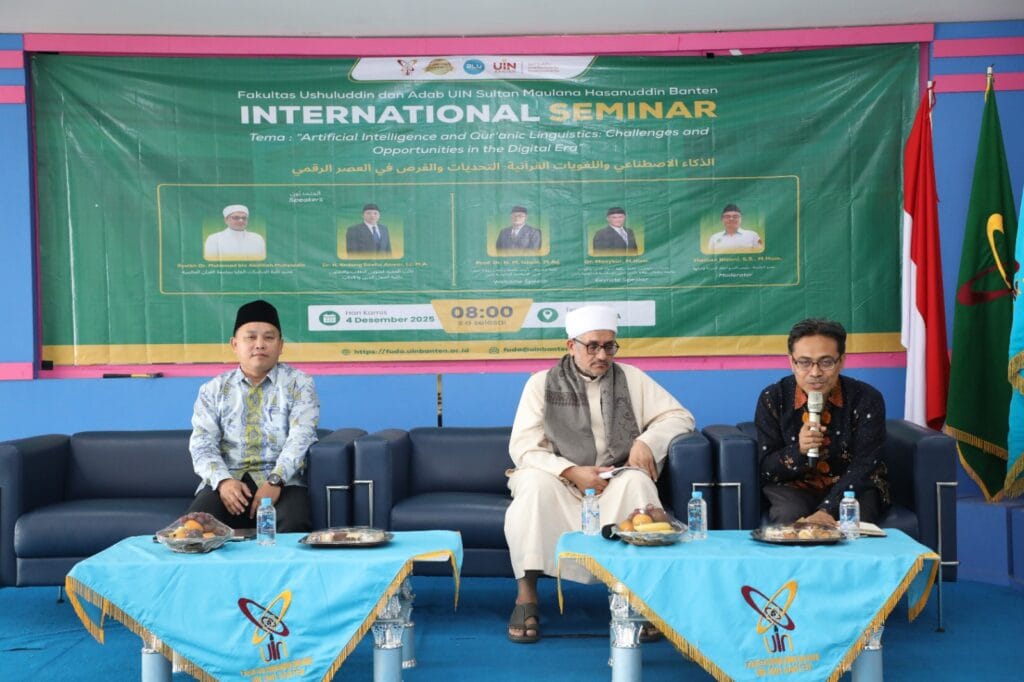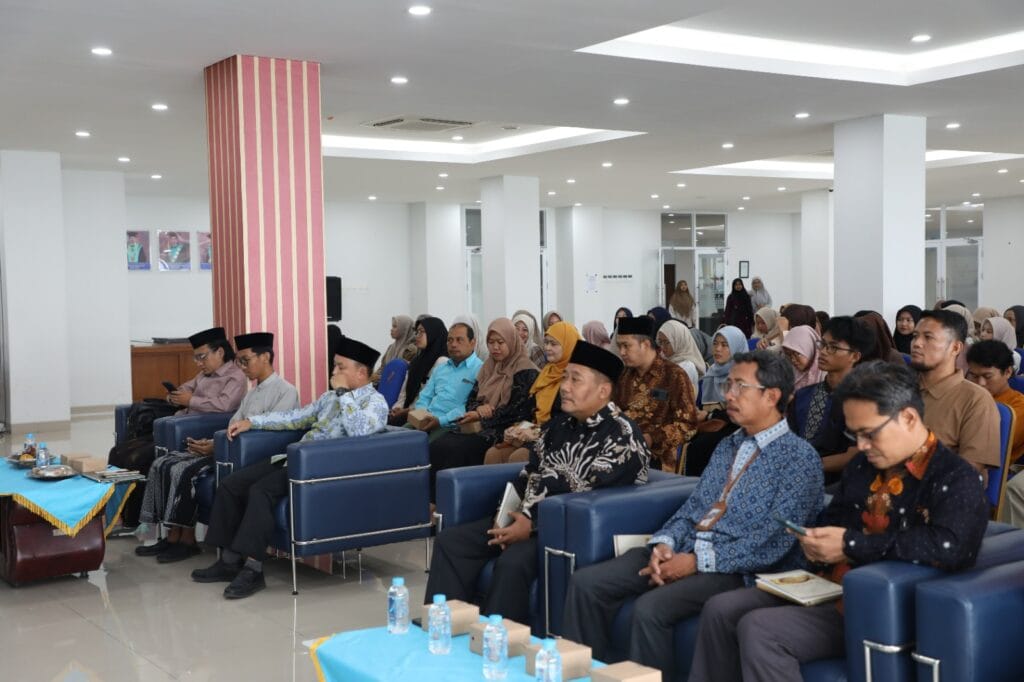
FUDA I December 4, 2025 - The Faculty of Ushuluddin and Adab (FUDA) of Sultan Maulana Hasanuddin State Islamic University (UIN SMH) Banten once again demonstrated its commitment as the frontline in progressive Islamic studies by organizing International Seminar themed “Artificial Intelligence (AI) and Qur'anic Linguistics: Challenges and Opportunities in the Digital Age.” The event took place on the 2nd floor of the FUDA Building and was attended by academics, researchers, students, and technology practitioners from various regions and partner institutions.
The event, which began at 09.00 WIB, was structured in an interactive scientific discussion format, so that it was not only a place to deliver material, but also a forum for the exchange of multidisciplinary ideas on how technology, especially AI, can synergize with Islamic disciplines.
Opening: Affirming the Urgency of Islamic Scholarship in the Midst of Digital Transformation
The event began with the recitation of the holy verses of the Qur'an by students of the Qur'anic Science and Tafsir (IAT) Study Program, followed by chanting selawat which brought a solemn atmosphere. After that, the moderator introduced the invited guests, speakers, and the academic objectives of the activity.
The opening session featured Dr. H. Nana Jumhana, M.Ag., Vice Chancellor I for Academic Affairs and Institutional Development, who provides Welcome Speech representing the Rector of UIN SMH Banten.
In his speech, he emphasized that the ongoing digital transformation-from automation, machine learning, to the development of large language models (LLM)-has changed the way humans learn, interact, and produce knowledge. Therefore, Islamic educational institutions should not be mere spectators.
“Today, the development of AI is inevitable. AI is no longer just a futuristic discourse, but a reality that we use every day. So the task of Islamic universities, including FUDA, is to ensure that technology is used to advance Qur'anic scholarship and religious studies, without losing the originality and richness of the Islamic scientific tradition.”
He also invited the FUDA academic community to dare to take a role in developing manuscript-based digital research, computational linguistics studies, and religious learning innovations.
Keynote Speech: AI as an Opportunity and Challenge for Islamic Science
As Keynote Speaker, Dr. Masykur, M.Hum., Dr. Masykur, Dean of FUDA UIN SMH Banten, gave a scientific speech that combined the understanding of Islamic philosophy with modern technology. In his explanation, Dr. Masykur highlighted that the history of Islamic civilization itself is very close to innovation, starting from the translation movement, classification of knowledge, to text criticism methods (tahqiq). Thus, FUDA's involvement in addressing AI is a continuation of that scholarly tradition.
“Qur'anic linguistics is the heart of Ushuluddin and Adab. With AI, we have the opportunity to conduct structural, lexical, and semantic analysis of Qur'ānic verses in ways that were previously unimaginable. However, we are also challenged to ensure that the depth of meaning is not reduced to mere data.”
He emphasized that AI can be a strategic partner for Islamic scientists, not a substitute for scientific authority. Scholars and researchers still play a role in providing context, wisdom, and ethical value.
Speaker Presentation Session: Two Perspectives, One Goal
The seminar featured two speakers representing international and local perspectives, hosted by Hadian Rizani, M.Hum., Head of the Department of Arabic Language and Literature at FUDA.
1. International Perspectives - Dr. Mohammed Abdullah bin Ali Muhyiddin
Dean of Postgraduate Studies at Sudan International Qur'an University
Dr. Abdullah explained the development of AI research in the Arab world and Africa, especially in the fields of digital memorization, computational tafsir, and database management of Islamic manuscripts.
He explained that a number of universities in the Middle East have developed algorithms for:
detecting Qur'anic recitation errors,
mapping the root word (jidzr) automatically,
building a semantic network of Qur'ānic words,
and grouping verses based on thematic themes (maudhu'i).
However, he also cautioned that AI does not have dzauq lughawi or sense of language that is at the heart of the Qur'ān's beauty.
“AI can process data at high speed, but it lacks linguistic intuition. Therefore, scholars and scholars remain the guardians of the authenticity of knowledge.”
He encouraged cooperation between Indonesia and Sudan in the development of standardized Qur'anic database, This includes data on morphology, syntax, and classical exegesis.
2. Local Perspective - Endang Saeful Anwar, M.A.
IAT Lecturer & Vice Dean III FUDA UIN SMH Banten
Endang Saeful Anwar presents a critical analysis of the position of AI in the study of tafsir, which has demanded historical sensitivity, understanding of asbabun nuzul, and knowledge of the context of pre-Islamic Arab society.
He emphasized some of the limitations of AI:
AI only recognizes patterns, not the inner meaning of the verse,
AI cannot understand the context in which the verse was revealed,
AI risks oversimplifying the dynamics of interpretation,
and AI are highly dependent on the quality of the data used.
“AI should be understood as a tool. To understand a verse, we must still refer to authoritative sources such as books of tafsir, scholars, and scientific traditions that have been preserved for centuries.”
He also gave examples of how students can use AI positively, for example in literature reference searches, keyword exploration, or initial text analysis, but still prioritize a scientific approach.
Interactive Discussion: FUDA Students Become More Tech-Savvy
The Q&A session was one of the most interesting parts. The participants asked various questions, such as:
Can AI be used to develop thematic interpretation?
To what extent can AI help understand Qur'ānic balaghah?
What are the ethical uses of AI in religious research?
What steps does FUDA need to take to keep up with digital developments?
The interviewees' responses indicate that the dialogue between Islamic tradition and technology needs to continue through directed research, adaptive curricula, and international collaboration.
Closing: FUDA Establishes Itself as a Technology-Based Center for Islamic Studies
The International Seminar closed with a message to strengthen collaboration between faculty, students, and research institutions. The digital era is not a threat, but a great opportunity for FUDA to expand scientific horizons.
This activity is also proof that FUDA UIN SMH Banten is ready to look forward to a more progressive, competitive, and global technology-based Islamic education future.
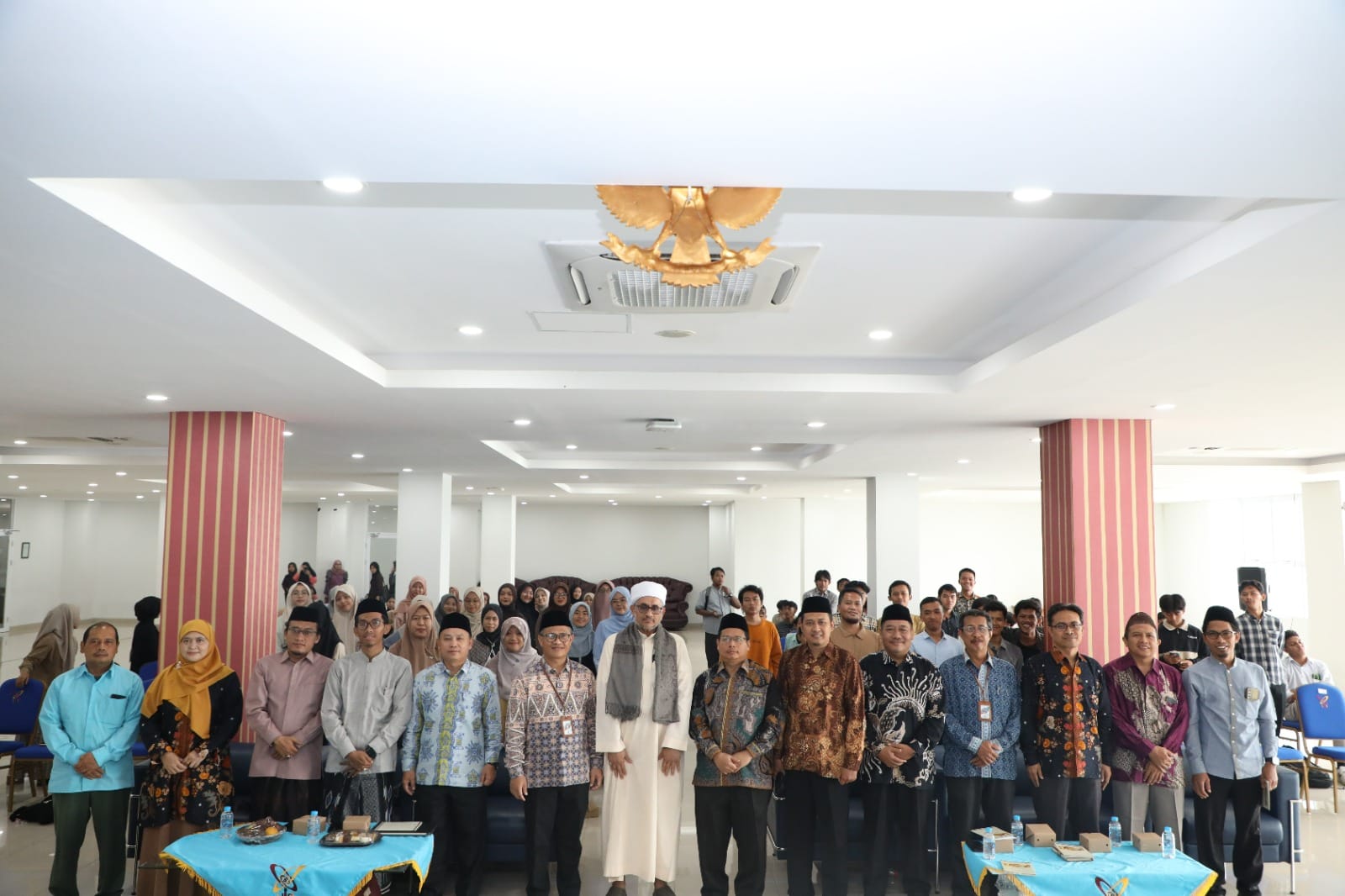
The event ended with the awarding of plaques and a group photo session.
(Esafa)