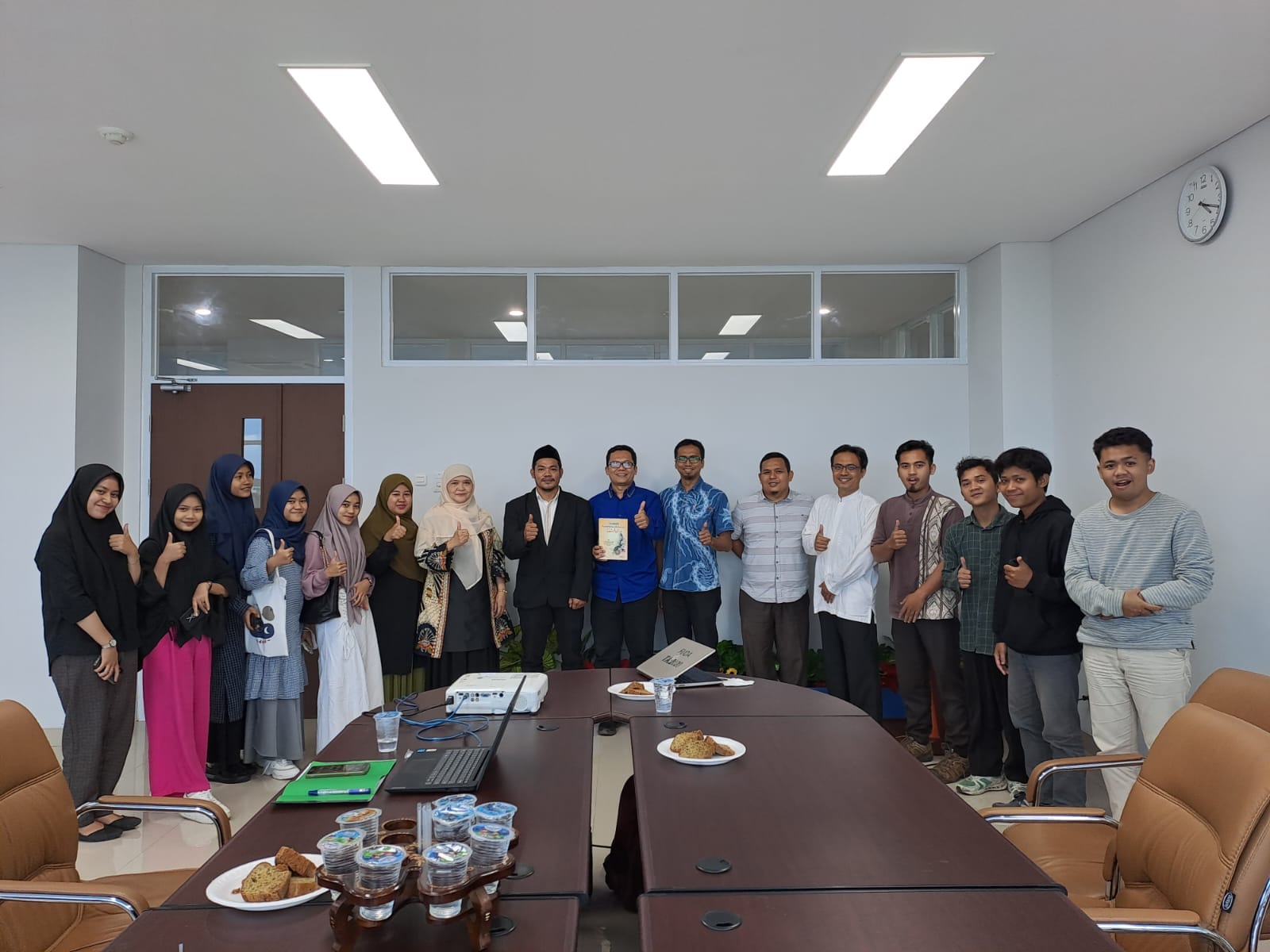
FUDA | Friday (10/02/2023) - In collaboration with the Faculty of Ushuluddin and Adab, the Bantenology Laboratory held a Friday Edition discussion series. In the 8th series, the discussion was held on February 10, 2023 at the FUDA Conference Room, and was attended by a number of participants from lecturers and students as well as some who attended the live broadcast via bantenologi's live Instagram.
The speaker was Dr. Lalu Turjiman Ahmad, M.A., Head of Arabic Language and Literature at the Faculty of Ushuluddin and Adab, with moderator Rohman, M.A., director of Bantenology Laboratory and Secretary of ICMI Banten Province. The theme raised in the 8th series was “Polemics of Religious Language in the Perspective of the Ulama of the Third Century Hijriyah.”
Ahmad recounted that the various differences of opinion among the scholars, which today constitute Islam's rich intellectual heritage, were crystallized in schools of thought that can be traced back to the third century Hijriyah. A number of scholars from various disciplines lived during this period. Among them were al-Jahizh (d. 255 AH), al-Bukhari (d. 256), Abu Yazid al-Bustomi (d. 260), and others.
At that time, along with the incessant translation activities, the “imported” sciences from Greece had become an important factor that colored the way of looking at religious texts (al-Qur'an and hadith). This was supported by the state which gave a privileged position to the intellectuals.
Not least in the advancement of science at that time, was the religious factor that played a significant role, where scholars were encouraged in the development of science because religious texts must be understood correctly so that religion can be a guide for improving the quality of life of mankind.
The rationalists, who were then getting their stage, tried to optimize the use of reason in understanding religious texts. Even sacred texts that were considered contrary to reason had to be interpreted to be in line with reason.
Diametrically opposed, the textualists, represented by the scholars of ahl al-hadis, avoided the use of reason in order not to stray too far into misunderstanding the text. But the latter were increasingly weakened by the challenge of a group of people who had previously opposed religion, represented by the mulhids who were no less vociferous in their views.
Each group and sect, as Ahmad describes it, contested to win their respective arguments. He adds, “the book Tarikh Bagdad can be used as a source of reading that so completely describes the intellectual life of Muslims at that time.”
In this context, said Ahmad, Ibn Qutaibah al-Dinawari (d. 276 AH), a founding linguist of the Bagdad school, can be seen as a figure who is able to place himself in the middle between rationalists and textualists. He was able to explain various polemics over the meaning of the holy book and the Prophet's sunnah with the approach of linguistic sciences.
His thought project on i'jaz al-Qur'an which carries the concept of nazhm (Qur'anic construction) gained wide acceptance, not only in the field of linguistics and Balagah science that he worked on, but also in various Islamic disciplines. Later, the term majaz that he popularized can then be found as an interpretive tool in various scientific disciplines, after previously he described it into various uslub (language styles). Majaz with its various uslub can be an explanation for the various understandings adopted by the ahlul-hadis group - and he belongs to this group - as well as a mechanism for interpretation.
Answering the audience's question about what can be reflected from the intellectual life of Ibn Qutaibah, Ahmad said that this figure was an encyclopedic figure. He studied various scientific disciplines, ranging from philosophy, medicine, pharmacology, and a series of shari'ah sciences and, of course, linguistics. This can be seen from the number of books he composed in each of the scientific disciplines that developed at that time.
Ibn Qutaibah, Ahmad continued, studied with scholars from various schools. The concept of majaz that he popularized and developed, he learned from Abu Ubaidah (d. 209 AH), an important figure in the Khawarij sect. He also studied directly with al-Jahizh (d. 255 AH) and the works of al-Farra’ (d. 207 AH), two leading figures in the Mu'tazilah school and did not hesitate to quote their views.
As a result, Ibn Qutaibah comes as a figure with multi-disciplinary knowledge, but is able to maintain the intellectual treasures that come purely from “within”. He also had academic independence, so that he could position himself in a new school (Baghdad school) between the two major schools (Bashrah and Kufa) in the field of linguistics.
With this academic independence, Ahmad concluded, he was able to present a moderate understanding of religious texts as manifested in the Ahlus-Sunnah wal-Jama'ah school several decades before the arrival of Abu al-Hasan al-Ash'ari (d. 324 AH), the figure who is called the greatest imam among the founders of this school.