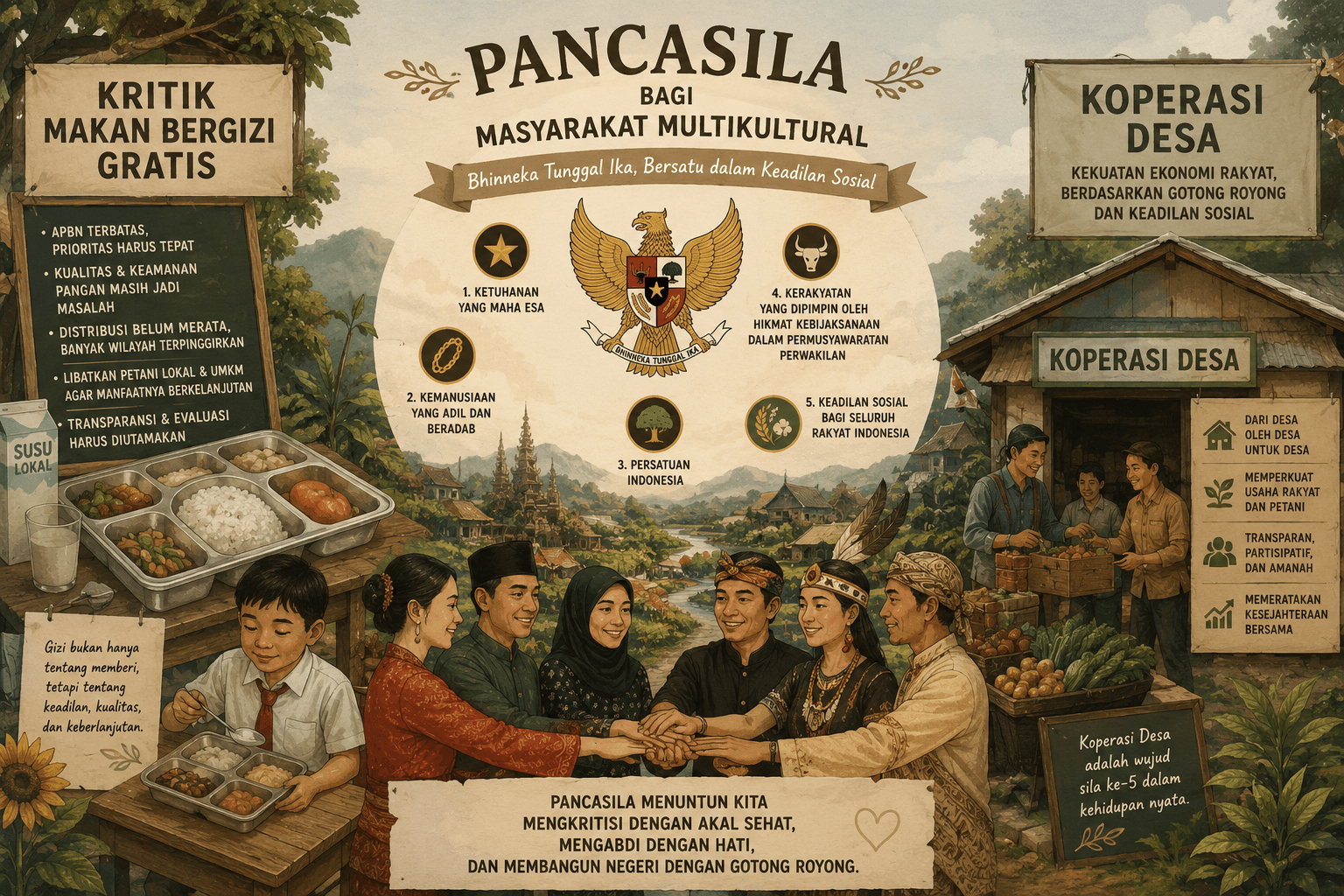
Pancasila should not stop as a memorization, ceremony, or national slogan. In Indonesia's multicultural society (different religions, ethnicities, languages, social classes, and geographical conditions) Pancasila must be present as a way for the state to manage public policies in a fair, sustainable, and resource-efficient manner.
Two state priority programs that are currently in the public eye are the Free Nutritious Meal (MBG) and the Red and White Village Cooperative (Kopdes). In terms of ideas, both have noble intentions. MBG aims to address nutrition, child health, pregnant women, nursing mothers, and vulnerable groups. Kopdes wants to mobilize the village economy, strengthen food distribution, and open up space for people's businesses from below.
However, good intentions do not necessarily automatically become Pancasila policies. Policies are called Pancasila not only because they use the terms populist, gotong royong, or welfare. It must be tested by sustainability, fairness of distribution, budget efficiency, community involvement, and the ability to respect public infrastructure that has been built before.
This is where criticism needs to be raised. MBG and Kopdes seem to be moving with a new development logic, namely building kitchens, building service units, building outlets, warehouses, cooperative facilities, and preparing thousands of new operational points. In fact, the state has previously built employment and training infrastructure through the Ministry of Manpower, especially the Job Training Center (BLK) and Community Job Training Center (BLKK).
Data from the Ministry of Manpower shows that more than 4,652 Community BLKs have been built by 2024. The Ministry of Manpower's 2024 Performance Report also notes the implementation of competency-based training through 21 BLK UPTP, 13 service units, and 262 BLK UPTD. This means that the country already has a fairly extensive job training network. This infrastructure should not be treated as if it does not exist when the state creates new priority programs.
Meanwhile, the National Nutrition Agency notes that tens of thousands of SPPGs (MBG kitchens) are operational. As of June 1, 2026, the BGN dashboard shows 29,842 operational SPPGs. On the other hand, the Kopdes program is also running fast. The government inaugurated 1,061 Kopdes that were ready to operate on May 16, 2026 and targeted around 30 thousand Kopdes to be completed and operational by August 16, 2026. A number of news reports also mentioned that thousands of Kopdes physical buildings have been completed.
The question is, why were the acceleration of MBG and Kopdes not initially designed as a continuation of the BLK and BLKK ecosystems? In fact, MBG requires cooks, kitchen managers, logistics personnel, hygiene supervisors, administrative personnel, supply chain managers, and personnel who understand nutrition and food safety. Kopdes needs managers, cooperative accountants, marketing personnel, warehouse managers, digital operators, distribution managers, and village business assistants. All of these needs are very close to the functions of BLK and BLKK as centers for vocational training and community empowerment.
If BLK and BLKK are not integrated, the country risks creating overlapping infrastructure. On the one hand, there are buildings and training workshops that have already been built. On the other hand, there are new buildings for MBG and Kopdes kitchens. If the two run independently, what happens is not institutional mutual cooperation, but sectoral ego between programs.
In the perspective of Pancasila, this issue touches on the fifth principle, which is social justice for all Indonesian people. Social justice is not just about distributing aid to the people. Social justice also means ensuring that state money is not spent wastefully, not repeating developments that could be synergized, and not leaving public assets idle.
Social justice also requires that local communities are not just passive beneficiaries, but actors. Village youth, women, santri, people with disabilities, MSME players, farmers, fishermen, and local communities must be trained to become part of the MBG and Kopdes ecosystem. BLK and BLKK can be the training nodes.
In a multicultural society, a uniform approach from the center often fails to read local diversity. An MBG kitchen in Banten would have different challenges from an MBG kitchen in Papua, NTT, Kalimantan, or the islands. Village cooperatives in agrarian areas are different from cooperatives in fishing areas, industrial areas, Islamic boarding schools, or indigenous territories. Therefore, Pancasila demands policies that respect locality, not just homogenize institutional design.
The third precept, Persatuan Indonesia, should also not be read as uniformity. Unity instead demands coordination between institutions so that state programs do not negate each other. MBG, Kopdes, BLK, BLKK, BUMDes, pesantren, campuses, and local governments should be included in one national work map. Policy unity means there is continuity, not that each regime and each ministry builds its own projects.
The fourth precept is also important. A democracy led by wisdom in deliberation/representation demands a dialogical planning process. Village communities need to be asked, do they need new buildings or do they need to strengthen existing ones? Can BLKK pesantren, course institutions, community kitchens, or village assets be used as MBG and Kopdes training centers? Will the cooperative really be managed by the villagers, or will it just be a new name for an administrative project?
This is where BPIP needs to take a more substantive role. It is not enough for BPIP to socialize Pancasila through seminars, competitions, or state ceremonies. BPIP should develop a Pancasila audit of priority public policies. The audit is not to hamper the President's program, but to ensure that the national program is truly in accordance with the values of Pancasila.
A Pancasila audit can ask simple but fundamental questions. Does the program strengthen social justice? Does it avoid wasteful spending? Does it build on the country's existing infrastructure? Does it involve local communities as subjects? Does it reduce regional disparities? Does it open access for vulnerable groups? Does it build inter-agency cooperation, or does it reinforce sectoral ego?
Within this framework, criticism of MBG and Kopdes is not a rejection of the program. Rather, it is a critique that seeks to salvage its noble goals. MBG needs to succeed because the nutrition of the nation's children is the foundation of the future. Kopdes needs to succeed because the village economy should not continue to depend on a long and unfair distribution chain. However, the success of both will be stronger if they are connected to the training infrastructure that the state has built through BLK and BLKK.
Concrete steps can be taken. First, the government needs to map the locations of BLKK, BLKK, SPPG, Kopdes, BUMDes, pesantren, and village assets in an integrated dashboard. Second, BLK and BLKK are used as training centers for MBG and Kopdes personnel, such as training in healthy cooking, kitchen sanitation, food safety, warehouse management, cooperative accounting, digital marketing, and local logistics. Third, Kopdes needs to ensure that they become suppliers of MBG food ingredients from local farmers, fishermen, breeders, and MSMEs. Fourth, BPIP needs to develop indicators of “Pancasilais public policy” that measure justice, sustainability, institutional mutual cooperation, and respect for local diversity.
Pancasila for a multicultural society is not just a moral teaching about living in harmony. It is the ethics of public policy. In a country as big as Indonesia, priority programs cannot be run with a “start from scratch” mentality every time there is a change in political direction. The state must have institutional memory.
If MBG and Kopdes are able to continue, revive, and utilize BLK and BLKK, then the program will not just be a physical development project. It will become a social justice movement, which feeds the nation's children, drives the village economy, trains people to work, and ensures that state assets are not wasted.
That is the living Pancasila. Not Pancasila that is only recited, but Pancasila that saves the budget, connects policies, empowers the people, and brings social justice to all Indonesian people.