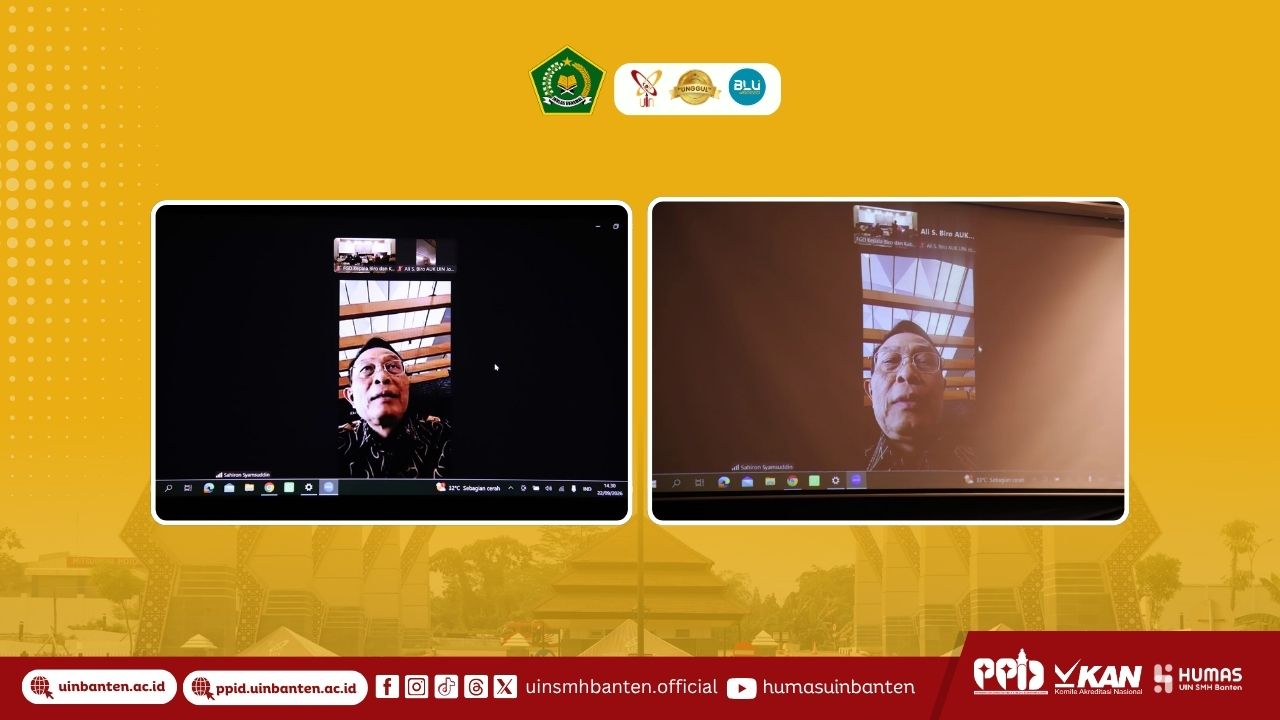
UIN Public Relations – The Ministry of Religious Affairs of the Republic of Indonesia continues to strive to optimize the fulfillment of the need for qualified educators at State Religious Universities (PTKN). This strategic initiative was discussed in depth during a Focus Group Discussion (FGD) for PTKN Bureau Chiefs and Division Heads, which took place on Tuesday, September 22, 2026.
The Director of Islamic Higher Education at the Directorate General of Islamic Education, Ministry of Religious Affairs of the Republic of Indonesia, Prof. Dr. Phil. Sahiron, M.A., delivered an online presentation on the topic “Roadmap for Mentoring: Preparing Former Officials to Become Professional Lecturers at Islamic Higher Education Institutions (PTKN).”.
In his remarks, Prof. Dr. Phil. Sahiron, M.A., emphasized that the transition of former government officials to faculty positions offers many tangible benefits for universities, particularly in terms of efficiency and improving institutional accreditation standards.
“There are many benefits, ranging from more efficient fulfillment of faculty needs to accelerating improvements in accreditation pillars. If we rely solely on civil service recruitment, the process takes quite a long time, whereas these former officials who have been reassigned already possess the technical readiness, qualifications, and experience,” said Prof. Dr. Phil. Sahiron, M.A.
Furthermore, Prof. Dr. Phil. Sahiron, M.A., explained that the adjustment of lecturers’ functional ranks for former officials will be managed in a structured manner through a mentoring program. He noted that changes in rank, such as the adjustment from Senior Lecturer to Lecturer, are part of a reasonable transition mechanism and can be reversed in a relatively short period of time.
“It is possible that there will be a demotion from Senior Lecturer to Lecturer, but with this mentoring program, they can return to the position of Senior Lecturer after one year. This is very positive for their academic career development,” said Prof. Dr. Phil. Sahiron, M.A.
Regarding administrative requirements, Prof. Dr. Phil. Sahiron, M.A., noted that the age limit is one of the primary considerations in the reassignment of these positions. He explained that the maximum age limit for former Echelon 3 officials is set at 55 years old, for former Echelon 2 officials at 60 years old, and for lower-level officials at 53 years old.
In addition to age, Prof. Dr. Phil. Sahiron, M.A., also emphasized the importance of meeting the qualification requirements for scholarly work for prospective lecturers transitioning from government service. He stressed that former government officials are expected to have a track record of publications recognized in the academic world, such as those in SINTA-indexed journals.
Regarding the administrative challenges and regulatory changes that have arisen in the field, Prof. Dr. Phil. Sahiron, M.A., confirmed that the Ministry of Religious Affairs is currently finalizing supporting regulations, including Ministerial Regulations (PMA), to ensure a smooth transition.
“We realize there are several procedural and regulatory hurdles that will take time to resolve. However, we now have new regulatory guidelines and a team that is actively working on this. God willing, in the near future, these officials who have transitioned to new roles will have clear legal status and certainty as professional faculty members,” concluded Prof. Dr. Phil. Sahiron, M.A.
Through this roadmap for guidance and regulatory certainty, the Ministry of Religious Affairs is optimistic that the transition of former officials will produce professional faculty members who are ready to enhance the quality of religious higher education in Indonesia.
The post To Strengthen Academic Quality at PTKNs, the Ministry of Religious Affairs Finalizes a Transition Plan for Former Officials to Become Lecturers first appeared on Spirituality, Intellectuality, Professionalism.