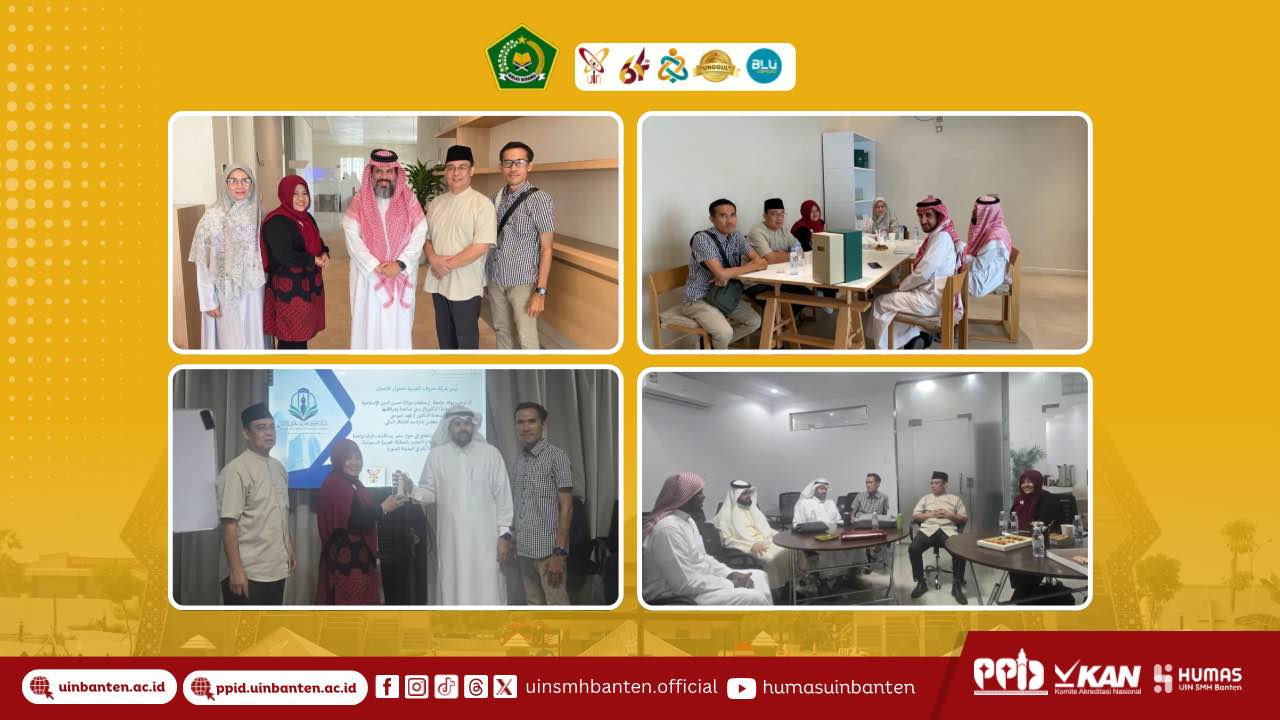
UIN Public Relations – UIN SMH Banten has once again strengthened its international academic network through a series of Focus Group Discussion (FGD) in Medina, Saudi Arabia, on Thursday (October 1, 2026). The series of activities focused on the study of khat, Qur’anic calligraphy, and the implementation of Memorandum of Understanding (Memorandum of Understanding) with Harfu Al Arabiah regarding the development of Arabic language instruction.
The first event was held at the Prince Mohammed bin Salman Global Center for Arabic Calligraphy—Dar Al-Qalam, in Medina. The forum served as an academic space to discuss developments in Arabic calligraphy, particularly its connection to the tradition of writing the Qur’an and the evolution of calligraphic art in the contemporary era. During the meeting, the UIN Banten delegation held discussions with the Director of Dar Al-Qalam, Dr. Salah Al Suhaimi. The discussion framed calligraphy not only as a visual art but also as an intellectual and cultural heritage of Islam that is closely linked to the history of the transmission of the Qur’anic text.
The director of Dar Al-Qalam, Dr. Salah Al Suhaimi, emphasized the importance of this collaboration for the advancement of Islamic studies on a global scale.
“Arabic calligraphy is not merely a matter of the beauty of the script, but is also part of the journey of Islamic scholarship, culture, and civilization. Therefore, collaboration with universities such as UIN Banten is important for expanding research and introducing the rich heritage of calligraphy to the next generation of scholars on an international level,” said Dr. Salah Al Suhaimi.
The meeting also opened up opportunities for strategic cooperation in areas such as research, education, and documentation, workshop calligraphy, academic exchanges, and the advancement of manuscript studies and the art of Qur’anic calligraphy. For UIN Banten, khat and calligraphy are developed not merely as artistic expressions, but as a gateway to interdisciplinary studies that bring together the Qur’an, the Arabic language, the history of Islamic civilization, art, education, and digital technology.

The series of activities continued with a focus group discussion (FGD) on the implementation of the MoU with Harfu Al Arabiah to discuss the development of the Arabic language outside Arab countries as well as opportunities for cross-border academic collaboration. The forum was attended by the Director of Harfu Al Arabiah, Dr. Fahd Musa, and Dr. Omar Abdala Abu Bakir. The discussion focused on strategic issues such as the needs of Arabic language learners in Indonesia, technology-based learning innovations, and the development of teaching materials.
Dr. Fahd Musa, Director of Harfu Al Arabiah, emphasized the shift in the approach to Arabic language learning in the modern era.
“The development of the Arabic language is no longer limited to Arab countries. Arabic has become a global language studied in various educational and cultural contexts. Therefore, this collaboration with UIN Banten presents an important opportunity to understand the needs of Arabic learners outside the Arab world while developing more relevant learning models,” said Dr. Fahd Musa.
In line with this, Dr. Omar Abdala Abu Bakir highlighted the importance of adapting to an ever-changing learning ecosystem.

“The future of Arabic language learning requires collaboration among institutions, academics, technology, and the learning community. The exchange of experiences between Saudi Arabia and Indonesia can lead to new approaches that are better adapted to the needs of the younger generation,” said Dr. Omar Abdala Abu Bakir.
On behalf of the institution, the UIN Banten Delegation reaffirmed its commitment to taking Arabic language instruction to the international stage through innovation and research.
“UIN Banten believes that the development of the Arabic language should not be limited to conventional language proficiency. The Arabic language must be developed through research, technology, culture, and international networks. ”This meeting in Medina serves as a catalyst for building more concrete and sustainable collaboration between UIN Banten and its partners in Saudi Arabia,’ emphasized the UIN Banten delegation.”.
This collaboration is also relevant to digital transformation and development Artificial Intelligence (AI) in the field of education to create a more personalized, interactive, and adaptive Arabic language learning experience. The collaboration will be implemented through concrete programs such as joint research, academic exchanges, international seminars, teacher training, and the development of technology-based teaching materials. The series of events in Madinah underscores UIN Banten’s efforts to build knowledge diplomacy and expand the contribution of Indonesian Islamic universities to the global academic discourse.
The post UIN Banten Strengthens Academic Diplomacy in Madinah Through a Focus Group Discussion on Qur’anic Calligraphy and the Implementation of an MoU on the Arabic Language first appeared on Spirituality, Intellectuality, Professionalism.