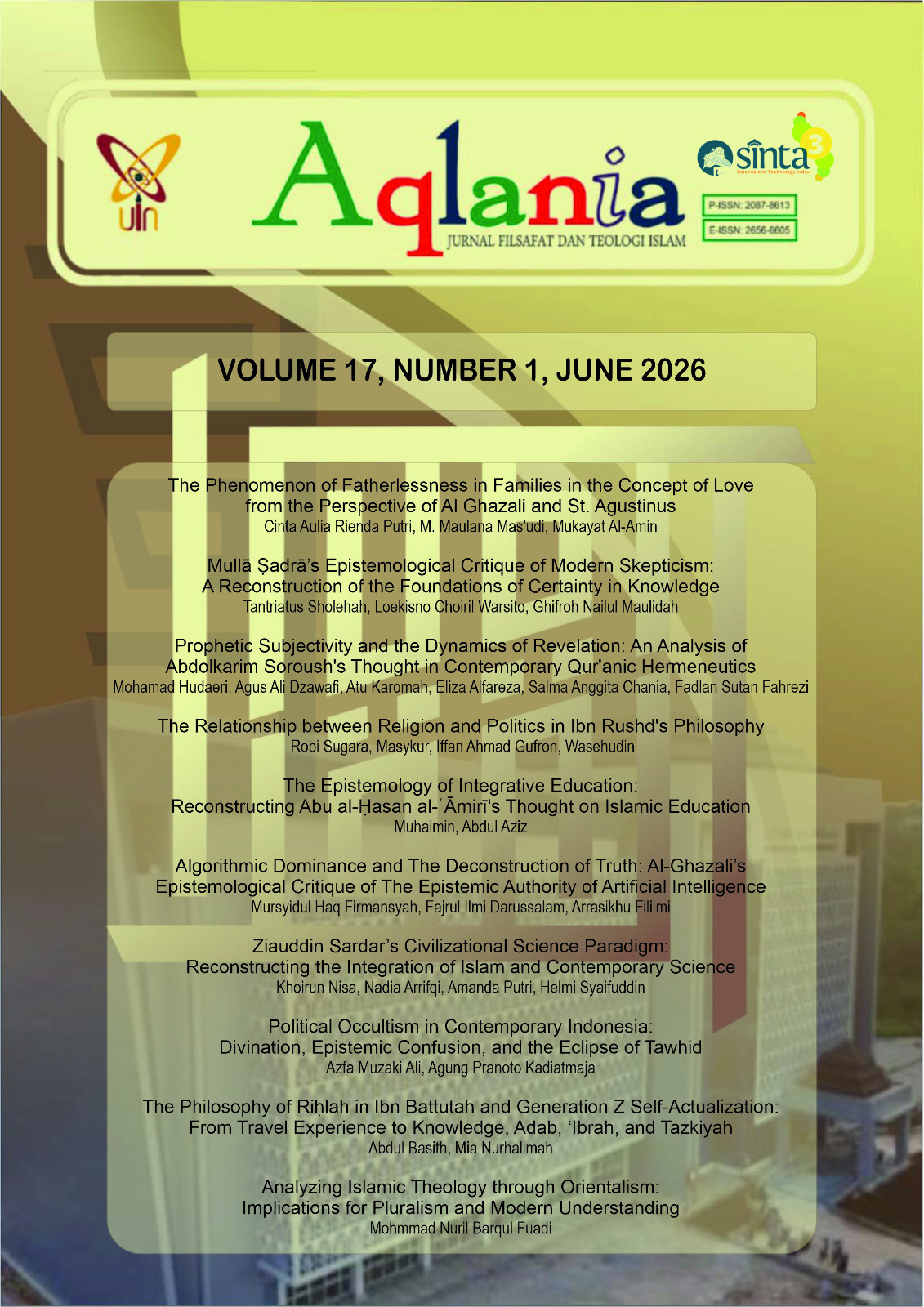
Prophetic Subjectivity and the Dynamics of Revelation: An Analysis of Abdolkarim Soroush's Thought in Contemporary Qur'anic Hermeneutics
DOI:
https://doi.org/10.32678/aqlania.v17i1.240Keywords:
Revelation, Prophetic Subjectivity , Abdolkarim Soroush , Quranic Hermeneutics , Islamic PhilosophyAbstract
Debates over the nature of revelation (wahy) in Islam have long occupied a central place in theological and hermeneutical inquiry. Classical Islamic theology generally understands revelation as a transcendent and ahistorical divine communication, thereby positioning the Prophet Muhammad as a passive recipient of God's message. Although this paradigm has been effective in preserving the sacred character of revelation, it has significant limitations when confronted with contemporary questions concerning interpretive plurality, the reformulation of Islamic law, and the demands of modern human values. This article critically examines Abdolkarim Soroush's conception of revelation as the Prophet's religious experience articulated through historical and human mediation. Using a qualitative, library-based method and a philosophical-hermeneutical approach, the study explores the epistemological and theological implications of Soroush's theory. The findings show that the distinction between religion and religious knowledge, as well as between the essential and accidental elements of religion, provides a philosophical foundation for contextual and dynamic readings of the Qur'an. At the same time, the article identifies major ontological and theological challenges in Soroush's framework, particularly with regard to the status of revelation and the authority of prophethood. Soroush's thought is therefore best understood not as a replacement for classical theology, but as an epistemological corrective that enriches contemporary Islamic theological discourse.
Downloads
Downloads
Published
Issue
Section
License
Copyright (c) 2026 Mohamad Hudaeri, Agus Ali Dzawafi, Atu Karomah, Eliza Alfareza, Salma Anggita Chania, Fadlan Sutan Fahrezi (Author)

This work is licensed under a Creative Commons Attribution 4.0 International License.