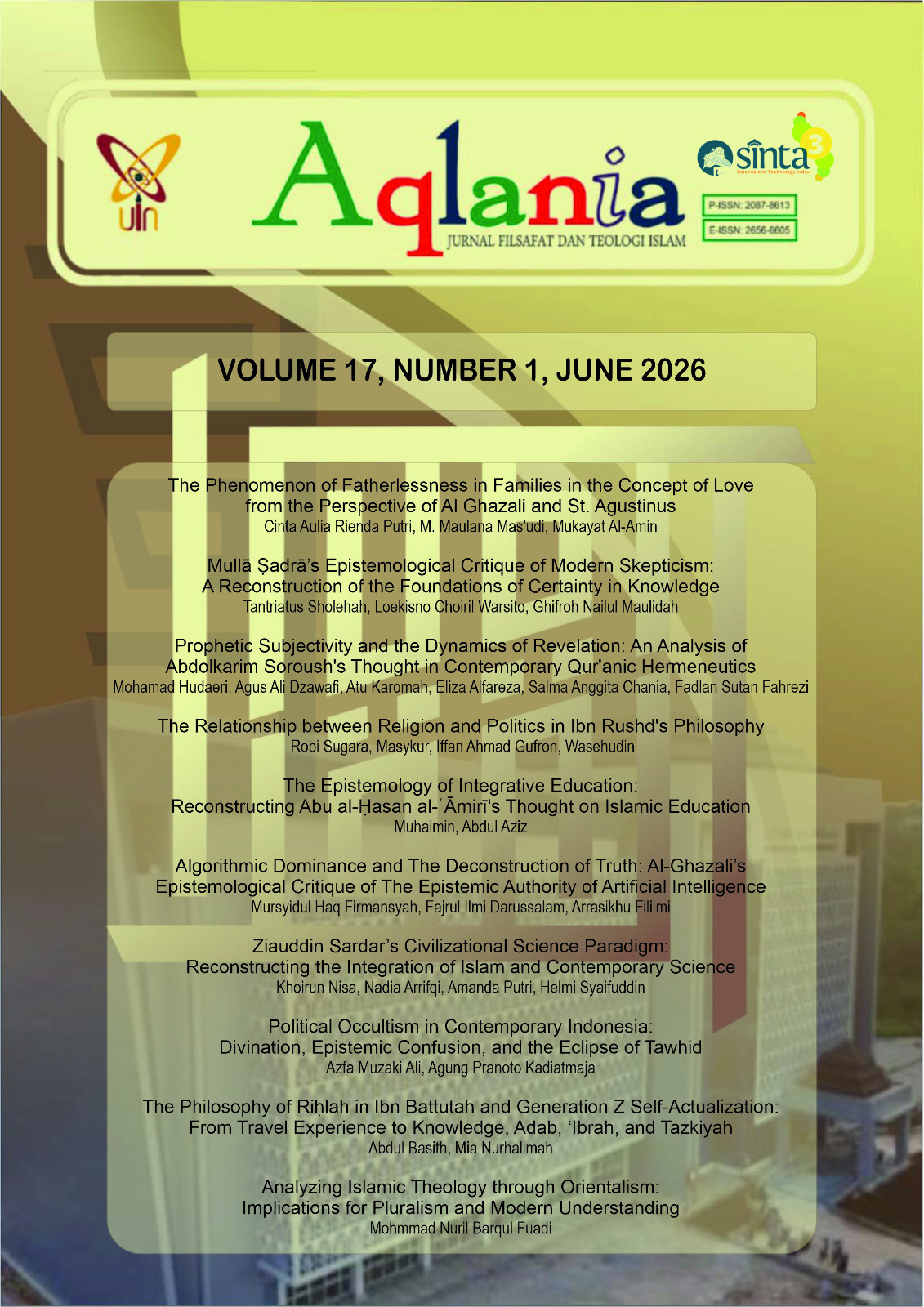
Analyzing Islamic Theology through Orientalism: Implications for Pluralism and Modern Understanding
DOI:
https://doi.org/10.32678/aqlania.v17i1.111Keywords:
Islamic Theology, Modernity, Orientalism, Postcolonialism, Religious PluralismAbstract
Over the years, Orientalism has been a factor in the shaping of various Western portrayals of Islamic theology especially through philological and historical-critical methods that have not only produced a deeper understanding of Islamic theology among scholars but have also contributed to the epistemic reduction of it. In this context, the article looks at how the ambivalent effects, in the case of religious pluralism and modern Islamic theology, stem from this dual effect. It uses qualitative library research to examine Edward Said's critique of Orientalist representation, W. Montgomery Watt's historical reconstruction of early Islam, Talal Asad's critique of the secular categories, and Muslim responses as represented by Harun Nasution and Nurcholish Madjid. From the results it can be seen that historical contextualization as an auxiliary method rather than an total explanation of revelation is most useful in revealing the meaning of events. Therefore, the article presents a critical/dialogical Islamic theology based on four operations: normative fidelity to the revelation, historical contextualization of revelation and its transmission, postcolonial vigilance to Western cultural assumptions, and, last, ethical-dialogical responsibility toward humanity and the created world. Within this framework, pluralism denotes divine sovereignty under which human beings, different in beliefs, cultures, and social structures, have, as the first of God's laws, the dignity and freedom to be themselves according to God's plan, not simply recognizing Islam without relativization as one among the many truth-claims.
Downloads
Downloads
Published
Issue
Section
License
Copyright (c) 2026 Mohammad Nuril Barqul Fuadi (Author)

This work is licensed under a Creative Commons Attribution 4.0 International License.