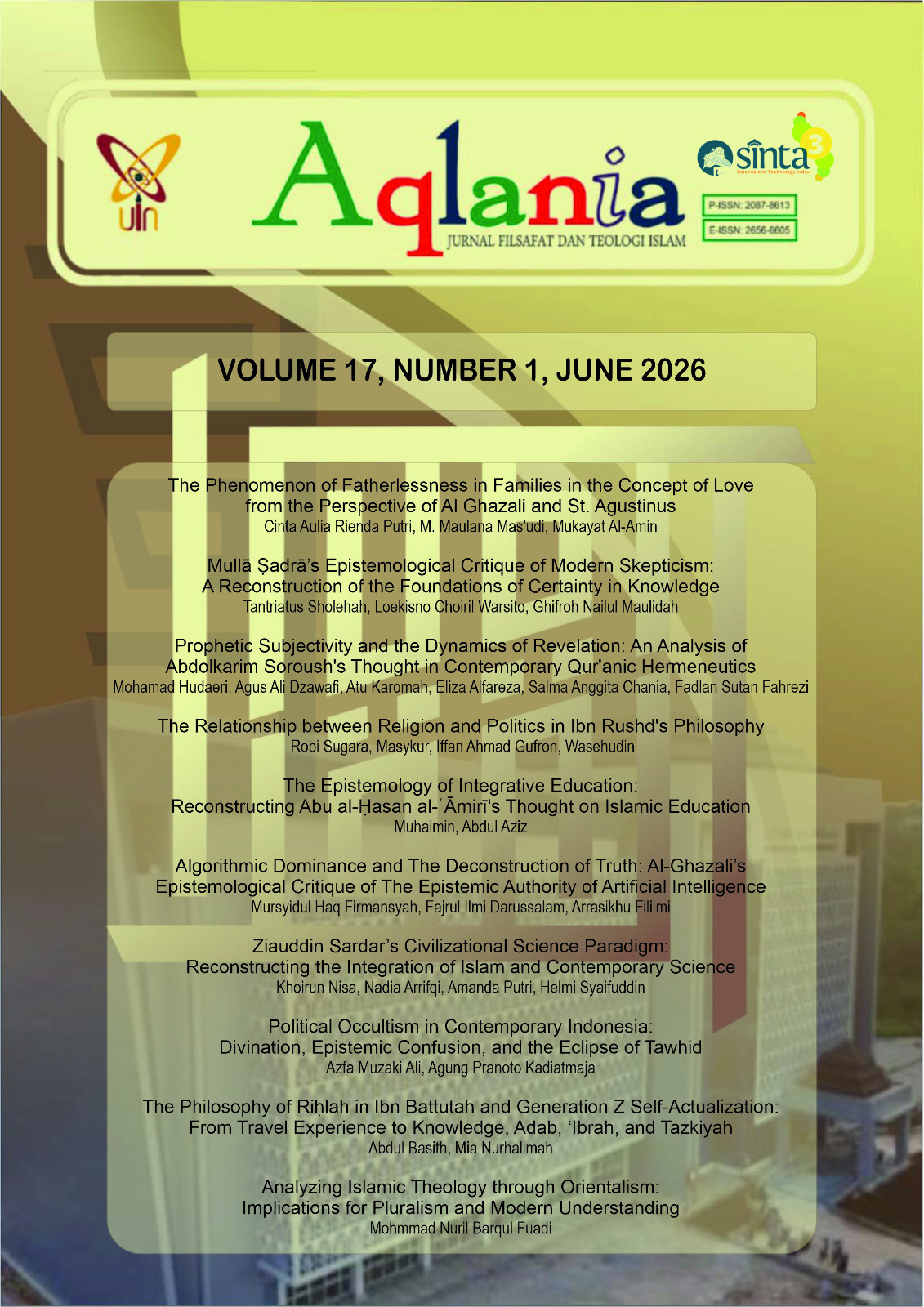
The Philosophy of Riḥlah in Ibn Battutah and Generation Z Self-Actualization: From Travel Experience to Knowledge, Adab, ‘Ibrah, and Tazkiyah
DOI:
https://doi.org/10.32678/aqlania.v17i1.341Keywords:
Adab, Generation Z, Ibn Battutah, Islamic self-actualization, RiḥlahAbstract
This research article investigates the concept of the journey in Ibn Battutah’s Rihlah and its relevance to generation z self-actualization. it uses qualitative library research, thematic content analysis as well as source criticism method in the article it presents selected scenes from the texts while also dialoguing with Maslow, Rogers, Kolb, and Urry. The study identifies four dimensions of Islamic riḥlah: ṭalab al-‘ilm as epistemic movement, adab as relational ethics, ‘ibrah as reflective interpretation, and tazkiyah as transcendent self-purification. Together, these dimensions constitute the Islamic Travel Self-Actualization (ITSA) model, which comprises orientation, experience, adab, ‘ibrah, and tazkiyah. This model is critical of travel reduced in form to mere seeing and getting validation and it puts a personal developmental factor within the scope of knowledge, moral responsibility, reflection, and orientation toward God. The article presents a philosophical account of the "riḥlah" concept without being confined to merely adopting the tenets of humanistic psychology by way of application to a travel text of Islamic nature.
Downloads
Downloads
Published
Issue
Section
License
Copyright (c) 2026 Abdul Basith, Mia Nurhalimah (Author)

This work is licensed under a Creative Commons Attribution 4.0 International License.