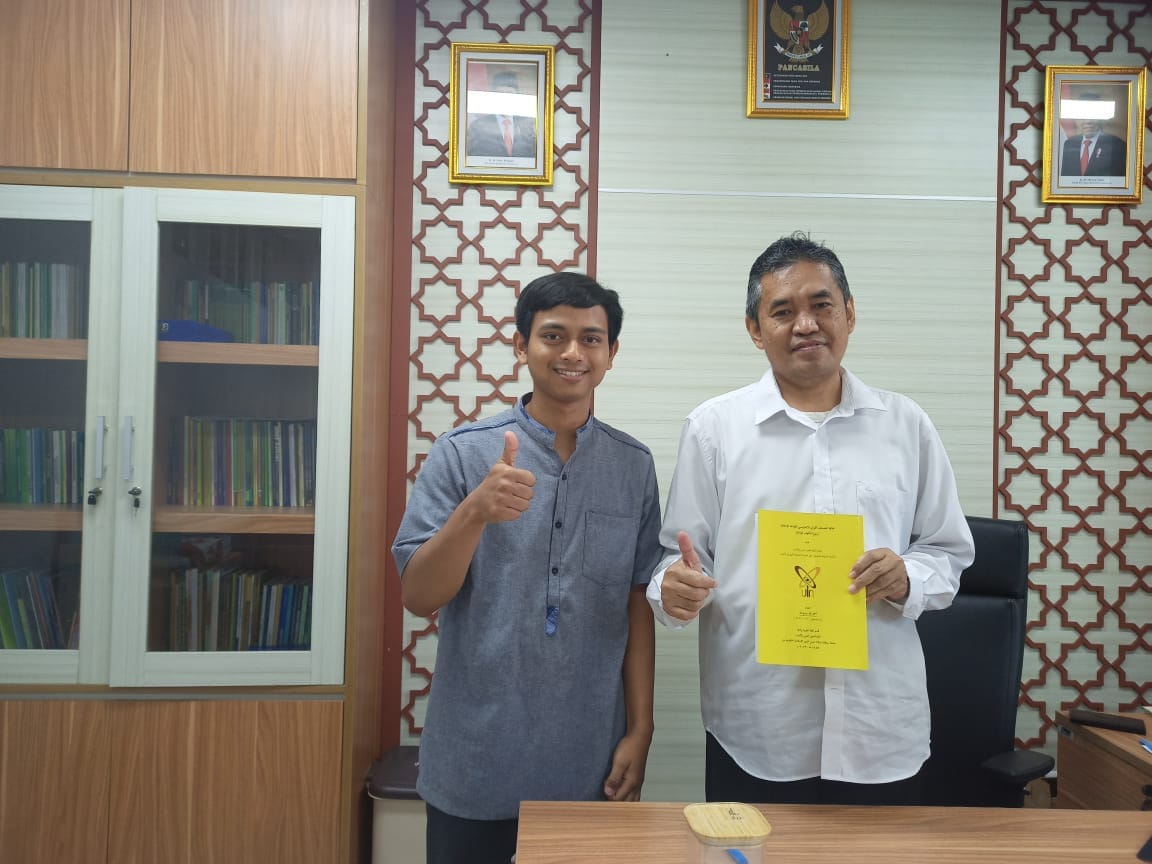
FUDA | Monday (16/10/2023) - Ahmad Najid Rasikhullah and Utfi Fahisfatun Ifadah became the first students at the Faculty of Ushuluddin and Adab UIN SMH Banten to graduate with a scientific article scheme or scientific journal publication as a substitute for a thesis in the Arabic Language and Literature (BSA) Study Program. Both graduated with different schedules. Utfi was judged on Monday, July 24, 2023, while Najid on Friday, October 6, 2023.
Najid's scientific article titled “Contradiction of Indonesian Standard Quran Mushaf from the Writing of Imla Hamza Al-Qath'i & Al-Washli Rules in Surah Al-Kahf” accepted at ‘Ajamiy Journal: Journal of Arabic Language and Literature Univ. Muhammadiyah Gorontalo., with SINTA 4 accreditation, based on the LoA issued by ‘Ajamiy to be published in the September 2023 edition, Vol. 12 No. 2., under the guidance of Dr. Lalu Turjiman Ahmad, M.A.
Utfi's article is titled “Analysis of Variant Forms of Insyā Ṭalabī's Kalam Meaning in Surah Al-Anfal” accepted to Tamaddun Journal: Journal of Islamic Culture and Literature of UIN Raden Fatah Palembang, with SINTA 4 accreditation, based on the LoA issued by Tamaddun to be published in the January 2023 edition, Vol. XXII No. 2, under the guidance of Dr. Ahmad Habibi Syahid, M.A.Pd.
This scheme of scientific articles or journal publications brings students to graduate without a thesis. The Arabic Language and Literature (BSA) Study Program opens opportunities for students to enrich their studies and also to introduce the UIN SMH Banten campus to a wider arena through writing scientific articles, so that they can be accessed by the general public as a result of the research study.
This was conveyed by Dr. Lalu Turjiman Ahmad, M.A. as the head of the Department of Arabic Language and Literature (BSA) UIN SMH Banten.
“In addition to the demands of accreditation with 9 criteria that are oriented towards OUTPUT and out come, The essence of writing journal articles by students lies in the spirit of disseminating scientific products. (nasyr al-intaj al-fikri) to an audience. And journals become meeting places (meeting point) for academics without academic degrees. In the journal, kulluna bahits (each of us is a researcher). This spirit of sharing and academic sillaturrahim needs to be improved.” Dr. Lalu Turjiman explained.
Both scientific articles from BSA students are the result of PPL, and then proceed to be published in a nationally accredited journal article with the student as the first author and the supervisor as a co-author by including the UIN Sultan Maulana Hasanuddin Banten institution.
Najid said that the process of writing this scientific article began with taking a topic given by the department during PPL. Then they began to conduct guidance with the supervisor regarding the title of the topic to be researched. After getting title approval from the supervisor, they began to prepare research instruments to be able to penetrate into the SINTA journal in the following way:
- Open the nationally accredited SINTA page
When opening the SINTA page, determine the direction of the publication of scientific articles according to each study and study program. In SINTA there are several levels from the highest SINTA 1 to SINTA 6. For the level of accreditation, the BSA study program provides standards for choosing SINTA 4 and below. So, make sure the goal of the scientific journal to be published is SINTA accredited in accordance with the agreed provisions of the department.
- Registering and Understanding the Rules of the Journal Manager
Once you've chosen your journal, be sure to contact us through our WA Number or e-mail on the journal's website. If the journal's response is long or there is no clear certainty, it is better to leave it and look for another one. If you have contacted the journal and there is a response that allows publication. Start registering on the journal's website and understand the rules of the journal management, whether it is free of charge or paid, and so on.
- Make sure your review is interesting and start to customize the journal template
Nationally accredited journals or SINTA will definitely be in great demand by researchers throughout Indonesia, and it is not uncommon that there will be a queue of researchers to be published. Therefore, it is very important to convince the manager that your research is really interesting and worth publishing. Make the journal manager interested in the title and study written so that your work can be accepted.
- Letter Of Acceptance (LoA)
After getting confirmation that your research is interesting by the manager and will be published in both unpaid and paid journals. Usually within a week you will be given a LoA. Or you can also contact the manager to ask for LoA. Then it will be converted into a thesis supervisor letter, meaning that we don't follow the Proposal Seminar flow, just with LoA.
- Revision from Reviewers
After uploading scientific articles that have been adjusted to the journal template. There will be revisions from reviewers through e-mail, and you need to do it right away. Use e-mail The revisions given from the institution for both students and lecturers. Do not let the revisions given by reviewers be left for a long time, because it could be that articles that are long revised will be published in the next volume, and that can take 6 months, according to how many times the journal manager publishes in a year.
- Publication and Start Registering for Munaqosah Session at the Faculty
The journal website will upload the revised scientific article. If your scientific article has been published. Because Najid and Utfi are BSA majors, it is recommended to translate it into Arabic first, guided by the supervisor who is on the thesis supervisor letter from the LoA conversion results. If it has been translated. Then, start getting ready to tidy up the munaqosah trial registration file as usual.
During the munaqosah session, what will be tested and revised by the examiners are the results of scientific studies of journal publications translated into Arabic. As for scientific journal articles that have been published, there is no problem. From the conversion of this thesis journal, it will then be booked like a thesis and given to the central library of UIN SMH Banten, faculties, and departments.
Author: A. Najid Rasikhullah