

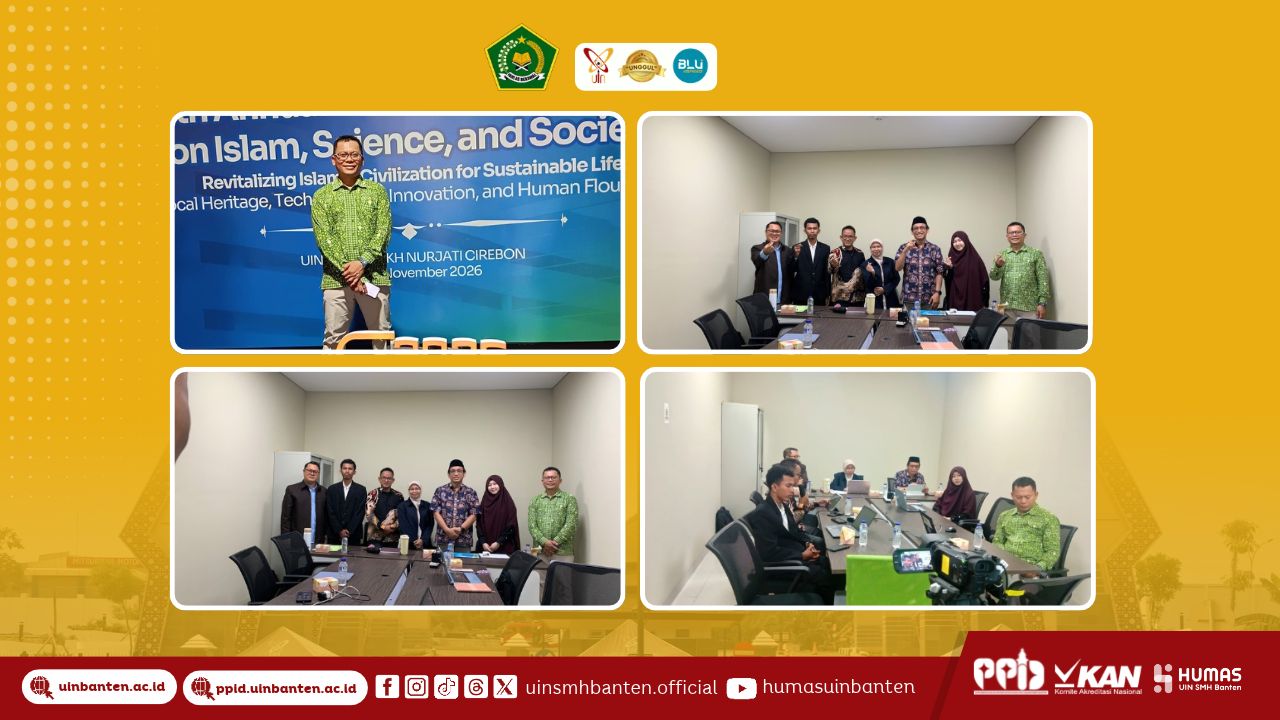
UIN Public Relations – The dynamics of the relationship between Islamic movements and state power emerged as one of the compelling issues discussed at the 2026 Annual International Conference on Islamic Studies (AICIS+), an international academic forum. During the Parallel Session Open Panel held at UIN Siber Syekh Nurjati in Cirebon, Dr. Rohman, a lecturer at the Sultan Maulana Hasanuddin State Islamic University (UIN) in Banten, presented the results of his research on the relationship between Islamic activism, moral politics, and local governance in Indonesia.
Presenting a paper titled “From the Street to the State: Islamist Activism, Moral Politics, and Local Governance in Indonesia,” Dr. Rohman discussed how the Islamist activism movement undergoes changes when it interacts with state institutions, particularly in building relationships and cooperation with local governments.
This study stems from an international academic debate regarding the transformation of Islamic movements, particularly as it relates to participation in state institutions, ideological moderation, political co-optation, and shifts in social movement strategies. Through this research, Dr. Rohman poses a fundamental question: how can Islamic activists with a history of religious mobilization collaborate with local governments without having to endorse all government policies or abandon their movement’s commitments?
To answer this question, the study employed a qualitative approach using a case study in Serang City, Banten. Data were collected through interviews with Islamic activists, religious leaders, and local government officials, as well as through the analysis of policy documents, mayoral decisions, and a historical reconstruction of the movement.
The study found that shared religious goals can serve as a foundation for cooperation between Islamic activists and local governments. One example of this is the “Serang Mengaji” program, which aligns the interests of religious movements with the local government’s agenda.
However, this cooperation does not automatically eliminate differences of opinion. Tensions continue to arise, particularly regarding differing interpretations of the law, strategic considerations, and assessments of political compromises. This is evident in the debate over the revision of the Regional Regulation on the Management of Tourism Businesses.
One of the key contributions of this study is the development of the concept of “conditional accommodation.” This concept explains that the involvement of Islamic activists in institutional cooperation with the government does not necessarily imply full acceptance of the government’s agenda or policies.
Conversely, cooperation can take place selectively on certain issues, with the limits of compromise continually negotiated based on strategic choices and moral responsibility among fellow activists.
Dr. Rohman explains these dynamics through three analytical dimensions. First, agenda alignment—the alignment of goals that enables cooperation between activists and the government. Second, strategic choice—the differing considerations in determining the movement’s strategy and the limits of political compromise. Third, moral accountability—the demand to be held accountable for political choices while maintaining credibility within the activist network.

These three dimensions demonstrate that the relationship between Islamic movements and local governments is not a simple one. It involves an ongoing process of negotiating interests, ideological considerations, political strategies, and moral responsibilities.
Furthermore, this study contributes to the international literature on inclusion-moderation, political co-optation, and institutional activism. The study’s findings indicate that the involvement of Islamic activists in state institutions does not automatically signify an ideological shift, the moderation of the movement, or the loss of the capacity to critique government policies.
The case of Serang City, Banten, serves as an empirical example of how Islamic activism can foster institutional cooperation while simultaneously maintaining a space for critical discourse on public policy. Thus, the dynamics of political Islam at the local level in Indonesia are relevant to broadening academic understanding of the relationship between the state and civil society.
Dr. Rohman’s participation in the AICIS+ 2026 Parallel Session Open Panel also highlights the contribution of academics from UIN Sultan Maulana Hasanuddin Banten to enriching international academic discourse through research grounded in Indonesia’s local experiences.
Through the AICIS+ 2026 forum, the study of Indonesian Islam will not only be the subject of discussion but will also serve as a source of knowledge and conceptual perspectives that can enrich the development of Islamic studies, politics, and governance at the global level.
The post Analyzing the Dynamics of Political Islam on the International Stage at AICIS+ 2026: UIN Banten Professor Proposes a Concept of Conditional Accommodation first appeared on Spirituality, Intellectuality, Professionalism.