

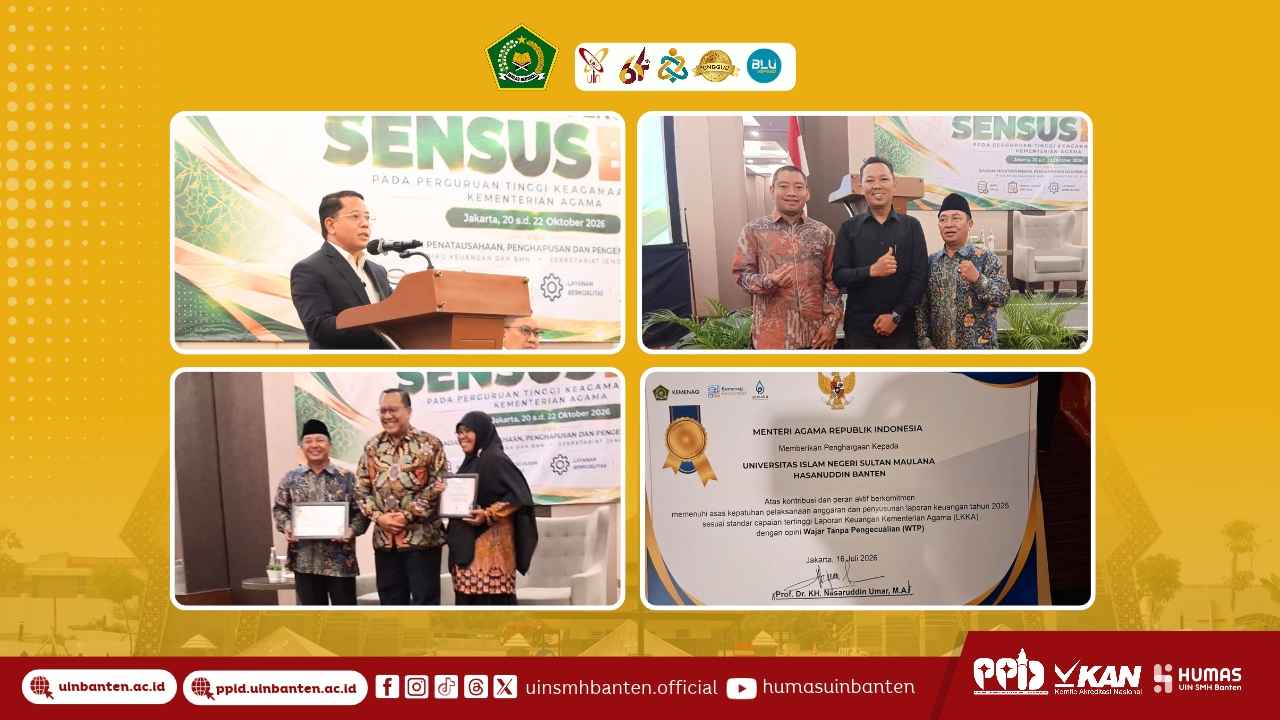
UIN Public Relations – UIN Sultan Maulana Hasanuddin (SMH) Banten reaffirmed its commitment to safeguarding State-Owned Assets (BMN) and ensuring the success of the BMN census. This commitment was conveyed during the Consolidation and Strengthening of the BMN Census for State Religious Universities (PTKN) throughout Indonesia, held at the Aston Pluit Hotel & Residence in North Jakarta from October 20 to 22, 2026.
This national event was officially opened by the Secretary General of the Ministry of Religious Affairs, Kamaruddin Amin, and was attended by bureau chiefs, division chiefs, section chiefs, and BMN operators from PTKNs across Indonesia.
In his opening remarks, Kamaruddin Amin, Secretary General of the Ministry of Religious Affairs, emphasized that the BMN census within PTKNs must not be limited to data collection and physical inspections on paper. The BMN census must ensure that all state assets are properly administered, legally protected, accountable, and optimally utilized for public service.

“The State-Owned Assets Census is not merely a routine data collection activity. It is a crucial tool for ensuring that every state asset is clearly recorded, legally secure, and accountable to the public,” stated Kamaruddin Amin in Jakarta on Tuesday (October 20, 2026).
Kamaruddin Amin added that the leadership of State Religious Universities must take an active role and not allow asset management issues to become a technical burden borne solely by the operators.
“The management of state-owned assets is the full responsibility of leadership. Operators handle the technical aspects, while leadership is tasked with ensuring that policy direction, resource allocation, oversight, and problem-solving proceed smoothly. ”The measure of a census’s success is not merely the percentage of completed applications, but rather the accuracy of the data in reflecting physical conditions and the resolution of issues identified in the field,” said Kamaruddin Amin.
Kamaruddin Amin also highlighted the importance of the principle of public benefit in the management of all state-owned assets by government agencies.
“Equally important are the benefits for the organization and the broader community. How can we make the most of the state-owned assets we have? We must ensure that no assets lie idle and fail to provide tangible benefits for educational or religious services,” Kamaruddin Amin added.
The urgency of this asset restructuring is in line with the statement by Ahmad Hidayatullah, Head of the Finance Bureau at the Ministry of Religious Affairs. In his report, Ahmad Hidayatullah revealed that out of the approximately 10,340 Category Registration Numbers (NUP) recorded within the PTKN system, 2,942 entries are missing photos or updated documentation. In addition, there are 880 assets that do not yet have a Designation of Use Status (PSP).
“At religious universities alone, there are approximately 10,340 state-owned assets that have been recorded. Among these, there is still data that has not been properly completed. We also found assets that physically exist on-site but have not yet been recorded or have not been fully documented,” said Ahmad Hidayatullah while presenting his activity report.
Ahmad Hidayatullah emphasized that this consolidation effort is designed to establish a systematic approach, ranging from the reorganization of assets listed on the Inventory Card (KIB)—which is targeted for completion by 2027—to the management of non-KIB assets during the 2027–2028 period. According to him, improving the governance of state-owned assets must be treated as an ongoing effort.
“The management of state-owned assets must be a continuous and well-planned process, not merely a sporadic response to findings from audits. Data updates, periodic physical inspections, and monitoring of asset utilization must be carried out so that we can identify and address potential issues early on,” explained Ahmad Hidayatullah.

At the conclusion of the event series, UIN Sultan Maulana Hasanuddin Banten solidified its position as one of the top state Islamic universities in terms of financial and asset management accountability. UIN SMH Banten received an award for its contributions and active role in upholding the principles of budget compliance and the preparation of the 2025 financial statements.
This achievement meets the highest standards set by the Ministry of Religious Affairs’ Financial Report (LKKA), which has successfully maintained an Unqualified Opinion (WTP) rating. This prestigious award was accepted in person by the Head of the Bureau of General Administration, Planning, and Finance (AUPK) at UIN Sultan Maulana Hasanuddin Banten, Dr. H. Zaenuri, S.Ag., M.Hum.

Through this award and the comprehensive implementation of the state-owned assets census, UIN SMH Banten is fully committed to ensuring transparency in the management of state assets to support the quality of education at Islamic higher education institutions in Indonesia.
The post Consolidation of State-Owned Assets at Ministry of Religious Affairs Higher Education Institutions: UIN SMH Banten Receives Award for Achieving an Unqualified Audit Opinion first appeared on Spirituality, Intellectuality, Professionalism.


