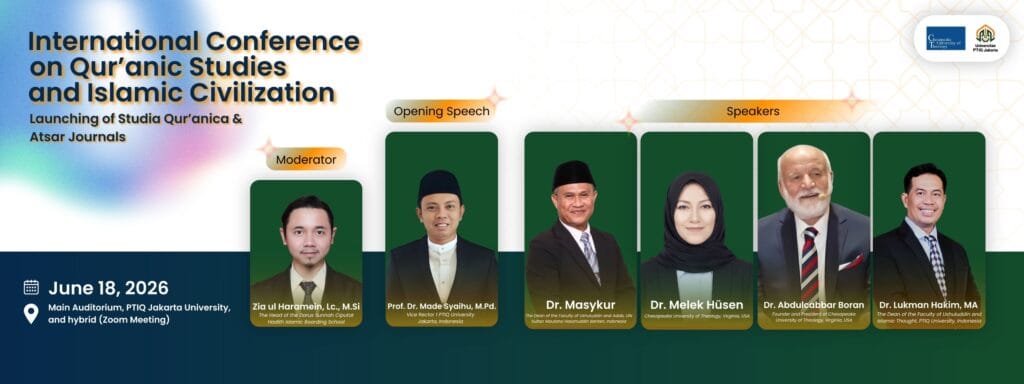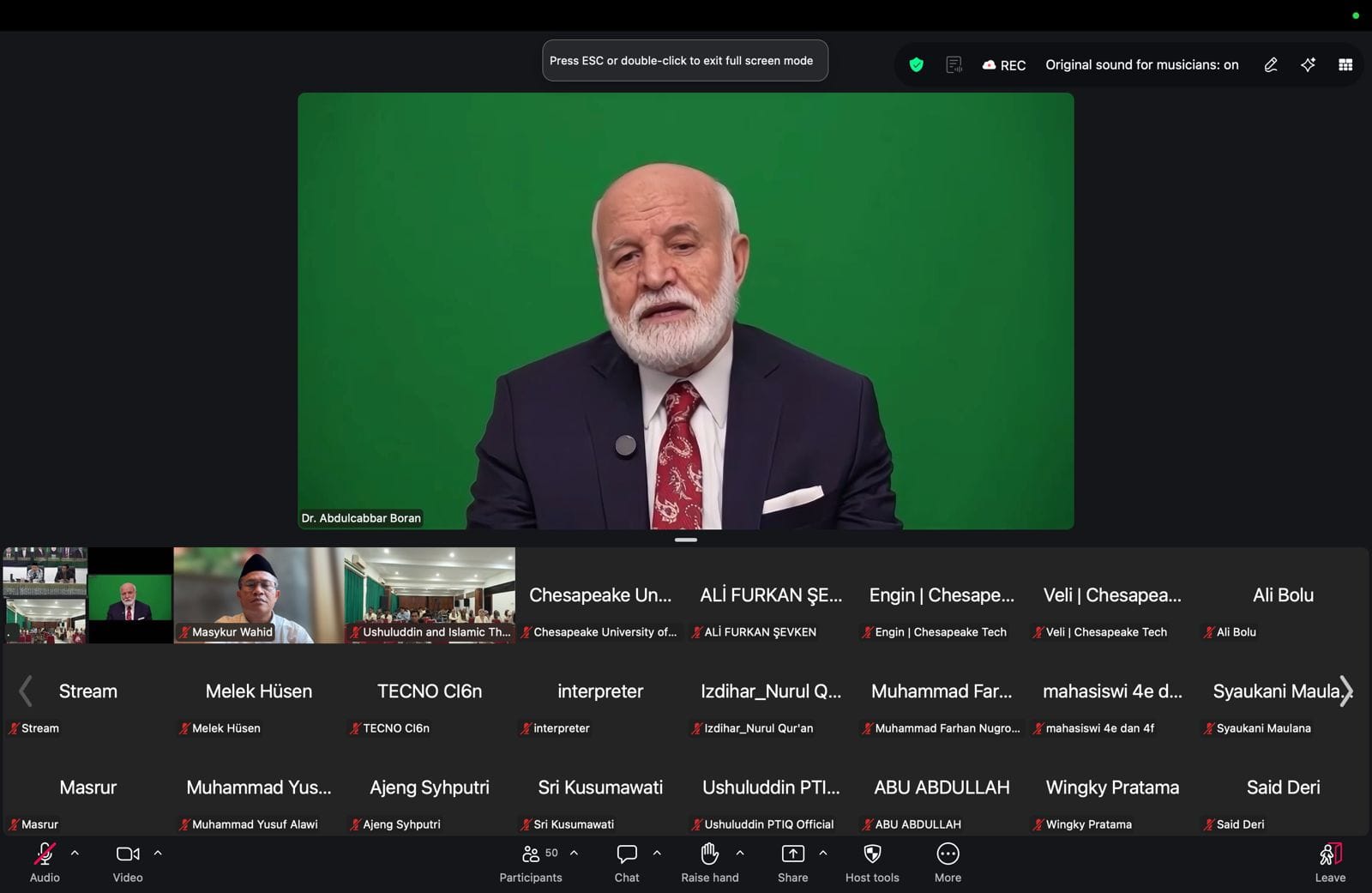
JAKARTA – PTIQ University (UPTIQ) in Jakarta successfully hosted International Conference on Qur’anic Studies and Islamic Civilization (ICQSIC) 2026 on Thursday (June 19, 2026). Held at the Main Auditorium of UPTIQ Jakarta, this international conference took place in a hybrid format (hybrid) and was enthusiastically attended by hundreds of participants from various backgrounds, including academics, students, and the general public.
This prestigious event was officially opened by the First Vice Rector of UPTIQ Jakarta, Prof. Dr. Made Syaihu, M.Pd. In his remarks, he emphasized the importance of discourse on Islamic civilization and Qur’anic studies in responding to the challenges of modernity and pluralism.
This conference features a lineup of leading experts and academics from Indonesia and abroad as keynote speakers. The speakers include:
Dr. Masykur, M.Hum. (Dean of the Faculty of Ushuluddin and Adab at UIN Sultan Maulana Hasanuddin Banten), Dr. Melek Husen (Chesapeake University of Theology, Virginia, USA)
Dr. Addulcabbar Boran (Founder and President of Chesapeake University of Theology, Virginia, USA), Dr. Lukman Hakim, M.A. (Dean of the Faculty of Ushuluddin and Islamic Thought at UPTIQ Jakarta)
Proposing a Resolution to Disputes Over Places of Worship
One of the highlights of this panel discussion was an in-depth presentation by Dr. Masykur, M.Hum., who spoke on the topic “Quranic Ethics and Recognition-Based Interfaith Dialogue in Houses of Worship”.
In his presentation, Dr. Masykur analyzed the sociological reality in Indonesia. He explained that although Indonesia constitutionally recognizes religious pluralism, in reality, local disputes over places of worship for minority groups still frequently occur.
“A house of worship is not merely a physical building. It is a space for prayer, education, the preservation of memory, moral development, and communal identity. ”When access to these places of worship is blocked, religious life is weakened both symbolically and materially,’ Dr. Masykur emphasized before hundreds of participants.”.
In response to these challenges, Dr. Masykur offers solutions drawn from the noble values of the Qur’an. He concludes that the Qur’an provides a strong ethical foundation for interfaith dialogue based on mutual recognition (recognition-based interfaith dialogue) in resolving disputes over places of worship.
According to him, the core issue lies in “recognition.” Minority communities, he emphasized, must be treated as citizens with equal rights, not merely as conditional participants in their own country.
From Administrative Harmony to Rights-Based Coexistence
In concluding his presentation, Dr. Masykur proposed a fundamental paradigm shift in fostering diversity in Indonesia. He urged a transition from mere ‘administrative harmony’ to ‘ethical-dialogical harmony,’ as well as a shift from the passive concept of ‘tolerance’ toward ‘rights-based coexistence.’.
For the Indonesian people, protecting places of worship is a civic responsibility (civic responsibility) as well as a moral obligation taught by the Qur’an.
“True harmony is not the invisibility of minority groups, but rather justice that allows all religious communities to worship with dignity,” he concluded, drawing applause from the conference participants.
It is hoped that the 2026 ICQSIC Conference will spark the emergence of new ideas that are not only academically relevant but can also be implemented to strengthen Islamic harmony and civilization that a blessing for all the worlds at the global level.