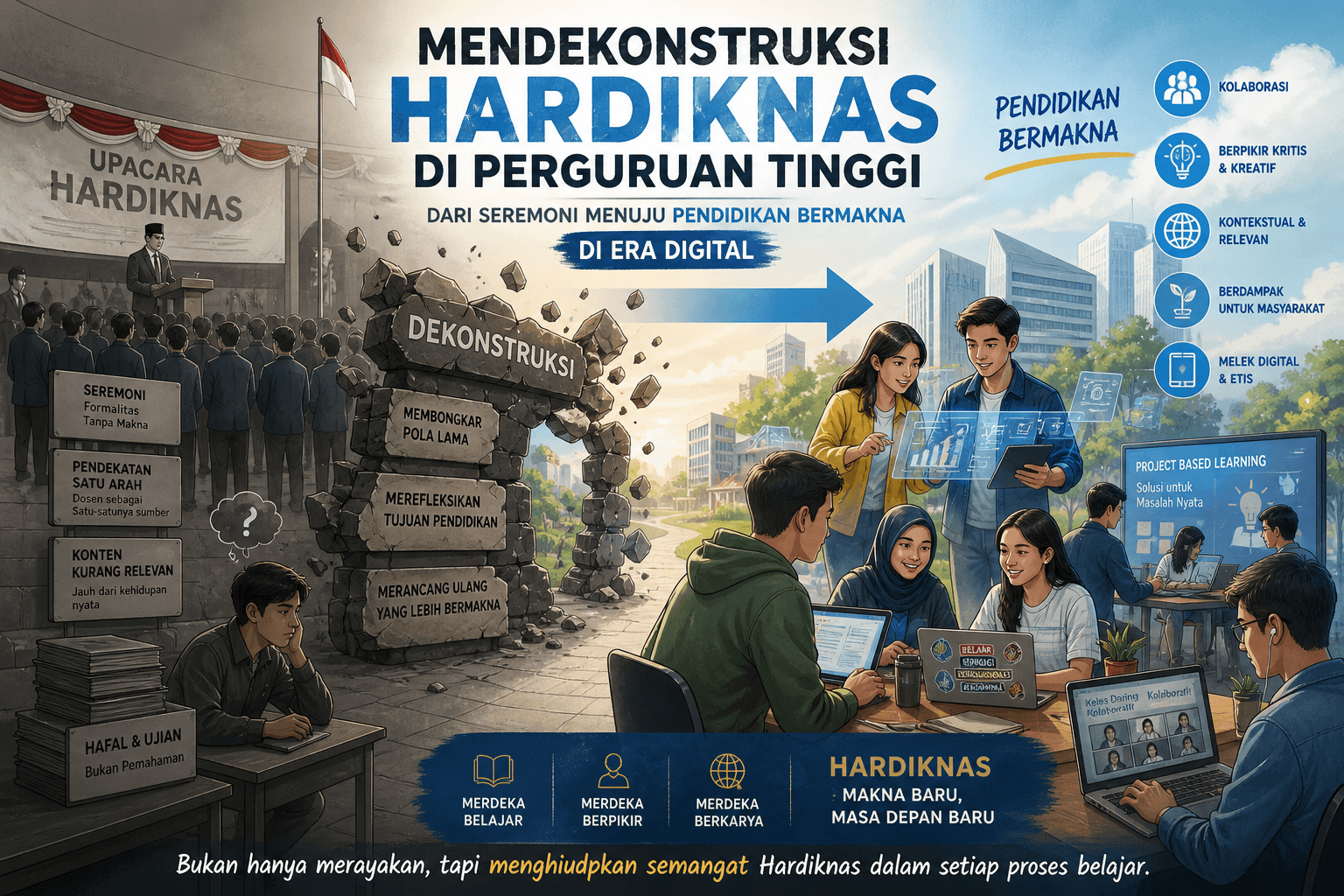
Every May 2, Indonesia commemorates National Education Day or Hardiknas. In various educational units, including universities, this commemoration is commonly marked by flag ceremonies, reading of official speeches, wearing traditional clothing, documentation of activities, and publication on the institution's social media. Symbolically, all of this is important. The ceremony reminds us of the history of national education, of the services of the nation's education pioneers, and of the national values that must be maintained from generation to generation.
However, a critical question that needs to be asked is: Is it enough to celebrate Hardiknas in higher education with an annual ceremony? Does the commemoration of National Education Day only stop at neat rows in the field, reading of speech scripts, group photos, then finished as an administrative agenda? This question is important, especially because universities have a much bigger mandate than just being the organizers of annual ceremonies.
Higher education is not just an administrative work unit. It is a center of knowledge, a research space, a laboratory of ideas, a place for the formation of national character, as well as an institution that has tridarma responsibilities: education and teaching, research, and community service. Therefore, Hardiknas in higher education should not only be understood as a ceremonial agenda, but also as a reflective momentum to re-read the direction of national education.
Circular Letter of the Secretary General of the Ministry of Religious Affairs Number 8 of 2026 on the Commemoration of National Education Day emphasizes that the commemoration of Hardiknas should be carried out simultaneously, solemnly and meaningfully. The national theme, “Strengthening Universal Participation in Realizing Quality Education for All”, contains a strong message. This theme not only invites educational institutions to carry out ceremonies, but also opens space for broad involvement in building more inclusive, quality and equitable education.
This means that the policy text actually does not rule out the possibility of expanding the meaning of Hardiknas beyond the formal ceremony. In fact, the word “meaningful” in Hardiknas commemoration needs to be translated more substantively. Meaningful is not just solemn in the ceremony, but also has an impact on academic work. Meaningful is not only neat in the implementation of ceremonies, but also strong in the commitment to educate, liberate, and humanize students.
This is where Jacques Derrida's deconstructive approach becomes relevant. Deconstruction does not mean destroying tradition or rejecting symbols. Deconstruction is a way of re-reading the structure of meaning that has been considered natural, established, and unquestionable. In the context of Hardiknas in higher education, there is a hierarchy of meaning that needs to be revisited. So far, ceremonies are often placed as the center of commemoration, while research, academic reflection, literacy, learning innovation, and community service are positioned as complements.
Symbols eventually seem more dominant than substance. Administrative compliance is more prominent than academic independence. Ceremonies are more visible than the silent work of building educational quality. In fact, universities should be the most courageous space to question, criticize, interpret, and renew the meaning of education.
If the theme of Hardiknas 2026 talks about “universal participation”, then the campus must translate it in the form of real involvement of all elements of education. Lecturers, students, education personnel, alumni, communities, local governments, businesses, civil society, schools, madrasas and pesantren must be part of a mutually reinforcing educational ecosystem. Universal participation should not stop as a slogan in speeches, but needs to be realized in real programs that touch the needs of the community.
Similarly, the phrase “quality education for all” is not enough to be uttered in a speech. It must be tested through research and academic work. Is our education truly inclusive? Does the university curriculum answer the needs of the times? Does the research of lecturers have an impact on schools, madrasas, pesantren, local communities, and public policy? Is educational technology being used to expand access, or is it widening the gap? These questions should be the main agenda of the campus in commemorating Hardiknas.
In this context, Soekarno's thoughts on nation and character building find relevance again. Soekarno did not see education only as a process of educating the brain, but as an effort to build the soul of the nation. Education is not just a tool to produce labor, but a way to form Indonesian people with personality, independence, courage, and responsibility for the future of their nation.
The phrase often attached to Soekarno, “there is no nation-building without character-building”, contains the message that national development cannot be established without the development of human character. A nation can build tall buildings, highways, industries, and technology, but without character, all that progress can lose its way. Therefore, national education is not just a curriculum project, but a project of culture, spirituality, ethics, and civilization.
If Soekarno emphasized the importance of national character building, Mohammad Hatta gave ethical depth to education. For Hatta, education must precede teaching. Education shapes character, while teaching provides knowledge. Knowledge will only be useful if it is in the hands of people with character. Knowledge without ethics can give birth to manipulative intelligence, while education without moral depth can give birth to a generation that is smart but bereft of conscience.
Hatta also set a very strong literacy example. His phrase, “I am willing to be in prison as long as I am with books, because with books I am free,” shows that true education can never be imprisoned by formal spaces. Education is inner liberation, the formation of reason, and moral maturity. In the context of today's campus, Hatta's message can be read as a criticism of the academic culture that only pursues ceremonies, degrees, accreditation, and administrative publications, but is weak in the tradition of reading, researching, writing, dialoguing, and serving.
At this point, Hardiknas needs to be read as a momentum to return the campus to its scientific dignity. Campuses should not only be busy with administrative governance, but lose intellectual depth. Campuses should not only pursue quantitative indicators, but forget the human impact. Campuses should not only talk about digital transformation, but neglect character transformation.
In the perspective of philosophy of religion, education does not merely deal with the transfer of knowledge, but also with the formation of humans as meaningful beings. Religion provides value orientation, philosophy provides depth of reflection, and science provides rational tools to understand reality. The three should not be separated in higher education.
Campuses that only develop technology without morals risk producing dry intelligence. A campus that only teaches religion without critical thinking risks producing a closed piety. Campuses that only emphasize work skills without character risk producing people who are technically adaptive, but ethically fragile. Therefore, higher education must build the whole person: rational thinking, spirituality, social morality, and responsibility for the nation.
The digital era presents new challenges for education. Artificial intelligence, social media, big data, online learning platforms, and information technology open up great opportunities for equal access to education. Students can access learning resources quickly. Lecturers can develop more creative learning methods. Campuses can expand the reach of academic services through digital technology.
However, on the other hand, the digital era also presents new crises: information flooding, academic plagiarism, instant culture, decreased reading depth, verbal violence in digital spaces, disinformation, and weakened academic ethics. In this situation, it is not enough for campuses to teach the ability to use technology. Campuses must teach wisdom in using technology.
Meaningful digital education is not just about moving classes to screens, assignments to platforms, and administration to applications. Meaningful digital education is education that is able to shape humans to be critical of information, honest in academic work, wise in social media, responsible in using artificial intelligence, and still have social sensitivity in the midst of the swift flow of technology.
This is where national character becomes the main agenda. National character is not just a moral slogan, but a collective ability to be honest in knowledge, fair in policy, polite in differences, critical of power, and concerned about the suffering of society. A national education with character will not only produce smart graduates, but also people with conscience. Not only able to compete, but also able to share. Not only capable of working, but also able to serve.
Therefore, universities need to deconstruct the commemoration of Hardiknas from a mere ceremony to an academic-spiritual movement. The ceremony can still be held as a symbolic tribute to the history of national education. However, after the ceremony, campuses must move towards a more substantive agenda: education policy research, strengthening digital literacy, developing character-based curriculum, training in academic ethics, service to schools and madrasah, and publishing educational ideas for the wider community.
Hardiknas can be a momentum for lecturers to reflect on the meaning of teaching. Teaching is not just about delivering material, but guiding students to find the direction of their lives and social responsibilities. Hardiknasnas can also be a momentum for students to understand that learning is not only about pursuing grades, diplomas, and jobs, but also shaping themselves into independent, critical, and moral human beings. For education personnel, Hardiknas is a reminder that education administration services are also an important part of the nation's intelligence ecosystem.
Furthermore, Hardiknas in higher education should produce impactful research. Campuses need to research the real problems of education in society: inequality in access to learning, low literacy, digital learning problems, the quality of madrasah and pesantren education, teacher welfare, inclusive education, and the ethical challenges of using artificial intelligence. Such research will make Hardiknas not just a symbol, but a real contribution to the improvement of national education.
Thus, Hardiknas is not just a day to stand tall in the field, but a day to re-establish the dignity of knowledge. It is not just a day to read circulars, but a day to re-read the direction of the nation's education. It is not just a day to wear traditional clothes, but a day to nurture the nation's cultural roots and spirituality. It is not just a day to remember Ki Hadjar Dewantara, Soekarno, and Hatta, but a day to continue their ideals: to make education a path of liberation, intelligence, character building, and service to humanity.
Ultimately, universities must dare to ask themselves: are we celebrating education, or just celebrating educational procedures? Are we building a nation, or just repeating a calendar of activities? Are we educating people, or just carrying out institutional routines?
If Hardiknas is to be truly meaningful, campuses must answer through enlightening learning, impactful research, ethical technology, and service that touches people's lives. That is where national education finds its spirit: to educate, liberate, and humanize Indonesian people in the midst of changing times.