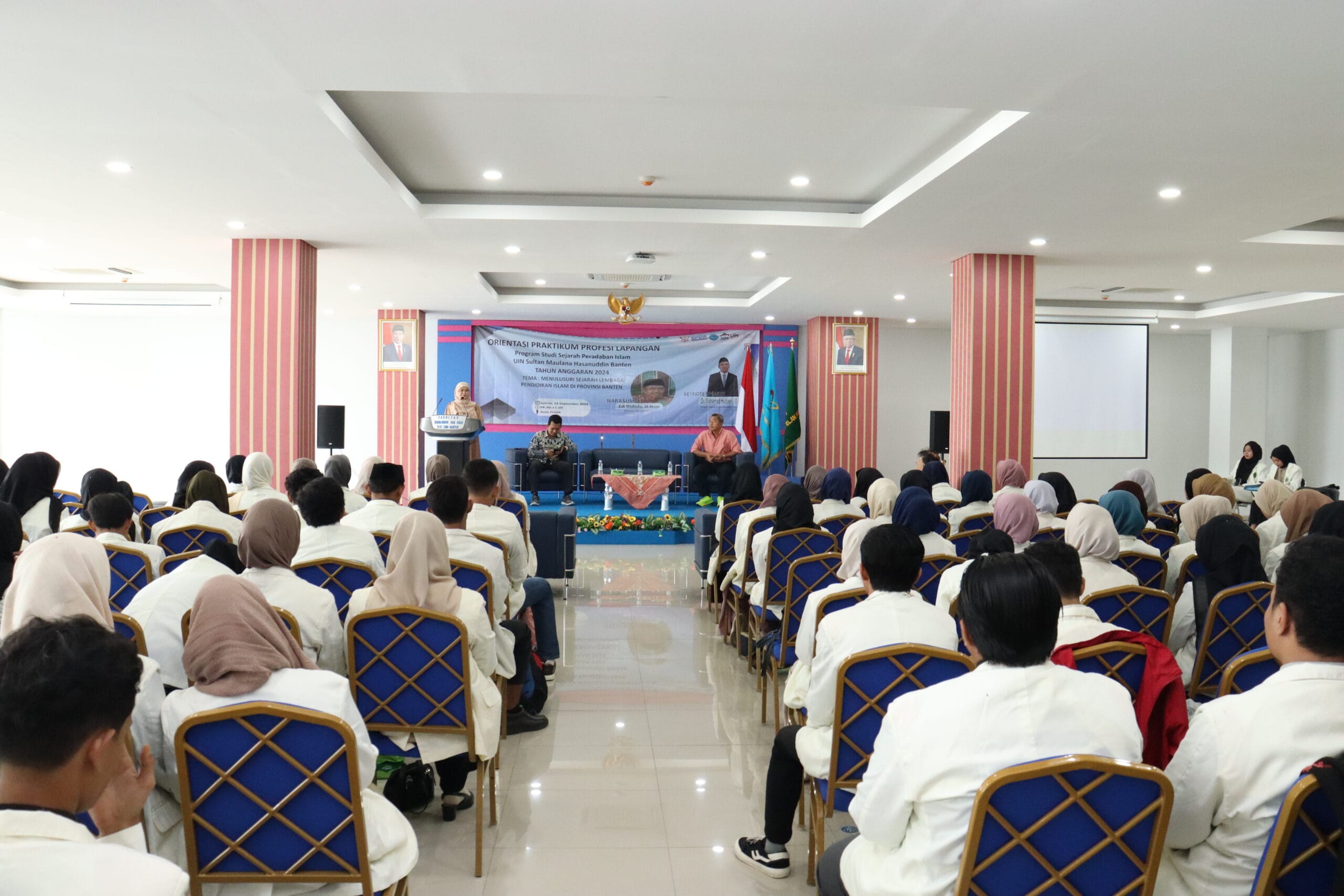
FUDA I Friday (September 13, 2024) - The History of Islamic Civilization Study Program, Faculty of Ushuluddin and Adab UIN Sultan Maulana Hasanuddin Banten held a Field Professional Practicum Orientation activity in the Fuda Hall lt. 2 on Friday, September 13, 2024 with the theme: “Tracing the History of Islamic Education Institutions in Banten Province”.
The activity was attended by the Heads of Faculties and Study Programs as well as several lecturers and employees, while the participants of the Field Professional Practicum Orientation of the History of Islamic Civilization Study Program numbered around 105 participants from semester VII. This activity is a briefing to face the implementation of field work practices as part of the obligation to follow lectures that will soon face the final project.
In her speech, vice dean 2 Dr. Hj. Eva Syarifah Wardah said History is a process of dialogue between the present, the past and the future. For this reason, students of the Islamic Civilization History Study Program, Faculty of Ushuluddin and Adab UIN Sultan Maulana Hasanuddin Banten must be serious in carrying out Field Professional Practicum.
Edi Widodo, M.Hum as a resource person from this activity explained that The history of Islamic education in Indonesia reflects a long and dynamic journey from the beginning of the arrival of Islam to the development of education today. Here are some important points in the history of Islamic education in Indonesia.
Key points in the activity material include: Early Spread: Islam first entered Indonesia through Arab, Persian, and Indian traders in the 13th-14th centuries, Early Spread: Islam first entered Indonesia through Arab, Persian, and Indian traders in the 13th-14th centuries, Dutch Colonial influence: During the Dutch colonization, Islamic education faced various challenges. Nonetheless, pesantren survived and flourished, with many ulama playing an important role in maintaining the tradition of Islamic education. Independence and the Establishment of the National Education System (20th Century) Independence Era (1945-1965): After Indonesian independence, the government began to organize a national education system that included Islamic education. Regional Autonomy and Islamic Education: After the 1998 Reform era, regional autonomy gave more freedom to regions to manage education, including Islamic education. This allowed the development of Islamic schools with an approach that was more in line with local needs.
Author: Faisal