

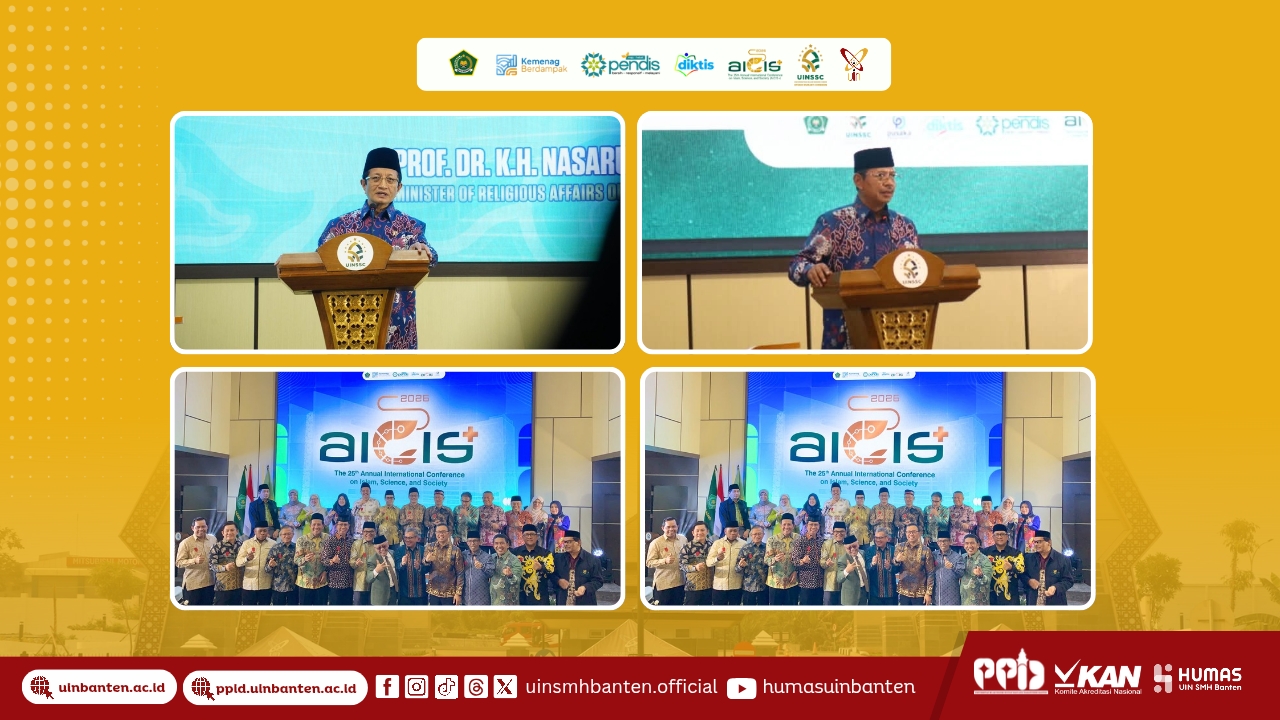
UIN Public Relations – The Minister of Religious Affairs of the Republic of Indonesia, Prof. Dr. K.H. Nasaruddin Umar, M.A., officially opened the Annual International Conference on Islam, Science, and Society (AICIS+) 2026, held at the UIN Siber Syekh Nurjati Cirebon (UIN SSC) campus in West Java on Tuesday (November 17, 2026).
With the main theme “Revitalizing Islamic Civilization for Sustainable Life: Local Heritage, Technological Innovation, and Human Flourishing,” this annual event is designed to integrate Islamic discourse with science, technology, and modern social issues through November 20, 2026.
In a speech titled “Ecotheology, Moderation, and Human Flourishing: An Indonesian Vision for Revitalizing Islamic Civilization,” the Minister of Religious Affairs urged the academic community to take a critical look at the current religious landscape.
He highlighted the essential difference between a moderate stance that stems from a mature comparative understanding and a moderate stance that results from a lack of religious literacy.

“Here in Indonesia, something is happening that legitimizes ignorance. So, perhaps some of our Indonesian people—Indonesian Muslims—have become moderate precisely because of their ignorance,” said Prof. Nasaruddin to the conference participants.
In addition, the Minister of Religious Affairs emphasized the cultural transformation in the era of globalization, in which the essence of Islamic teachings can now be theoretically separated from the Arab cultural traditions that have accompanied them from the very beginning.
According to him, Muslims in Indonesia can practice their religion fully without having to sever their ties to their Indonesian cultural identity.
“We can be 100% Muslim, but we can also be 100% Indonesian in terms of culture. This has consequences because religious teachings have become separated from the cultural background that has long been intertwined with them,” he emphasized.
Meanwhile, in his introductory report, the Director General of Islamic Education at the Indonesian Ministry of Religious Affairs, Prof. Dr. Amien Suyitno, M.Ag., explained that the reorientation from AICIS to AICIS+ marks a broadening of academic horizons that involves extensive interdisciplinary collaboration.
“The difference is that we combine Islamic studies, science, and social research. So this isn’t just about Islamic studies, but also social research and, of course, scientific research,” explained Prof. Amien.
The Director General of Islamic Education also praised the achievements of UIN Siber Syekh Nurjati Cirebon as the pioneer of Indonesia’s first Islamic online university.
He emphasized that the discourse on eco-theology calls for concrete action through the harmonization of religious norms with the standards of modern science.

“Islamic values aren’t just about theory; we must also learn about ecology. Let’s use these values to influence our approach to ecology. So, this is combined with norms—Islamic norms, and of course scientific norms,” he concluded.
The post Minister of Religious Affairs Opens AICIS+ 2026, Emphasizes the Strategic Role of PTKINs in Addressing the Challenges of Globalization and Ecotheology first appeared on Spirituality, Intellectuality, Professionalism.