

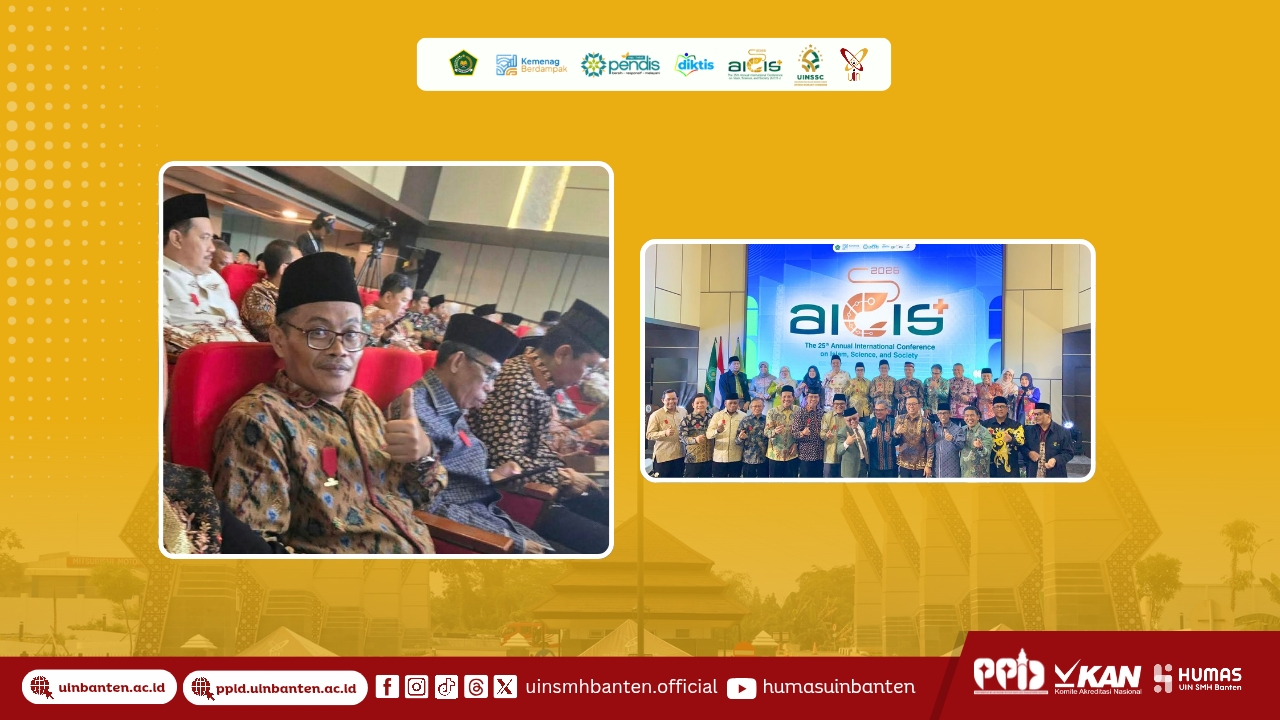
UIN Public Relations – The Rector of Sultan Maulana Hasanuddin State Islamic University (UIN) Banten, Prof. Dr. H. Muhammad Ishom, M.A., attended the opening of the prestigious Annual International Conference on Islam, Science, and Society (AICIS+) 2026, organized by the Ministry of Religious Affairs of the Republic of Indonesia in collaboration with the Syekh Nurjati Cirebon State Islamic University (UIN SSC).
The opening ceremony took place on Tuesday (November 17, 2026) at the UIN SSC Campus in Cirebon, West Java, and was attended by leaders of State Islamic Religious Universities (PTKIN) from across Indonesia.
Under the overarching theme “Revitalizing Islamic Civilization for Sustainable Life: Local Heritage, Technological Innovation, and Human Flourishing,” this international conference—scheduled to run through November 20, 2026—serves as a strategic forum for synthesizing studies in Islam, science, technology, and contemporary social issues.
The event officially opened with a keynote speech by the Minister of Religious Affairs of the Republic of Indonesia, Prof. Dr. K.H. Nasaruddin Umar, M.A., who delivered a presentation titled “Ecotheology, Moderation, and Human Flourishing: An Indonesian Vision for Revitalizing Islamic Civilization.”.

In his remarks, the Minister of Religious Affairs emphasized the importance of religious moderation that stems from a deep scholarly understanding, rather than from superficial knowledge.
“Here in Indonesia, something is happening that legitimizes ignorance. So, perhaps some of our Indonesian people—Indonesian Muslims—have become moderate simply because of ignorance,” said Prof. Nasaruddin.
He also highlighted the challenges faced by Islamic educational institutions—such as UINs, IAINs, and pesantren—in the era of globalization, as they strive to continue deepening the study of Islam while adapting to the changing times.
In addition, Prof. Nasaruddin touched on the phenomenon of separating religious teachings from their cultural roots, noting that Indonesians can be fully Muslim while still maintaining their Indonesian cultural identity.
“We can be 100% Muslim, but we can also be 100% Indonesian in terms of culture. This has consequences because religious teachings have become separated from the cultural background that has long been intertwined with them,” he emphasized.
Earlier, the Director General of Islamic Education at the Indonesian Ministry of Religious Affairs, Prof. Dr. Amien Suyitno, M.Ag., stated in his report that the transformation from AICIS to AICIS+ broadens the scope of study beyond purely Islamic studies to include integration with the sciences and social sciences.

“The difference is that we combine Islamic studies, science, and social research. So this isn’t just about Islamic studies, but also social research and, of course, scientific research,” he explained.
Prof. Amien also commended the selection of UIN Siber Syekh Nurjati Cirebon as both the host and the pioneer of Indonesia’s first cyber-based Islamic university. He emphasized that Islamic values—particularly regarding eco-theology—must not remain merely theoretical but must be tangibly implemented through the integration of Islamic principles and scientific norms.
“Islamic values aren’t just about theory; we must also learn about ecology. Let’s use these values to influence our approach to ecology. So, this is combined with norms—Islamic norms, and of course scientific norms,” he said.

The participation of Prof. Dr. H. Muhammad Ishom, M.A. at this international forum demonstrates UIN Sultan Maulana Hasanuddin Banten’s commitment to supporting the development of interdisciplinary collaborative research, strengthening global academic networks, and implementing the values of religious moderation and eco-theology on campus.
The post The Rector of UIN SMH Banten Attends the Opening of AICIS+ 2026 in Cirebon, Advocating for the Integration of Islam, Science, and Ecotheology first appeared on Spirituality, Intellectuality, Professionalism.