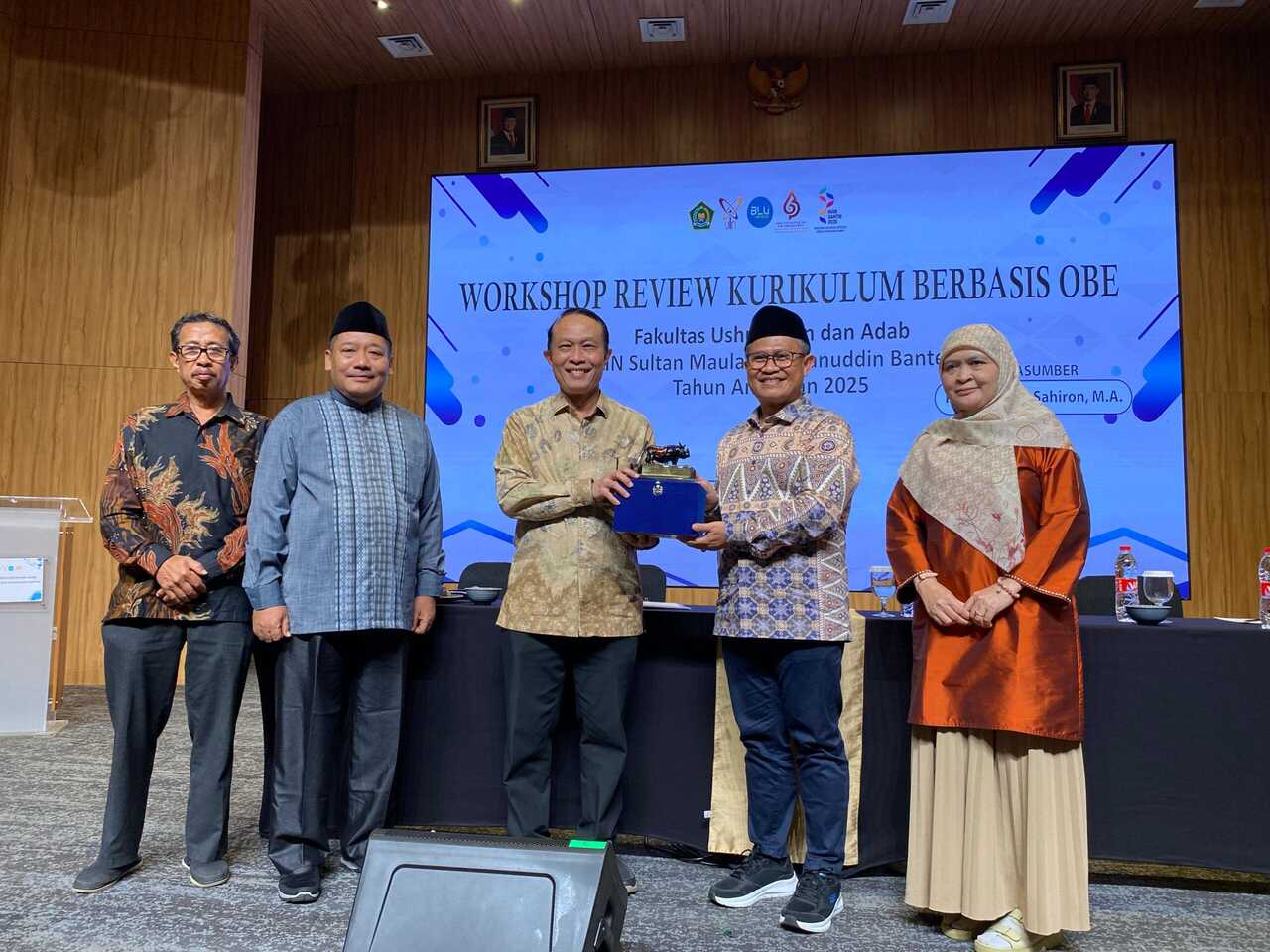
South Tangerang, October 15, 2025 - In order to strengthen the academic quality and suitability of the curriculum with the development of the needs of the times, the Faculty of Ushuluddin and Adab (FUDA) UIN Sultan Maulana Hasanuddin (SMH) Banten held an activity to strengthen the academic quality and suitability of the curriculum. Outcome Based Education (OBE) Curriculum Review Workshop. This activity took place from October 14 to 16, 2025, at the Trembesi Hotel, South Tangerang City, Banten.
This event was attended by 50 participants consisting of elements of faculty leadership, such as the Dean, Vice Deans, Heads and Secretaries of Study Programs, Quality Control Groups (GKM), representatives from the Rectorate, as well as education personnel ranging from the Head of Administration to the executive staff. All participants showed high enthusiasm and commitment in participating in the entire series of activities, which were designed to strengthen the structure and direction of a relevant, up-to-date and applicable curriculum.
OBE: Developing Curriculum with an Orientation to Real Results
Outcome Based Education (OBE) based curriculum is a modern learning approach that emphasizes the achievement of learning outcomes (learning outcomes) that are measurable and relevant to the real world. In this approach, the center of attention is not only the teaching material or content, but the achievement of student competencies after they complete their education.
The OBE model ensures that alignment between graduate profiles, Graduate Learning Outcomes (LLOs), learning methods, and assessment systems. This approach is considered more effective in preparing graduates who not only have theoretical understanding, but also practical skills and work readiness.
In the context of FUDA UIN SMH Banten, the implementation of OBE is part of a strategic step towards excellent and competitive faculty, Therefore, the curriculum review process was conducted in depth and involved stakeholders who have competence and direct responsibility for academic quality. Therefore, the curriculum review process is carried out in depth and involves stakeholders who have competence and direct responsibility for academic quality.
Strategic Direction Prof. Dr. phil. Sahiron, M.A.
As the main speaker in this activity, there were Prof. Dr. phil. Sahiron, M.A., Director of Islamic Higher Education (DIKTIS) of the Ministry of Religious Affairs of the Republic of Indonesia. In his presentation session, Prof. Sahiron provided various strategic directions that are very relevant to the challenges and dynamics of higher education today.
He emphasized that OBE curriculum development must be carried out in intensive coordination with the Quality Assurance Agency (LPM). at the university and faculty levels. Quality assurance is not just a formality, but is the main instrument in maintaining curriculum conformity with national and international standards.
In addition, Prof. Sahiron also emphasized the importance of paradigm shift in higher education, He also emphasized the importance of transforming the learning process from a mere delivery of information to a learning process that trains students' skills and abilities. According to him:
“Students should not only be taught to know something, but should also be trained to able to do something. Education must produce human beings who are competent, adaptive, and able to contribute significantly to the life of society.”
Love-Based Curriculum (KBC): Spiritual and Human Dimensions of Education
In the forum, Prof. Sahiron also conveyed an important message from Minister of Religious Affairs related to development and implementation Love-Based Curriculum (KBC) in the environment of Islamic Religious Universities (PTKI).
KBC is an educational approach that makes “love” as the main foundation of learning. This curriculum aims to form a whole person spiritually, emotionally, socially, and intellectually. In practice, KBC does not only emphasize cognitive aspects, but also integrates human values, tolerance, and diversity.
KBC is built on five core values known as PANCINTA, namely:
The KBC concept is currently in the process of finalizing the draft, and will soon be released in the form of an official document by the Ministry of Religious Affairs. In its implementation on campus, KBC can be present as independent study or integrated into existing courses.
Prof. Sahiron emphasized that the KBC approach will enrich the technocratic OBE curriculum with a touch of spiritual and human values. He also emphasized that the role of religious universities has two major functions, namely:
Participant Enthusiasm and Institutional Commitment
This activity took place in a very interactive and constructive atmosphere. The participants actively discussed, exchanged views, and designed strategies for implementing the OBE curriculum and KBC integration according to the scientific context of each study program at FUDA.