

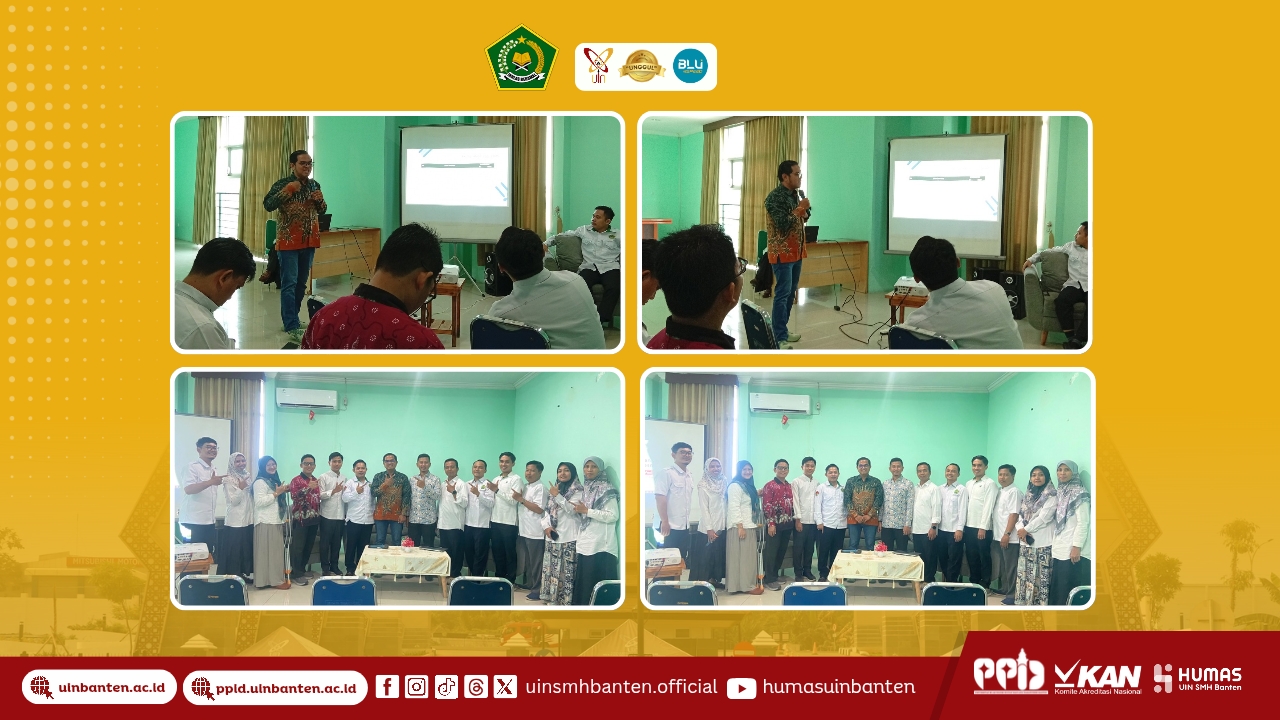

UIN Public Relations – As part of efforts to establish a professional, accountable, and sustainable First-Party Professional Certification Body (LSP-P1), the Director of the LSP at UIN Sultan Maulana Hasanuddin Banten, Jamaluddin, M.E., was invited to serve as a speaker at the Focus Group Discussion (FGD) on Updating the Re-Licensing Documents for the LSP-P1 at UIN Prof. K.H. Saifuddin Zuhri Purwokerto, held on Monday (November 9, 2026).
In his presentation, Jamaluddin emphasized that the re-licensing process by the National Professional Certification Agency (BNSP) is not merely an administrative formality aimed solely at extending the validity period of a license. More than that, he explained that re-licensing is a strategic opportunity to conduct a comprehensive evaluation of institutional performance, the consistency of certification implementation, and the effectiveness of the quality management system.
According to him, an LSP must be able to demonstrate concretely that all certification activities are conducted properly and are properly documented.
Furthermore, Jamaluddin outlined the specific characteristics inherent to LSP-P1 at higher education institutions. He explained that LSP-P1 operates within the higher education governance ecosystem, which is closely linked to academic programs and educational implementation units. Its primary task is to provide competency certification for students or training participants in accordance with a predetermined scope. However, he also reminded administrators to always maintain the independence of certification decisions, while still requiring full support from the institution regarding policies, human resources, funding, and facilities and infrastructure.
During the session, Jamaluddin also outlined six key strategic issues that LSP administrators must address, including institutional aspects, the availability of human resources and competent assessors, the relevance of certification schemes to competency needs, the suitability of Competency Testing Center (TUK) facilities, operational budget support, and consistency in the implementation of the quality management system. He also detailed the cycle and process for BNSP relicensing, which takes approximately 60 business days, starting from the submission of complete registration documents, verification by the assessor team, through the plenary meeting, and the issuance of the decision letter.
In addition, the update of re-licensing documents covers six key document categories based on BNSP guidelines, ranging from legal and institutional documents, human resources, quality management systems, planning and reporting, scheme documents and assessment tools, to TUK documents and certification results. Through this FGD, it is hoped that LSP-P1 UIN Prof. K.H. Saifuddin Zuhri Purwokerto can thoroughly prepare all necessary instruments to achieve excellent and trustworthy governance of the certification body.
The post Quality Improvement Strategy: Director of the UIN Banten LSP Emphasizes the Importance of Updating Re-Licensing Documents at the UIN Prof. K.H. Saifuddin Zuhri Purwokerto Focus Group Discussion first appeared on Spirituality, Intellectuality, Professionalism.