

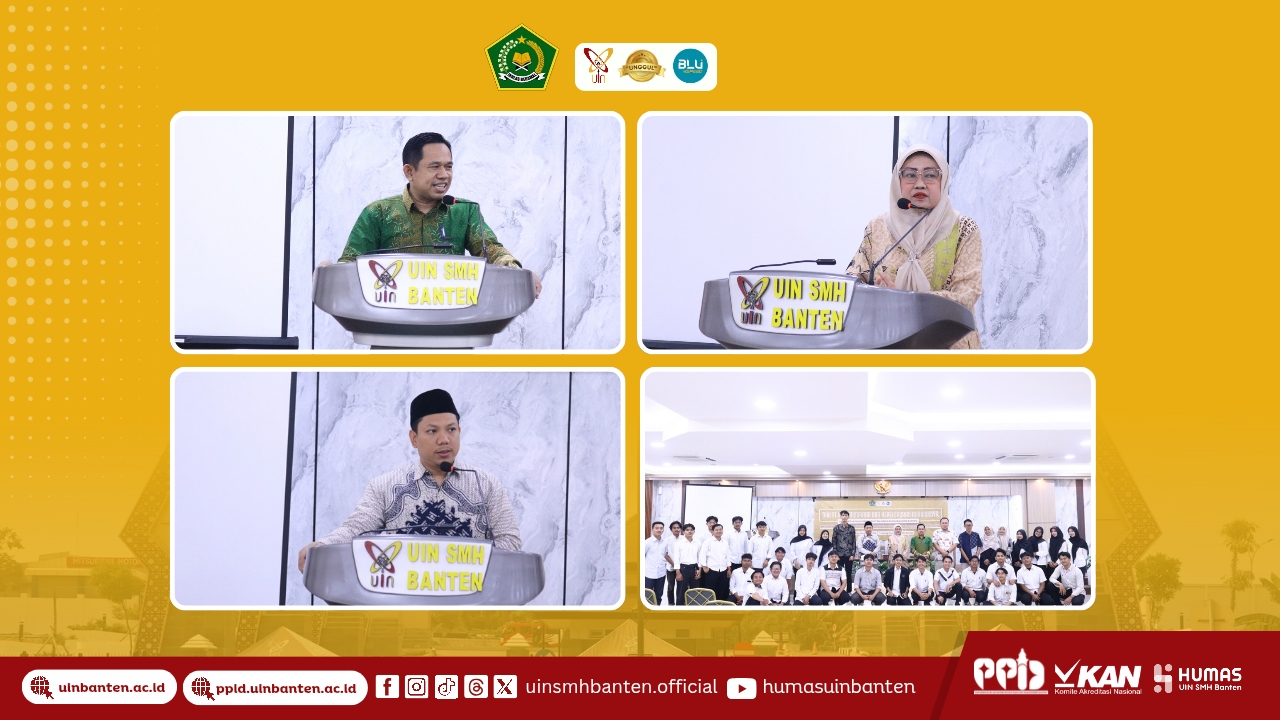

UIN Public Relations – The Student Activities Advisory Team (TPKM) at UIN Sultan Maulana Hasanuddin Banten equipped students with character-building and mental resilience through a Student Leadership and Pioneering Education and Training (Diklat) program held at the UIN SMH Banten Training Center, Wednesday (November 11, 2026).
Under the theme “Mental Health Leadership: Strengthening Student Leadership in Interpreting Academic and Social Phenomena,” this training program is designed as a platform to equip students with leadership skills that focus not only on organizational abilities but also on mental health considerations when navigating academic and social dynamics.
A total of 45 participants—including representatives from the Student Senate (SEMA), the Student Executive Council (DEMA), Departmental Student Associations (HMJ), and scholarship recipients—took part in the event. Over the course of the two-day event, participants received training and guidance to develop critical thinking skills while strengthening leadership qualities grounded in an awareness of mental health.
The Event Chair, Salim Rosyadi, M.Ag., explained that this training serves as preparation for students who will take on leadership roles in student organizations. According to him, leadership is not merely about position or organizational experience, but also requires a broad perspective in understanding various issues.
“This event is an important preparatory session for students who plan to pursue careers in organizations. It’s not just about earning a certificate, but about developing a leadership perspective through the theme of Mental Health Leadership. Strength and mental health must be developed simultaneously, as evidenced, among other things, by an attitude of valuing time. This is important so that students can critically analyze social and academic phenomena, rather than viewing them through a narrow lens,” said Salim Rosyadi, M.Ag.
In line with this, the Head of the AAKK Bureau at UIN SMH Banten, Dr. Hj. Siti Aminah, M.Pd.I., highlighted the challenges faced by Generation Z students amid the development of digital technology. She noted that the ability to adapt to technology must be balanced with mental resilience and sensitivity to the surrounding environment.
“Gen Z students are digital natives who are adaptable to the technological revolution. However, in this era of disruption, many young people are vulnerable to mental fragility due to excessive interaction in the digital world. ”This training program is designed to foster strong, sensitive, and empathetic leadership qualities, so that student organization leaders can mobilize all elements of their organizations to achieve shared goals,” said Dr. Hj. Siti Aminah, M.Pd.I.
In addition to mental resilience, discipline is also an aspect emphasized in the character development of a leader. The Vice Rector III of UIN SMH Banten, Dr. Dedi Sunardi, M.H., stated that students need to cultivate a disciplined attitude and the ability to adapt as preparation for life after college.
“Time management is the most essential foundation for aspiring leaders. This disciplined attitude is not only useful when participating in campus organizations and attending classes, but also serves as a key asset when you enter the workforce and engage with the wider community. Through this leadership training program, students are equipped to understand diverse personalities and cultures, preparing them to become future leaders,” said Dr. Dedi Sunardi, M.H.
Through this training program, UIN SMH Banten hopes that participants will be able to complete the entire series of activities through Thursday (November 12, 2026) and apply the leadership knowledge and values they have gained, both in their organizational lives and when contributing to the community.
The post To Build the Character of Young Leaders, TPKM UIN SMH Banten Holds a Student Leadership Training Program first appeared on Spirituality, Intellectuality, Professionalism.