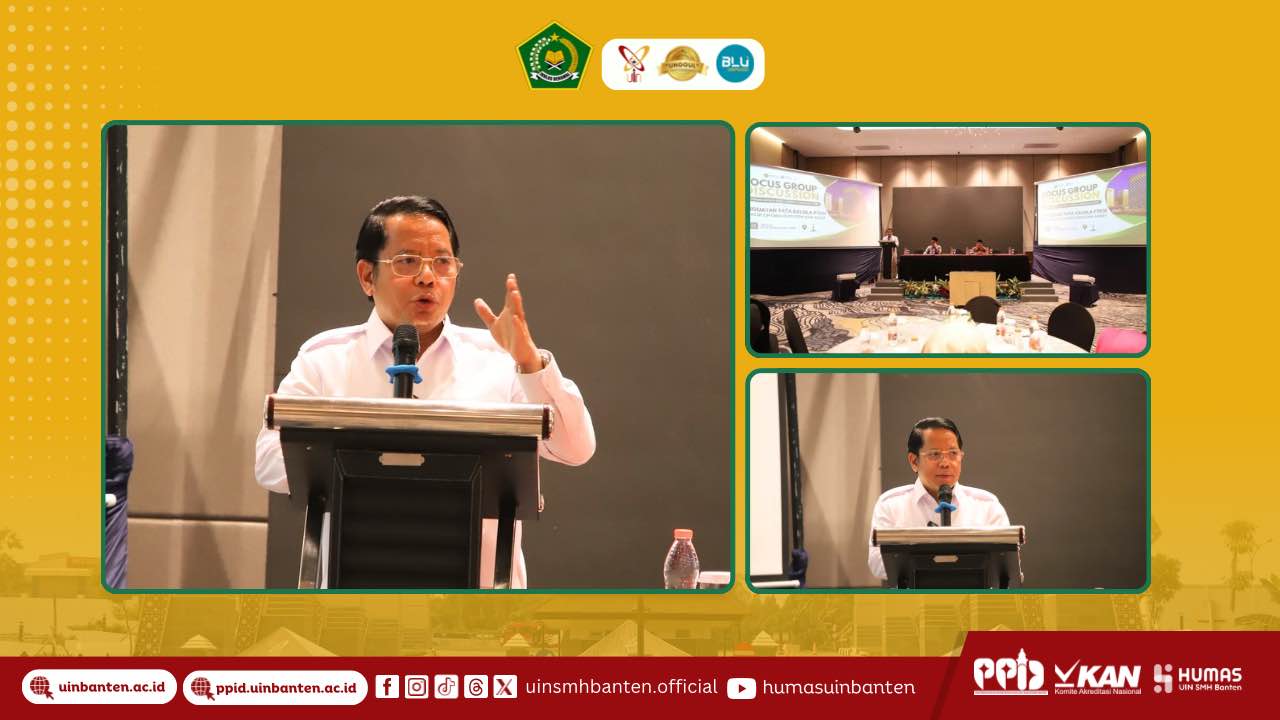
UIN Public Relations – Kamaruddin Amin, Secretary General of the Indonesian Ministry of Religious Affairs, urged all bureau heads at State Religious Universities (PTKN) to pay special attention to improving human resource (HR) capacity, particularly in terms of proficiency in Artificial Intelligence (AI). Mastering this advanced technology is considered an absolute necessity that can no longer be postponed in order to improve efficiency and the quality of governance on campus.
Kamaruddin Amin emphasized that the adoption of AI within PTKN must be carried out comprehensively and in a planned manner by the various bureaus. “AI is extremely important, and we can no longer ignore it. I propose that we schedule AI training for our staff. AI is extremely important, and at the Ministry of Religious Affairs, I will also ask all bureaus to learn about, understand, and utilize this highly advanced technology,” said the Secretary General of the Indonesian Ministry of Religious Affairs.
In addition to bureau leaders and staff, faculty members at universities are also urged to adapt to the latest digital developments. “Especially on campus, this is extremely important. Lecturers today who aren’t familiar with AI are seriously behind the times. So it’s not just about using basic applications, but also being able to use them broadly and extensively because they can save an incredible amount of time,” said the Secretary General of the Indonesian Ministry of Religious Affairs.
He provided a concrete example of how AI makes it easy to process large documents in a short amount of time. “If we were to read a book that’s 500 to 1,000 pages long manually, it would take us days. But by using AI, we simply upload the digital version of the book, and the AI can generate a summary in the form of a narrative, a PowerPoint presentation, or even a podcast—allowing us to grasp the main points immediately without having to read hundreds of pages manually,” said the Secretary General of the Indonesian Ministry of Religious Affairs.
In addition to technological proficiency, the issue of the quality of institutional budget planning and spending has also become a key focus in strengthening campus governance. “Our challenge lies not only in the size of the state budget or government revenue, but an equally important challenge is the quality of our spending. This is largely determined by the quality of planning on campus, where we must shift our focus from merely building physical infrastructure to improving the quality and efficiency of spending,” stated the Secretary General of the Ministry of Religious Affairs of the Republic of Indonesia.
Regarding regional budget management and operational efficiency, restrictions on official overseas travel are also being implemented selectively. “I have requested that most proposals for official overseas travel be postponed or denied if they are not of significant importance. Please screen and filter them; if the trip is truly urgent and of high benefit to the agency, we will certainly approve it,” emphasized the Secretary General of the Indonesian Ministry of Religious Affairs.
To support the financial independence of universities, he also encouraged the optimization of physical assets and the potential of faculty members through collaboration schemes. “We have abundant human resources and experts in various fields, but they have not yet been adequately utilized. Universities must consider how this human capital can be leveraged by providing opportunities for faculty members to collaborate with industry, the public, and local communities to generate benefits and revenue for the university,” concluded the Secretary General of the Indonesian Ministry of Religious Affairs.
The post Secretary General of the Ministry of Religious Affairs Asks the PTKN Bureau to Maximize the Potential of the Institution’s Human Resources and Assets first appeared on Spirituality, Intellectuality, Professionalism.