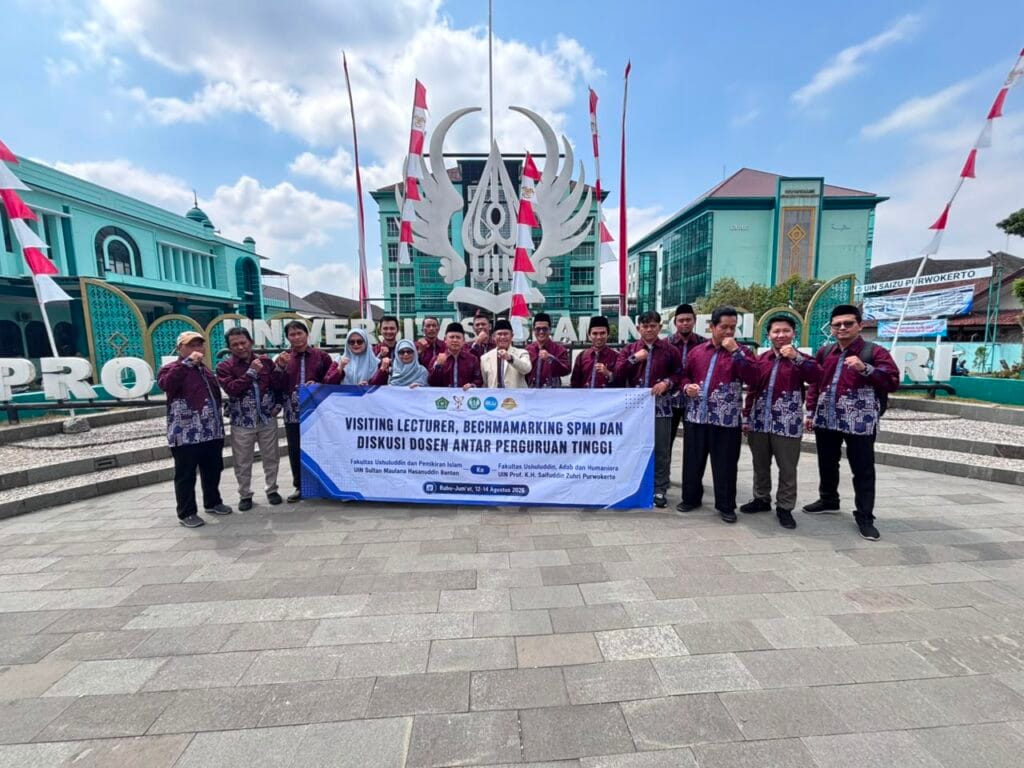
PURWOKERTO – The Faculty of Ushuluddin and Islamic Thought (FUSPI) at UIN Sultan Maulana Hasanuddin Banten and the Faculty of Ushuluddin, Literature, and Humanities (FUAH) at UIN Prof. K.H. Saifuddin Zuhri (UIN Saizu) in Purwokerto continue to demonstrate concrete steps to strengthen their positions as leading, highly competitive institutions. Through academic visits and the signing of a cooperation agreement that took place from August 12 to 14, 2026, these two institutions have clearly demonstrated their shared commitment to accelerating the quality of Islamic higher education in Indonesia.
The FUSPI delegation from UIN SMH Banten, which departed on August 12, 2026, was warmly welcomed at the opening ceremony held in the FUAH meeting room at UIN Saizu Purwokerto on August 13, 2026. The Dean of FUAH UIN Saizu, Dr. Hartono, expressed his deep appreciation for the visit of the FUSPI UIN SMH Banten team. He emphasized that this collaboration—involving the exchange of knowledge and sharing of experiences in the management of the Study Program Management Unit (UPPS) and the faculty—serves as a crucial foundation for fostering innovations in academic governance that will have a tangible impact on the progress of both faculties.
The sentiment was reciprocated; the Dean of FUSPI at UIN SMH Banten, Dr. Masykur, M.Hum., emphasized that this partnership is not merely a formality but a manifestation of both parties’ dedication to growing together. According to him, the synergy that has been established will focus on strengthening the Tri Dharma of Higher Education—encompassing education, scientific research, and community service—which directly supports the improvement of academic quality standards and the acceleration of accreditation for study programs within FUSPI and FUAH toward achieving “excellent” status.
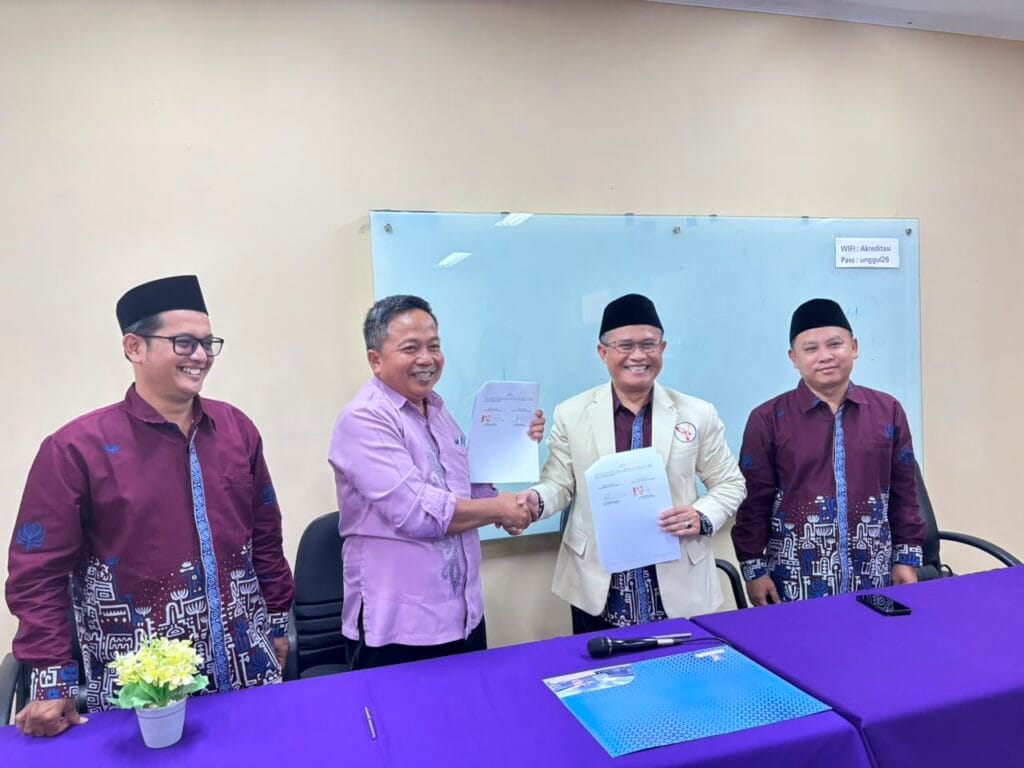
That commitment was formalized through the signing of a document Memorandum of Agreement (MoA) inter-faculty and Implementation Arrangement (IA) by the Heads of the Study Programs from both faculties. The collaboration did not end with the signing ceremony; it was immediately put into practice through three main events held simultaneously at different locations.
The first item on the agenda is academic quality, as demonstrated through the program Visiting Lecturer where experts from FUSPI at UIN SMH Banten shared in-depth insights with students from FUAH at UIN Saizu. This interactive lecture was led by an expert in Qur’anic exegesis, Dr. Endang Saeful Nawar, Lc., M.A., an expert in Hadith, Mus’idul Millah, M.Ag., and an expert in Ulumul Qur’an, Hikmatul Luthfi, M.A.Hum.
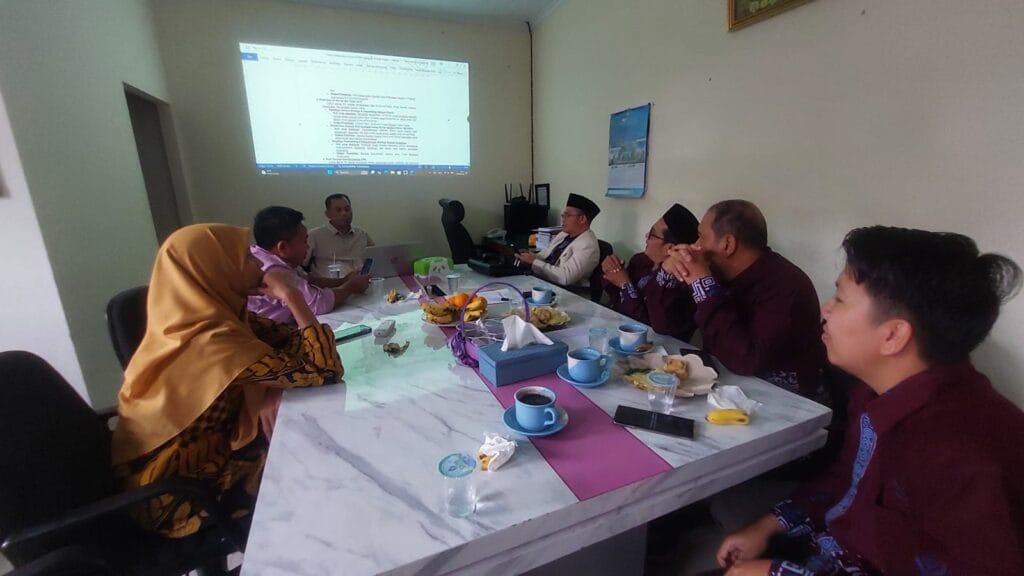
At the second venue, an Inter-University Faculty Discussion Forum was held, attended by FUAH Dean Dr. Hartono along with FUAH faculty members, as well as FUSPI Dean Dr. Masykur, M.Hum., the Associate Dean for Student Affairs, Alumni, and Cooperation, Dr. Ade Fakih Kurniawan, along with FUSPI faculty members. This forum served as a platform for the exchange of scholarly ideas and collaborative research to deepen knowledge in the fields of ushuluddin and the humanities.
Meanwhile, at the third venue, a comprehensive benchmarking session was held that not only focused on the quality assurance systems of the Quality Control Teams (GKM) from both faculties but also involved the Laboratory Directors and the Scientific Journal Management Teams from both institutions. This session examined strategies for internal quality control, curriculum effectiveness, the modernization and efficiency of research laboratory management, and the strengthening of scientific journal governance to achieve national and international reputation and accreditation.
This series of activities serves as clear evidence that FUSPI at UIN SMH Banten and FUAH at UIN Saizu Purwokerto continue to take a proactive approach in addressing the challenges of our time. By bringing in highly qualified faculty members, implementing strict quality control, providing well-equipped research laboratories, and offering strong support for scientific publications, both faculties are further establishing themselves as the top choice for prospective students seeking an Islamic education that is excellent, modern, and globally competitive.