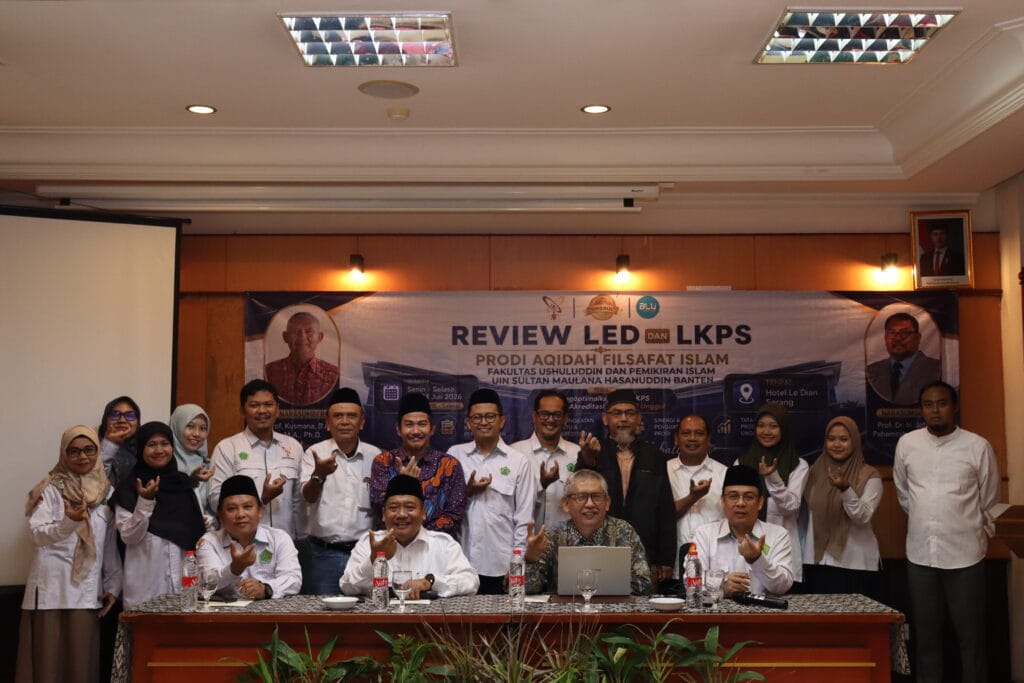
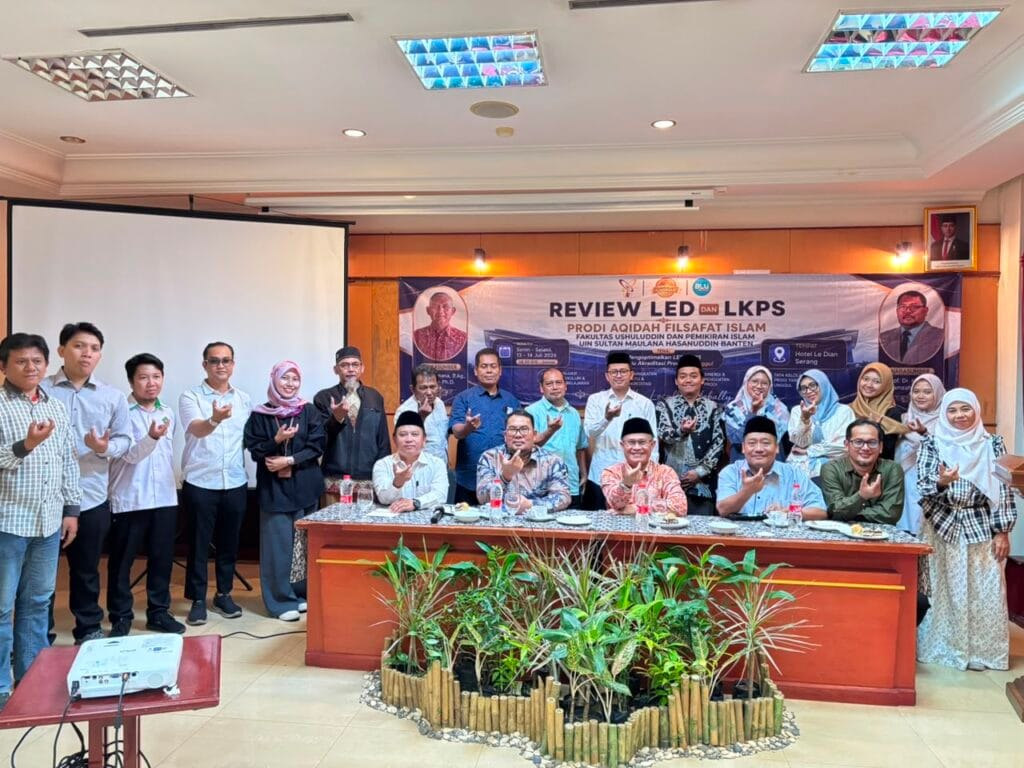
Serang, July 14, 2026 — The Aqidah and Islamic Philosophy (AFI) Program, Faculty of Ushuluddin and Islamic Thought, UIN Sultan Maulana Hasanuddin Banten, organized an event Review of the Study Program Performance Report (LKPS) and the Self-Evaluation Report (LED) Over two days, Monday–Tuesday, July 13–14, 2026. The event, held at the Le Dian Hotel in Serang, had the theme “Optimizing the LED-LKPS to Achieve Accreditation for the AFI Program.”
This activity is part of the AFI Study Program’s strategic efforts to improve the quality of governance, strengthen the quality assurance system, and refine accreditation documents so that they comprehensively reflect the program’s objective conditions, achievements, strengths, and direction of development.
On the first day, the event featured Prof. Kusmana, S.Ag., M.A., Ph.D., an academic at UIN Syarif Hidayatullah Jakarta. In his presentation, Prof. Kusmana emphasized the importance of building a systematic, objective, measurable, and sustainable culture of quality. According to him, accreditation should not be viewed merely as a matter of fulfilling administrative requirements or preparing documents, but must serve as a tool to ensure the delivery of high-quality higher education.
A culture of quality must be built through best practices that are consistently implemented. Therefore, improving the quality of academic programs should not depend solely on specific leaders, but must be supported by systems, regulations, a clear division of responsibilities, access to data, periodic evaluations, and well-documented follow-up actions.
Prof. Kusmana also explained the philosophy of accreditation, which is based on four main aspects, namely Culture, Relevance, Accountability, and Mission, or CRAM. A culture of quality relates to a study program’s ability to implement continuous quality improvement. Relevance pertains to the alignment of the curriculum, research, and community service with the needs of society, the workforce, and advancements in science. Accountability requires transparent and accountable governance, while mission differentiation requires academic programs to have a clear direction for development and distinct areas of excellence.
In the context of the AFI Study Program, the program’s existence cannot be explained solely in administrative terms. AFI must be able to demonstrate its strategic contribution to building a tradition of rationality among Muslims, developing critical thinking, strengthening interdisciplinary integration, and shaping a generation of Muslims who are rational, inclusive, moderate, and intellectually resilient.
The first day also included a discussion on the implementation of the Internal Quality Assurance System through the cycle Establishment, Implementation, Evaluation, Control, and Improvement, or PPEPP. Every program and activity must have standards, targets, evidence of implementation, evaluation results, follow-up actions, and evidence of quality improvement. Thus, the accreditation documents truly reflect the educational practices carried out within the study program.
On the second day, the activities continued with Prof. Dr. H. John Pahamzah, M.Hum. This session focused on reviewing and refining the draft LED for the AFI Study Program. The document was thoroughly reviewed to ensure consistency between the LED narrative, the quantitative data in the LKPS, and the available supporting documents.
The discussion covers strengthening the academic profile and vision of the study program, governance and management, the quality assurance system, human resources, finance and infrastructure, education, research, community service, the outcomes of the three pillars of higher education, as well as an analysis of achievements and development plans.
During the review process, each section of the LED is designed not only to be descriptive but also to include an analysis that highlights the current situation, indicator achievements, enabling factors, constraining factors, root causes, and follow-up actions. Consistency between data, narrative, and supporting evidence is a key priority to ensure the document maintains a high level of accuracy and accountability.
The review of the LED draft also emphasized the importance of avoiding repetitive narratives, filling in missing sections, strengthening the SWOT analysis, and demonstrating the connections between the vision, work programs, performance indicators, evaluations, and development plans. Every statement in the LED must be supported by valid, up-to-date, relevant, and easily traceable data.
Through this activity, the accreditation team received various notes, corrections, and recommendations to improve the LKPS and LED. The results of the review will be followed up through the assignment of tasks, data verification, updating of supporting documents, refinement of the self-evaluation narrative, and strengthening of evidence of the implementation of the quality assurance system.
The LKPS and LED review process is expected not only to produce comprehensive, high-quality accreditation documents but also to strengthen the commitment of the entire academic community to fostering a culture of quality. Through the synergy of leadership, faculty, staff, students, alumni, and stakeholders, the AFI Study Program is optimistic that it can improve the quality of its implementation of the three pillars of higher education and achieve its goals. Superior Accreditation.