

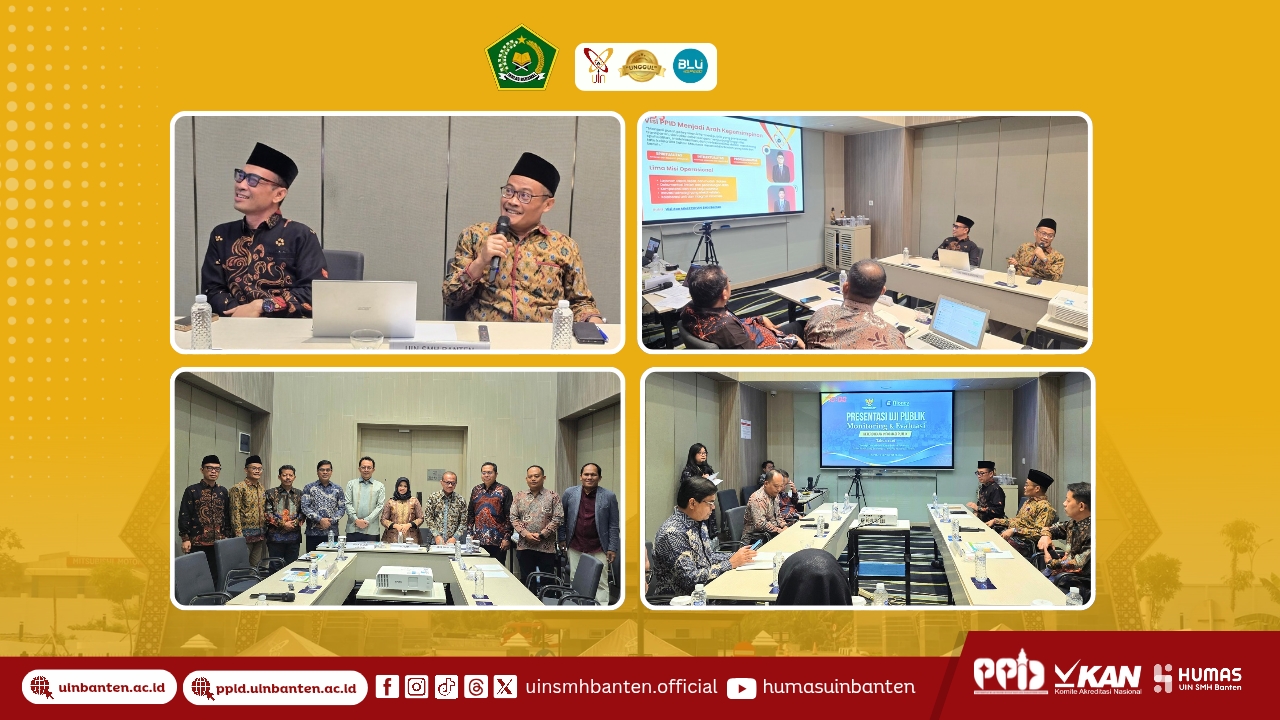
UIN Public Relations – The Rector and head of the Information and Documentation Management Officer (PPID) at Sultan Maulana Hasanuddin State Islamic University (UIN) in Banten, Prof. Dr. H. Muhammad Ishom, M.A., outlined his institution’s commitment to public information transparency before the Commissioners of the Central Information Commission (KIP) of the Republic of Indonesia. The event took place during the 2026 Public Information Transparency Monitoring and Evaluation (Monev) Presentation and Public Hearing at the Grand Mercure Kemayoran in Jakarta on Thursday, November 12, 2026.

During the session, the Rector of UIN SMH Banten was accompanied in person by the Vice Rector II, who also serves as Chair of the UIN SMH Banten Information Disclosure Board (PPID), Dr. Ali Muhtarom, M.Si. The presence of the university’s leadership underscores the institution’s commitment to establishing a system of information management that is transparent, accountable, and easily accessible to the general public.
”Alhamdulillah, the public hearing went smoothly, and we presented several key points regarding information transparency on our campus,” said Prof. Ishom during a press briefing following the event.
UIN SMH Banten’s participation in this public review phase is a strategic follow-up after the university was declared to have passed verification Self-Assessment Questionnaire (SAQ) 2026 Public Information Transparency Monitoring and Evaluation. This phase plays a crucial role in determining the qualifications of public agencies, particularly in assessing leadership commitment, information governance, and the quality of information services provided to the public.

Furthermore, Prof. Ishom emphasized that transparency at UIN SMH Banten is actively implemented in various academic and service aspects. According to him, when the university publishes its list of public information—particularly regarding new student admissions—the institution always openly states that the campus community adheres to the principle of inclusivity, embracing all groups without discrimination.
”We openly state that our campus is inclusive; we welcome students with disabilities, and we also welcome non-Muslims. Currently, there is one non-Muslim student at UIN Banten, and there is also one student with a disability,” said Prof. Ishom in his presentation.
He added that all of these students are provided with excellent and comprehensive services, without exception. These values of inclusivity are also consistently promoted openly through various scholarly articles by university leadership and the campus’s official media channels so that the public is aware of the institution’s commitment.
Nevertheless, the university continues to apply the principles of prudence and information exemption in accordance with applicable laws and regulations, particularly with regard to confidential documents. One example of such an exemption applies to the results of evaluations and the handling of victims and perpetrators of violations based on the institution’s code of ethics.
”But in this case, there are some things we also exclude. For example, information related to evaluation results and the handling of victims or perpetrators based on the code of ethics. We do not freely disclose this information,” Prof. Ishom emphasized.
This statement was issued in light of the recent surge in reports of sexual violence on college campuses, where certain parties often spread information without a solid basis. Therefore, UIN SMH Banten is committed to handling every report with the utmost care in order to protect privacy and prevent victims from experiencing further psychological trauma.
”Yesterday, we almost had a similar situation here. But we exercised caution, so initials and other details remain confidential. ”The bottom line is that we always post and raise awareness through our media channels about how we handle issues related to sexual violence and other matters, in the hope that the UIN Banten campus will truly be an inclusive environment,” he added.
In addition to academic services and the enforcement of ethical standards, UIN SMH Banten also maximizes public participation in the planning process for information management and the drafting of public documents. During this planning phase, the university actively involves stakeholders (stakeholder) in the surrounding area.
”Early on, when we were doing our planning—including deciding what we would publish and which documents to include—we definitely went through the planning stages. When we were planning, we invited stakeholder ”located within the UIN Sultan Maulana Hasanuddin Banten campus," explained Prof. Ishom.
As a concrete example of external collaboration, the university has also partnered with the Central Statistics Agency (BPS) to measure the employment rate of its alumni. The BPS’s involvement is considered highly beneficial to the university in obtaining accurate data on the percentage of UIN SMH Banten graduates in the Banten Province workforce, despite the institution’s budget constraints.
”We even collaborate with the Central Statistics Agency (BPS). For example, regarding the employment rates of our alumni, we seek their input. Since our budget is very limited, conducting a BPS survey allows us to gather this information. For example, within the scope of Banten Province, what percentage does UIN contribute, and so on. All of this is part of community participation,” he explained.
On the same occasion, Prof. Ishom also addressed the issue of handling public complaints and feedback, including anonymous complaints—often referred to as “anonymous letters.” University administrators stated that they are open to receiving and responding seriously to every report, as long as the complaint does not violate regulations regarding the confidentiality of government documents.

”And I should also mention—this is related to whistleblowing system. ”We also receive a lot of anonymous letters and complaints from the public—that’s just part of the job. We take them into consideration, but once again, as long as they don’t conflict with documents that must remain confidential, we’ll take them seriously. “However, if a request is in direct conflict with the confidentiality of state documents and so on, we will not process that request. Nevertheless, we will still provide a polite response,” he concluded.
The post To Promote Transparent Services, the Rector of UIN Banten Outlines Public Information Management Before the KIP first appeared on Spirituality, Intellectuality, Professionalism.