

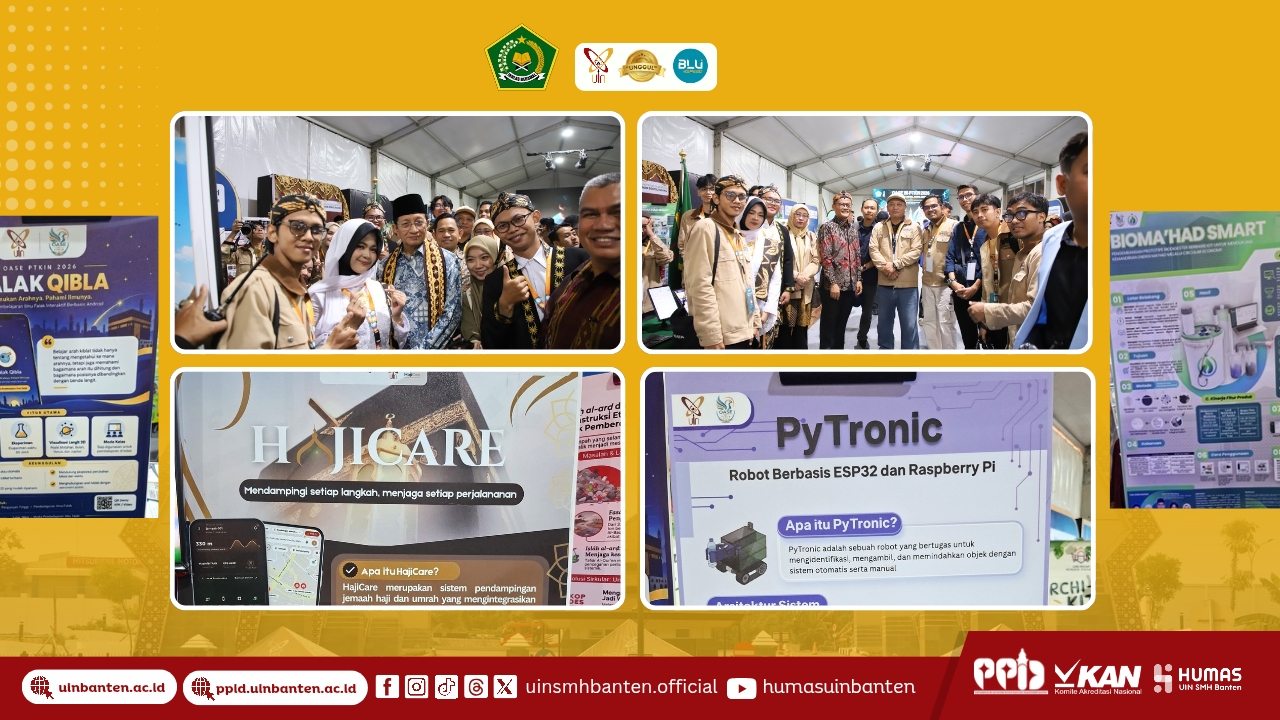

UIN Public Relations – UIN Sultan Maulana Hasanuddin (SMH) Banten delivered a stunning performance at the 3rd OASE (Olympics, Religion, Science, and Research) Expo for-PTKIN, held from November 4 to 6, 2026, at UIN Sunan Kalijaga in Yogyakarta.
At this prestigious exhibition, the UIN SMH Banten Expo Team showcased a variety of leading innovative products created by the academic community, ranging from robotics technology and religious applications to renewable energy based on Internet of Things (IoT), as well as systems to assist with the Hajj and ecological solutions.
This collection of creative works attracted widespread attention from expo visitors. The presence of these products demonstrates that students at Islamic religious universities not only excel in religious studies but are also capable of mastering modern technology and conducting applied research that has a direct impact on society.
Outstanding Innovative Works by Students at UIN SMH Banten
1. PyTronic: An App-Based Automated Robot
UIN SMH Banten proudly showcases PyTronic, an intelligent robotic innovation specifically designed to identify, pick up, and move objects both automatically and manually. This robot is operated using an application system that allows users to control its operations flexibly according to their needs.
This cutting-edge innovation is the result of the hard work of students from various academic programs, including M. Rizki Ramdhani (Physics), M. Ari Fudholi (Computer Science), M. Rifky Pradana (Physics), Putri Alfiah (Physics), Rudi Ramdhan (Computer Science), and Yudhistira Wisnu (Physics).
2. Falak Qibla App: An Interactive Learning Tool for the Science of Astronomy
In addition to robotics, the exhibition team also introduced Qibla Astronomy, an interactive Android-based astronomy educational app. This app is designed to be user-friendly and is ideal for a wide range of users, from madrasah students and college students to the general public who wish to deepen their knowledge of astronomy.
The app’s developer explains that, through this platform, the process of learning the direction of the qibla goes beyond simply indicating the geographical direction. Users are also encouraged to gain a deeper understanding of how that direction is calculated mathematically and how it aligns with celestial bodies.
This educational app was developed by a team of students from the Computer Science program, consisting of Muhammad Fikry, Safira Dwi Febryanti, and Sri Asri Napitupulu.
3. Bioma’had Smart: IoT-Based Energy Self-Sufficiency
As a demonstration of its commitment to environmental sustainability and clean energy, UIN SMH Banten is presenting Bioma’had Smart. This innovation is the development of a prototype biodigester for organic waste through real-time based on Internet of Things (IoT). This technology is designed to support energy self-sufficiency in the community ma’had (campus Islamic boarding school) through the implementation of the circular economy concept (circular economy).
This innovative project was carried out by M. Ghataan (Computer Science), Ahmad Rosyid (Computer Science), Raudhotus Sifa (Physics), and Ira Rahmawati (Physics).
4. Haji Care: A Pilgrim Support System Based on Smart Band
To provide a sense of security and convenience during worship, the exhibition team is showcasing Haji Care. This support system for Hajj and Umrah pilgrims integrates an Android app with a prototype smart bracelet (smart assistive band).
This system was specifically developed to support safety and accessibility, as well as to facilitate the fulfillment of worship needs for congregants, especially the elderly and people with disabilities. This social-technology innovation was designed by Computer Science students: Fadli Hifziansyah, Ferdi Ahyana, Humaida Athifah, M. Jihad Ardiansyah, and M. Abdurrahman.
5. Ecotheology System: Integrating Wudu, Catfish Farming, and Hydroponics
To conclude the series of flagship innovations, the UIN SMH Banten Ecotheology Team presented an integrated, environmentally friendly system for managing wudu wastewater. The water used for wudu is filtered and reused to fill a catfish aquaculture pond.
Furthermore, the waste from catfish farming is strategically processed into natural fertilizer to support the growing medium in the hydroponic system. This sustainable cycle is the result of interdisciplinary collaboration developed by Angga Permana (Qur’anic Studies and Exegesis), Deni Firdaus Fauzan (Hadith Studies), Fahd Fadhillah (Qur’anic Studies and Exegesis), Azuza Evania (Biology), and Anna Pusfitasari (Chemistry).
Through its participation in the OASE III competition for all PTKIN institutions, UIN SMH Banten hopes that the innovations emerging from the campus can continue to be developed in a sustainable manner, provide real solutions to community issues, and inspire the younger generation to continue making contributions in the fields of science and technology.
The post UIN SMH Banten Showcases Five Leading Innovations at the OASE III Expo 2026 first appeared on Spirituality, Intellectuality, Professionalism.