

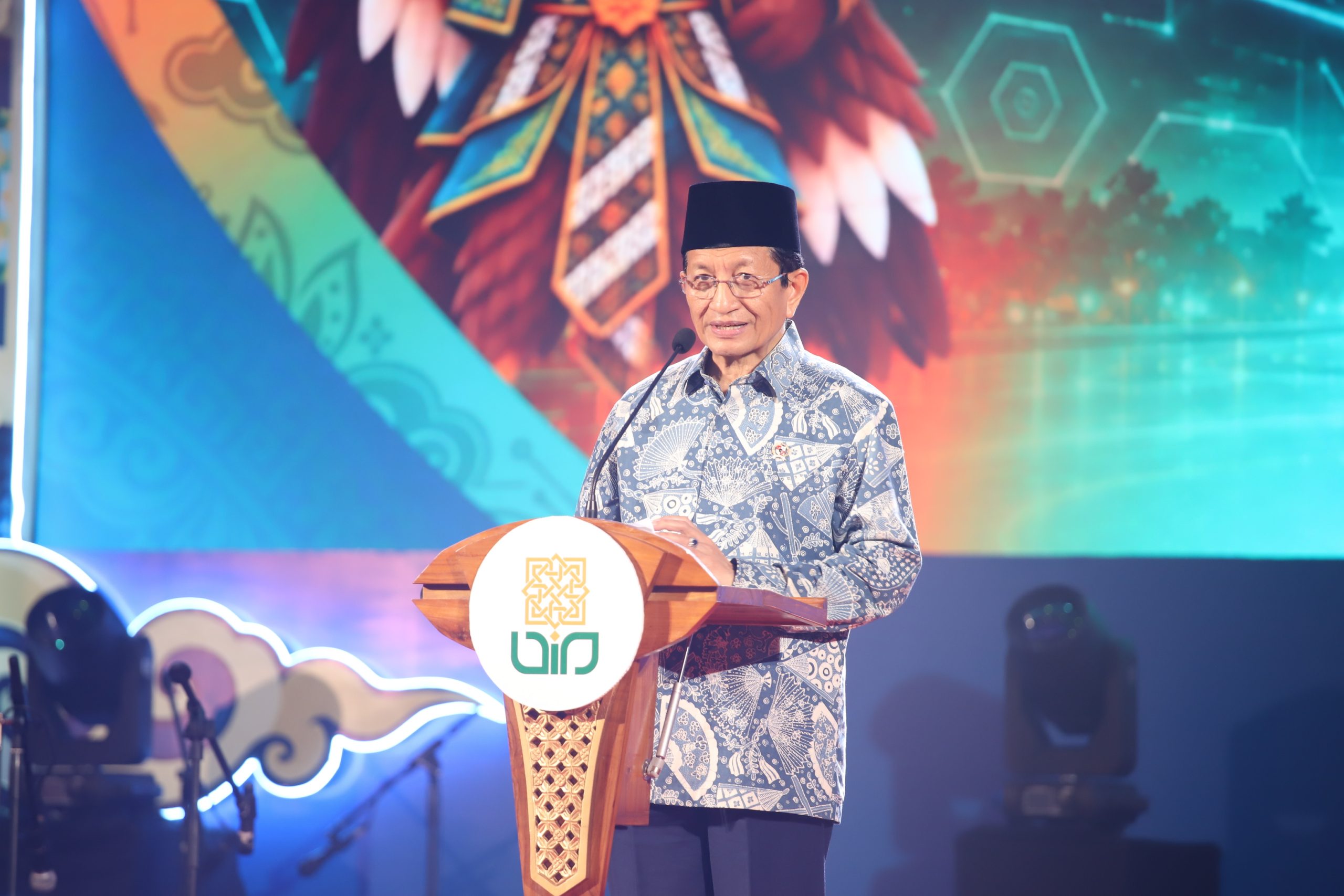
UIN Public Relations – The Minister of Religious Affairs of the Republic of Indonesia, Prof. Dr. H. Nasaruddin Umar, M.A., delivered an important address on the integration of Islamic values, science, and technology at the Third Religion, Science, and Research Olympiad (OASE) for State Islamic Higher Education Institutions (PTKIN). In his presentation, the Minister emphasized that Islam has a long history and a strong tradition of valuing knowledge, research, and creativity.
Furthermore, in his in-depth presentation, the Minister of Religious Affairs explained that the history of Islamic civilization, dating back to the time of the Prophet Muhammad (peace be upon him), has always placed a high value on science and technology.
“So if you’re creative, that’s your stepping stone to finding God, Al-Halim ”(God is the Most Creative), and we are called upon to emulate God’s creative nature,” said Minister of Religious Affairs Nasaruddin Umar in a direct quote.
The Minister of Religious Affairs explained that the Prophet Muhammad (peace be upon him) was not only a spiritual leader but also a figure who was very open to new discoveries and the creativity of his followers. He cited the Prophet’s appreciation for a young man in Medina who created a very bright lamp to illuminate the mosque—an innovation that had never before existed throughout the Arab world. Furthermore, the story of the creation of the first pulpit from a date palm trunk, as well as the initiative of a military architect named Salman al-Farisi in designing defense strategies and digging trenches, proves that Islam has always been grounded in research and intellectual ingenuity.

The Minister of Religious Affairs also explained that Islamic civilization in the past was filled with multi-talented scholars, where great religious scholars were not only well-versed in Islamic jurisprudence or religious studies, but were also experts in fields ranging from medicine and architecture to agricultural engineering and the social sciences. engineering. He gave examples of how the Prophet’s approach to medicine utilized natural ingredients such as garlic, onions, and Zamzam water, as well as innovations in irrigation systems and dam-building techniques to prevent flooding that were far ahead of his time.
Drawing a parallel between that history and the modern era, the Minister of Religious Affairs emphasized the importance of mastering science and technology so that Muslims do not fall behind in the global arena. He highlighted developments in artificial intelligence technology (Artificial Intelligence or AI) up to superintelligence which must be addressed wisely, critically, and innovatively by the nation’s younger generation.
”What you’re seeing here right now isn’t just about images—that’s already been done by a deadly civilization—and this time, science has advanced even further,” the Minister of Religious Affairs said in a direct quote, emphasizing the importance of mastering future research and technology.
After officially opening the event, the Minister of Religious Affairs continued the program by personally touring several exhibition booths set up by contingents from various PTKINs. One of the booths he visited was that of the UIN Sultan Maulana Hasanuddin (SMH) Banten contingent. During the visit, the UIN SMH Banten booth showcased a variety of leading innovative products, including eco smart, Ma’had Profile, pytronic, Hajj Care, including the Falak Qiblah app. The Minister of Religious Affairs commended the students’ creativity, which continues to drive innovation in the fields of technology and the environment.

Through this OASE III PTKIN event, the Minister of Religious Affairs hopes that Islamic universities will continue to transform into centers that nurture resilient scientists, researchers, and innovators capable of balancing deep spirituality with advances in modern science for the benefit of humanity.
The post Indonesian Minister of Religious Affairs Nasaruddin Umar: Follow the Example of the Prophet Muhammad (peace be upon him) as a Pioneer of Science, Technology, and Creative Innovation first appeared on Spirituality, Intellectuality, Professionalism.