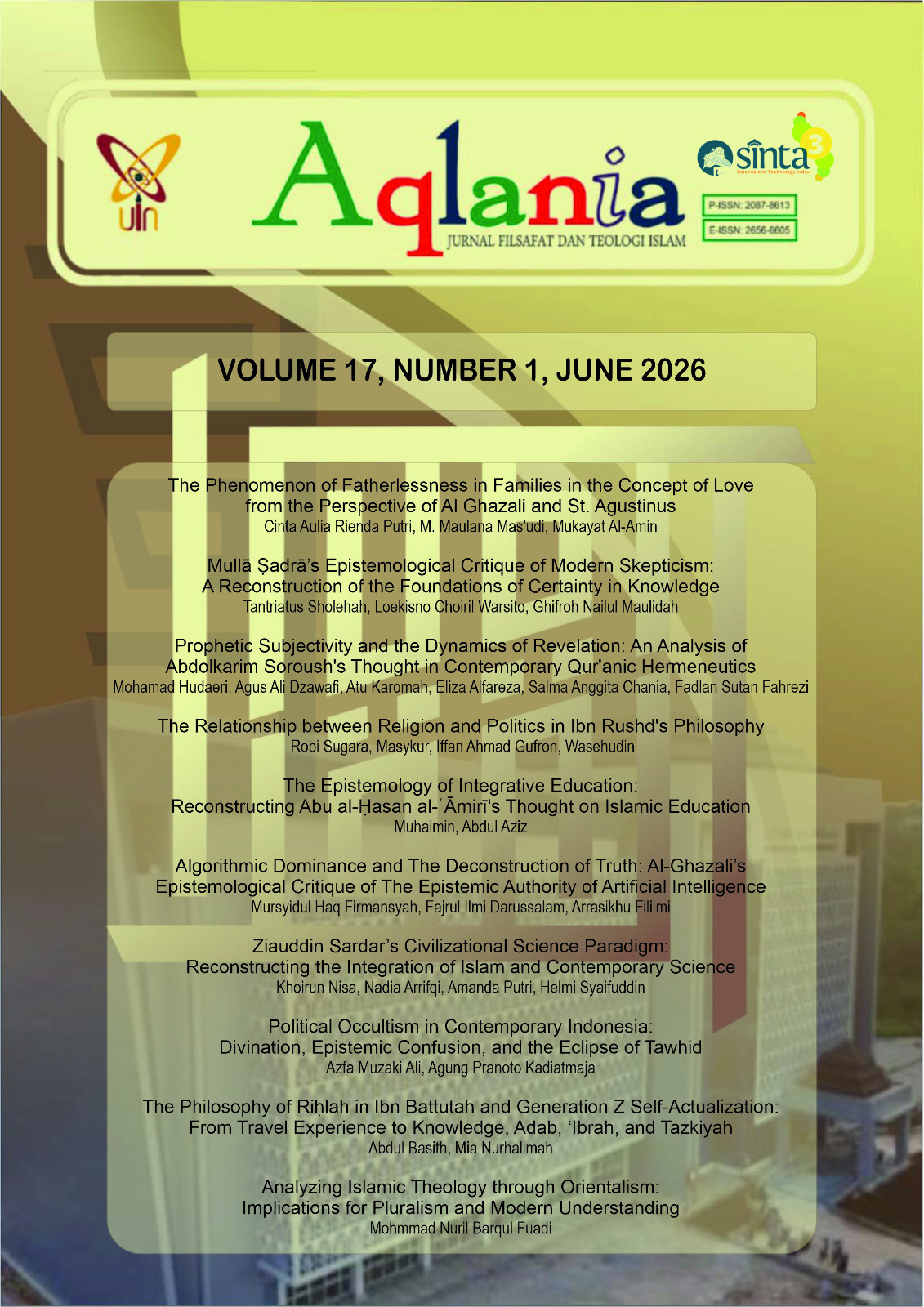
The Epistemology of Integrative Education: Reconstructing Abu al-Ḥasan al-ʿĀmirī's Thought on Islamic Education
DOI:
https://doi.org/10.32678/aqlania.v17i1.281Keywords:
Epistemology of Education, Abū al-Ḥasan al-ʿĀmirī, Islamic Philosophy of Education, Knowledge IntegrationAbstract
The epistemological dichotomy between religious and rational-empirical knowledge remains one of the most fundamental challenges confronting contemporary Islamic education. Against this backdrop, the thought of Abu al-Ḥasan al-ʿĀmirī (d. 381 AH/992 CE) — a fourth-century Muslim philosopher renowned for his integrative intellectual orientation — warrants serious scholarly re-engagement. This article aims to reconstruct al-ʿĀmirī's educational epistemology and to elaborate its relevance for the development of integrative Islamic education. Employing Hans-Georg Gadamer's philosophical hermeneutics within a qualitative library research framework, the study undertakes a close reading of al-ʿĀmirī’s works while engaging them in critical dialogue with an epistemology in education framework. The findings reveal that al-ʿĀmirī constructs an epistemology grounded in four complementary sources of knowledge: rational axioms (badihiyyāt al-ʿaql), empirical observation (tajribah), revelation (wahy), and practical capacity (quwwah ṣināʿah). Rather than treating these sources as hierarchically exclusive, he presents them as mutually reinforcing constituents of a unified epistemic framework. Within this structure, al-ʿĀmirī distinguishes between milliyyah sciences (religious) and hikmiyyah sciences (rational), while firmly rejecting any essential opposition between them on the grounds that rational truth and revealed truth ultimately share the same ontological source. His educational paradigm is subsequently elaborated through three interlocking concepts — taʾdīb, tarbiyah, and siyāsah — which collectively orient the educational process toward the actualization of the rational soul and the attainment of true happiness (al-saʿādah). The study concludes that al-ʿĀmirī's educational epistemology is not merely a historical-philosophical legacy, but offers a normatively significant and practically relevant conceptual framework for addressing the crisis of orientation in contemporary Islamic education.
Downloads
Downloads
Published
Issue
Section
License
Copyright (c) 2026 Muhaimin, Abdul Aziz (Author)

This work is licensed under a Creative Commons Attribution 4.0 International License.