

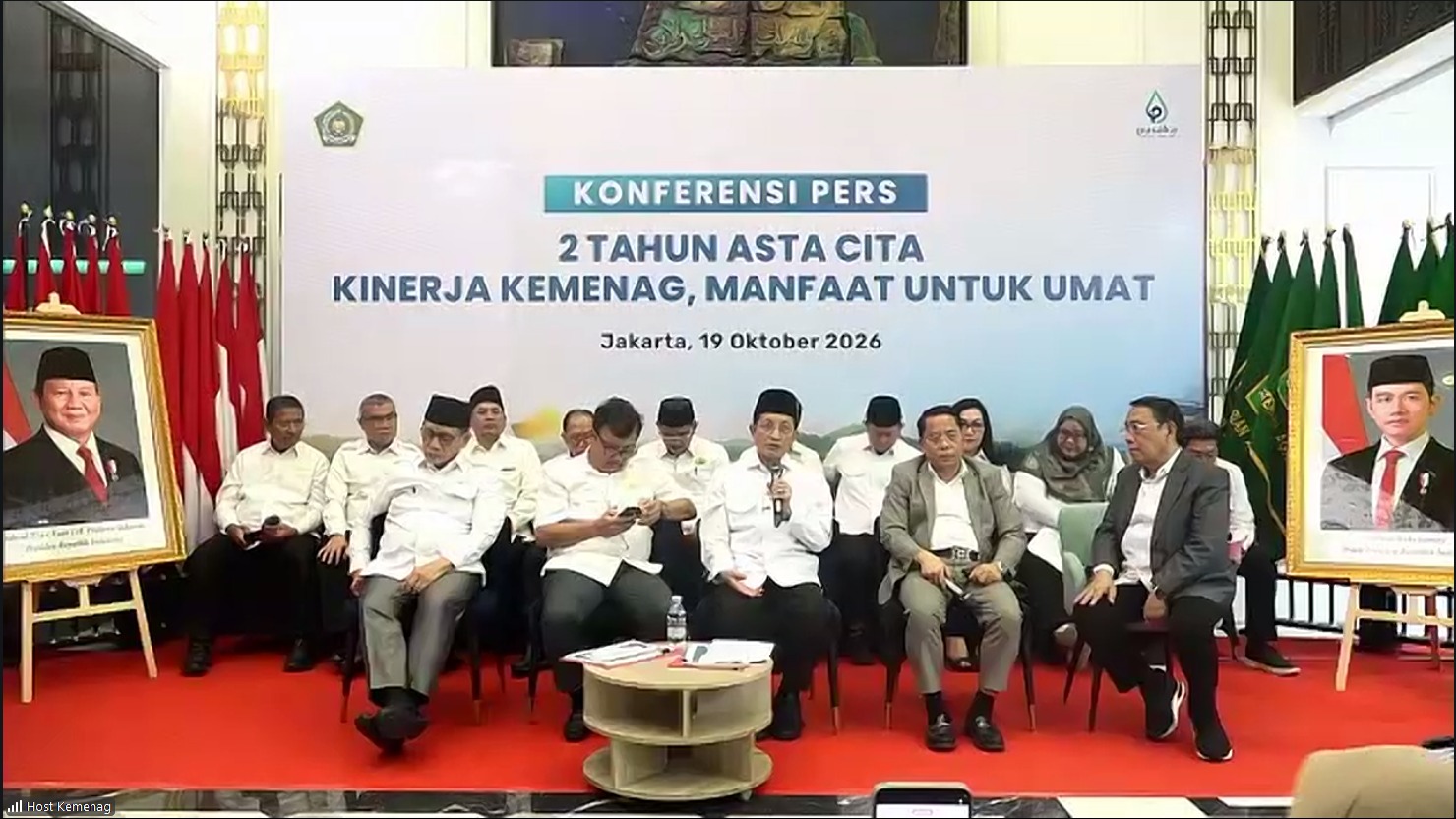
UIN Public Relations – The Ministry of Religious Affairs (Kemenag) of the Republic of Indonesia held a press conference titled “Two Years of the Ministry of Religious Affairs” Asta Cita Performance: Benefits for the Faithful” The event, held in a hybrid format from Jakarta, was attended by senior officials from the central Ministry of Religious Affairs, leaders of State Religious Universities (PTKN), and heads of regional offices of the Ministry of Religious Affairs from across Indonesia. Monday (October 19, 2026).
The purpose of this press conference is to present, in a comprehensive, transparent, and accountable manner, the Ministry of Religious Affairs’ various priority programs and strategic achievements. All of these programs are focused on having a direct impact on the public in support of the Asta Cita of the President and Vice President of the Republic of Indonesia.
In his presentation, Minister of Religious Affairs Nasaruddin Umar explained that the Ministry of Religious Affairs is promoting an eco-theology program to foster ecological awareness among the public through an approach based on religious values.

“We have introduced a very new concept at the Ministry of Religious Affairs, namely eco-theology. Public awareness of the need to protect the environment is very high when conveyed through religious language. In Islam, for example, one must recite the basmalah before slaughtering an animal. This religious language is very important,” said the Minister of Religious Affairs.
Philanthropic Achievements and Educational Assistance Programs
As part of its efforts to implement programs that have a direct impact on the welfare of the people and the development of high-caliber human resources, the Ministry of Religious Affairs has recorded significant improvements in the management of religious social funds and in the education sector over the past two years:
1. Religious Philanthropy: National zakat collections totaled Rp44.6 trillion. Meanwhile, philanthropic funds from the Christian community totaled Rp6.16 billion, from the Buddhist community Rp11 billion, and from the Hindu community Rp3.17 billion.
2. Waqf & the Muslim Community’s Economy: Cash waqf contributions totaled Rp4.7 trillion for community empowerment, while the number of waqf land parcels grew to 467,237. The Ministry of Religious Affairs also manages 287 economy-based KUA offices and 25 Waqf Cities.
3. Educational Assistance: Disbursements under the Indonesia Pintar (PIP) Program totaled Rp4.038 trillion, and those under the KIP Kuliah Program totaled Rp3.303 trillion.
4. Scholarships & Educator Welfare: A total of 3,659 students received scholarships worth Rp1.3 trillion. A welfare budget of Rp19 trillion was allocated for 452,790 teachers and university lecturers, and Rp25 trillion for madrasah teachers and interfaith religious education instructors.
5. Madrasah Revitalization: A total of 857 madrasahs received PHTC grants totaling Rp214 billion, and 80 madrasahs received funding for the revitalization of facilities and infrastructure totaling Rp169 billion.
In addition, the Ministry of Religious Affairs has also prepared standardized sermon materials focusing on environmental conservation, corruption prevention, and the strengthening of social solidarity. The Minister of Religious Affairs also highlighted the role of thousands of mosques that have been repurposed as service centers for the annual homecoming migration and as disaster response centers.
“A mosque is not just a place of worship, but also a place to help and empower the community. More than 6,000 mosques across Indonesia served as homecoming hubs and played a vital role in fostering social cohesion and reducing the number of accidents,” he emphasized.
Strengthening Harmony, Empowering Islamic Boarding Schools, and 3T Services
To ensure that religious programs have an equitable impact all the way down to the grassroots level, the Ministry of Religious Affairs has also established a number of strategic priorities:
1. Strengthening Harmony and Humanitarianism: The quality of interfaith harmony is enhanced through the integration of a curriculum based on humanitarianism into educational institutions, as well as by optimizing the role of the KUA in the early detection of potential conflicts with religious dimensions.
2. Empowerment and Self-Reliance of Islamic Boarding Schools: Accelerating business incubation programs at Islamic boarding schools to promote economic self-reliance, as well as establishing quality standards and securing global recognition for graduates of Islamic boarding schools.
3. Inclusive Religious Services in 3T Regions: Expanding access to religious services in Disadvantaged, Frontier, and Outermost (3T) regions, along with the provision of sacred texts and disability-friendly religious reading materials to strengthen equitable religious literacy.
4. Digitalization of Governance: Comprehensive integration of the Ministry of Religious Affairs’ service database systems to ensure that public policy interventions are transparent, swift, and well-targeted.
Commitment to Addressing Sexual Violence and Disaster Response
In response to the issue of sexual violence in religious educational institutions, the Ministry of Religious Affairs has reaffirmed its uncompromising commitment to providing a safe learning environment for students.
Deputy Minister of Religious Affairs, Romo H. R. Muhammad Syafi’i, stated that the Ministry of Religious Affairs has imposed severe sanctions, including the revocation of operating licenses, on institutions that have violated the regulations.
“The decisive action taken in Bekasi serves as an example that we have implemented operational guidelines (juklak) and technical guidelines (juknis) to impose strict sanctions on perpetrators and institutions. Perpetrators will never again be allowed to work as caregivers or teachers, and psychological testing has also been implemented this school year,” explained the Deputy Minister of Religious Affairs.
The Ministry of Religious Affairs is also ensuring the protection and continuity of education for Islamic boarding school students, including by facilitating distance learning for schools and madrasahs in areas affected by environmental disasters, such as the haze in Kalimantan.

At the end of the event, the Minister of Religious Affairs expressed his appreciation to the media and all staff of the Ministry of Religious Affairs. He reaffirmed the Ministry’s commitment to continuing to oversee a harmonious institutional transition and to ensuring that all religious services and education bring the widest possible benefits to all religious communities in Indonesia.
The post In Support of the Presidential and Vice Presidential Agenda, the Ministry of Religious Affairs Focuses on Implementing Programs That Make a Difference for the Muslim Community first appeared on Spirituality, Intellectuality, Professionalism.


