

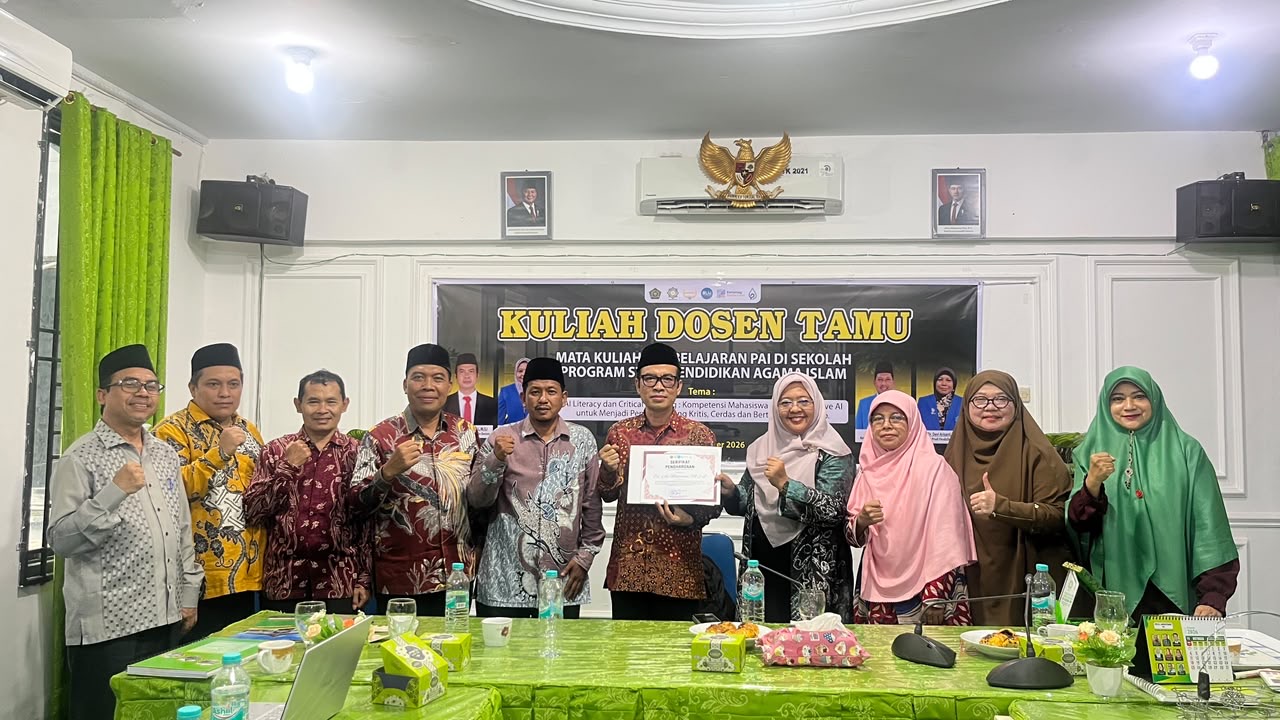
UIN Public Relations – Dr. Ali Muhtarom, Vice Rector II of UIN Sultan Maulana Hasanuddin Banten, encourages students to use artificial intelligence (AI) critically, intelligently, and responsibly.
Dr. Ali Muhtarom made these remarks while serving as a guest lecturer at a hybrid event hosted by UIN Sultan Syarif Kasim Riau on Friday, October 9, 2026. In front of hundreds of students, faculty members, and staff at UIN Riau, Dr. Ali discussed AI literacy and critical thinking as essential competencies in the era of generative AI (GenAI).
In his explanation, Dr. Ali Muhtarom said that the development of AI has changed the way students obtain information, study course material, and complete academic assignments. While it offers convenience, this technology also poses challenges to students’ ability to think independently and to the quality of learning.
“Students need to understand how AI works and its limitations, use it to support their learning, and evaluate the information it generates before relying on it as a basis for knowledge or decision-making,” he said.
Dr. Ali then highlighted the tendency of students to increasingly rely on technology to get instant answers, without always reading the original sources or verifying the accuracy of the information.

He also posed reflective questions about the learning process in the age of AI.
“If a professor creates questions using AI, and then students answer those questions with the help of AI, who is actually learning?” he said.
Dr. Ali Muhtarom noted that technological conveniences do not guarantee that students truly understand the material. Therefore, the learning process and assessment system must take into account students’ reasoning skills, conceptual understanding, and accountability for their work.
Furthermore, Dr. Ali emphasized that AI should assist lecturers and teachers in their work, not replace their role in education. This technology, Dr. Ali said, can be used to prepare course materials, design Semester Learning Plans (SLPs), develop teaching materials, create exam questions, and even provide initial feedback on student assignments.
AI can also assist with literature reviews, the drafting of scientific papers, and administrative tasks. For students, AI can serve as a personal tutor to help them understand concepts, create practice problems, summarize material, find research references, and improve the structure and grammar of their writing.
However, students must still be actively involved in the learning process and verify the accuracy of the information they receive.
“AI should help students understand problems, not take over the entire thought process and complete assignments without understanding,” said Dr. Ali.
The Importance of Critical Thinking
During the guest lecture, Dr. Ali Muhtarom also explained the importance of mastering AI competencies for students and prospective teachers through two frameworks: the AI Competency Framework for Students (AI CFS) and the AI Competency Framework for Teachers (AI CFT).
The AI CFS framework covers four competency areas across three levels: understand, apply, and create. Meanwhile, the AI CFT framework covers five domains across the levels of acquire, deepen, and create.
“Both of these frameworks emphasize the importance of a human-centered mindset, AI ethics, technological proficiency, and their application in learning,” he said.
On a practical level, Dr. Ali proposes six cognitive skills involved in critical thinking: interpretation, analysis, evaluation, inference, explanation, and self-regulation.
These skills help students understand information, evaluate arguments, assess the credibility of sources, draw conclusions based on evidence, and refine their own thinking processes.
“With these skills, students are expected not to simply accept the answers generated by AI, but to be able to verify sources, identify biases, and justify the decisions they make,” he explained.
The guest lecture for the Islamic Religious Education (PAI) course at the school was organized by the PAI Study Program at UIN Riau. The event also featured the Dean of the Faculty of Tarbiyah and Teacher Education, Prof. Dr. Amirah Diniaty, M.Pd., Kons.; the Chair of the PAI Program, Dr. Idris, M.Ed.; and the Secretary of the PAI Program, Dr. Devi Arisanti, M.Ag.
The post UIN Banten’s Vice Rector II Encourages Students to Use AI Critically, Intelligently, and Responsibly first appeared on Spirituality, Intellectuality, Professionalism.