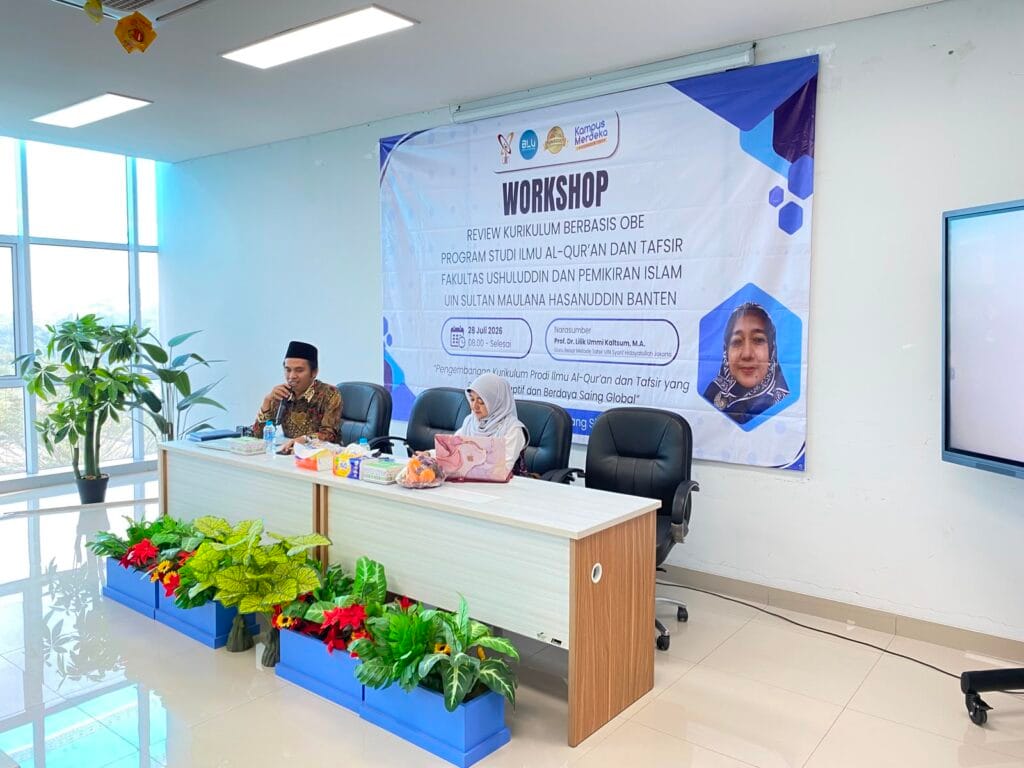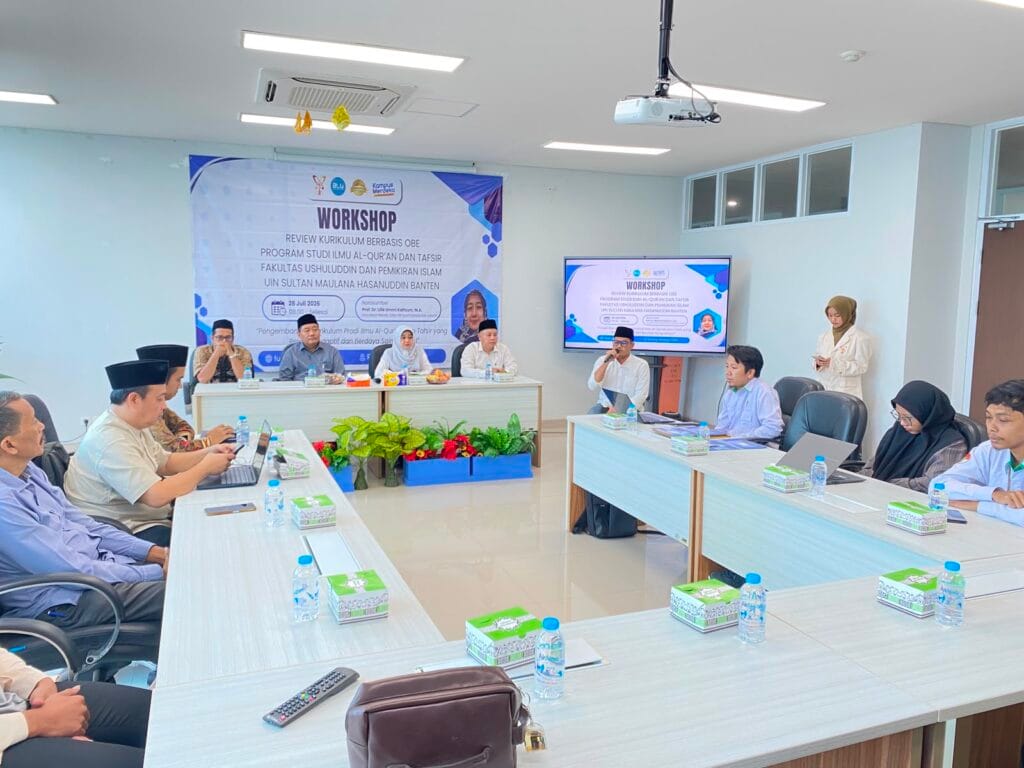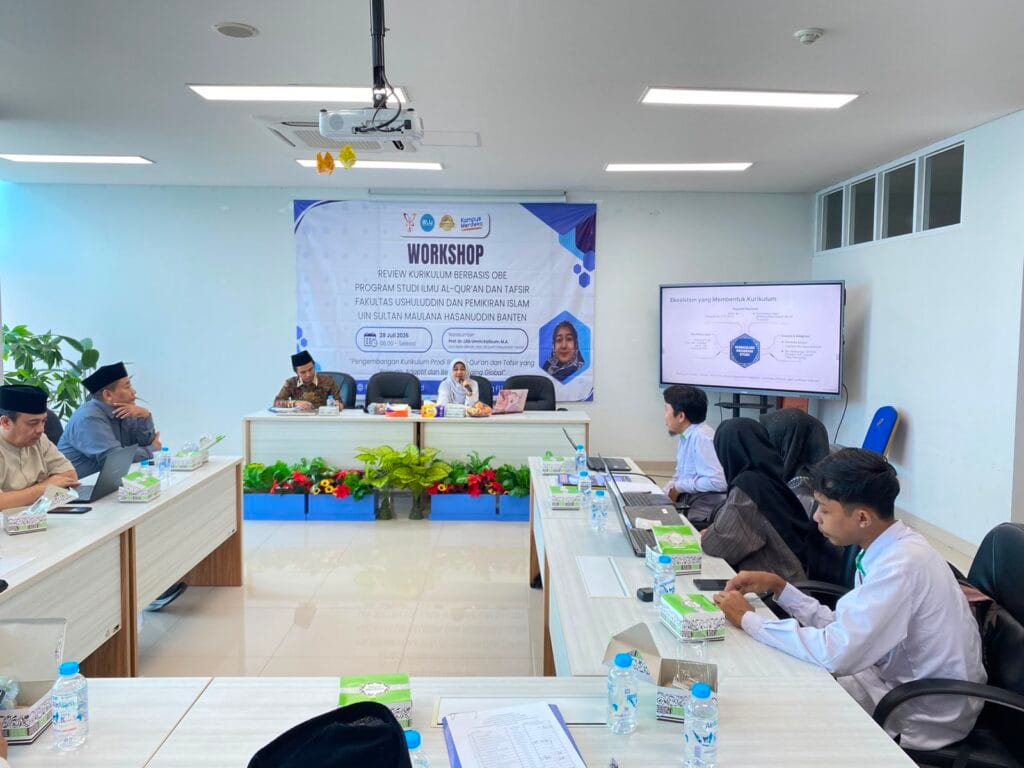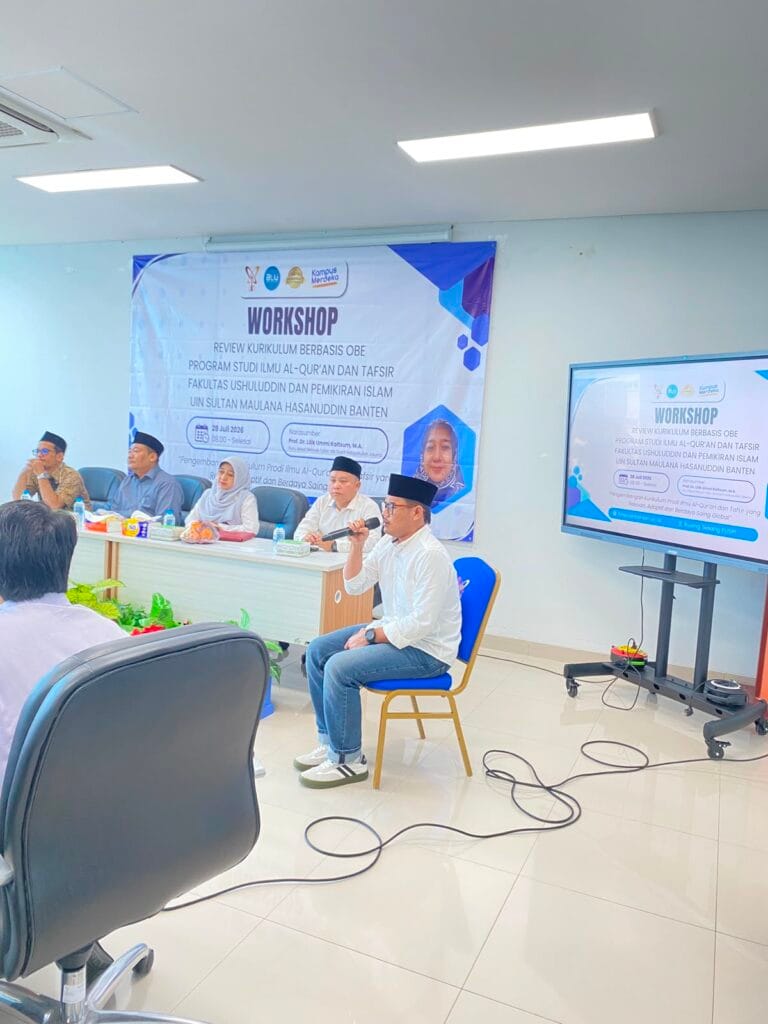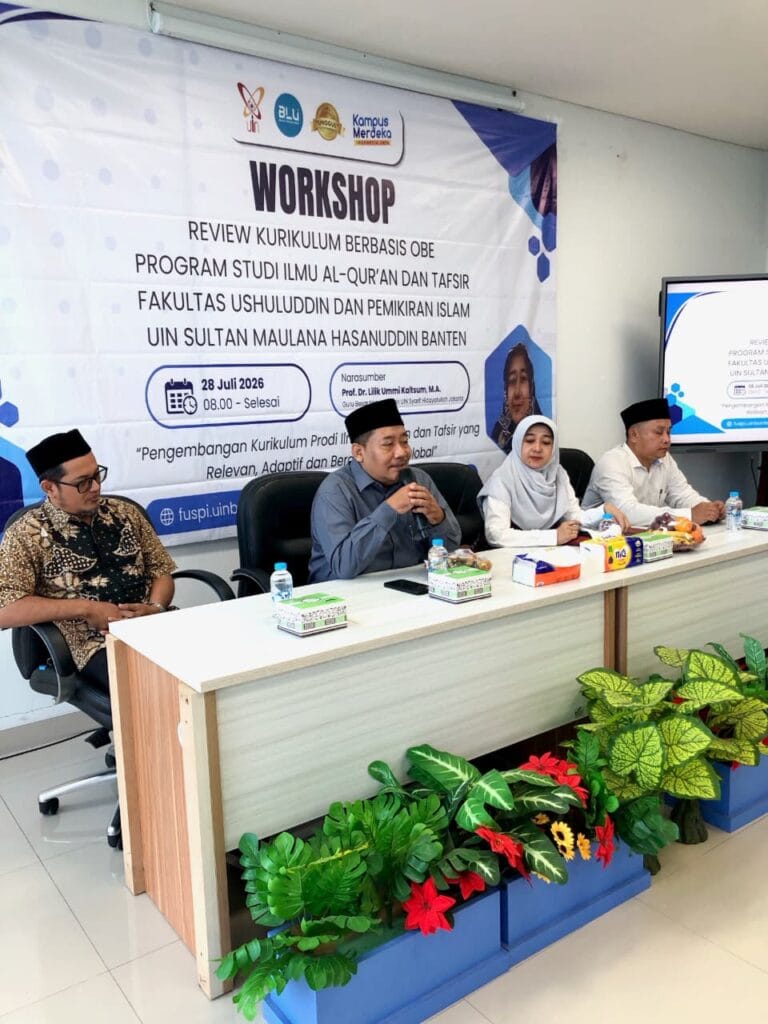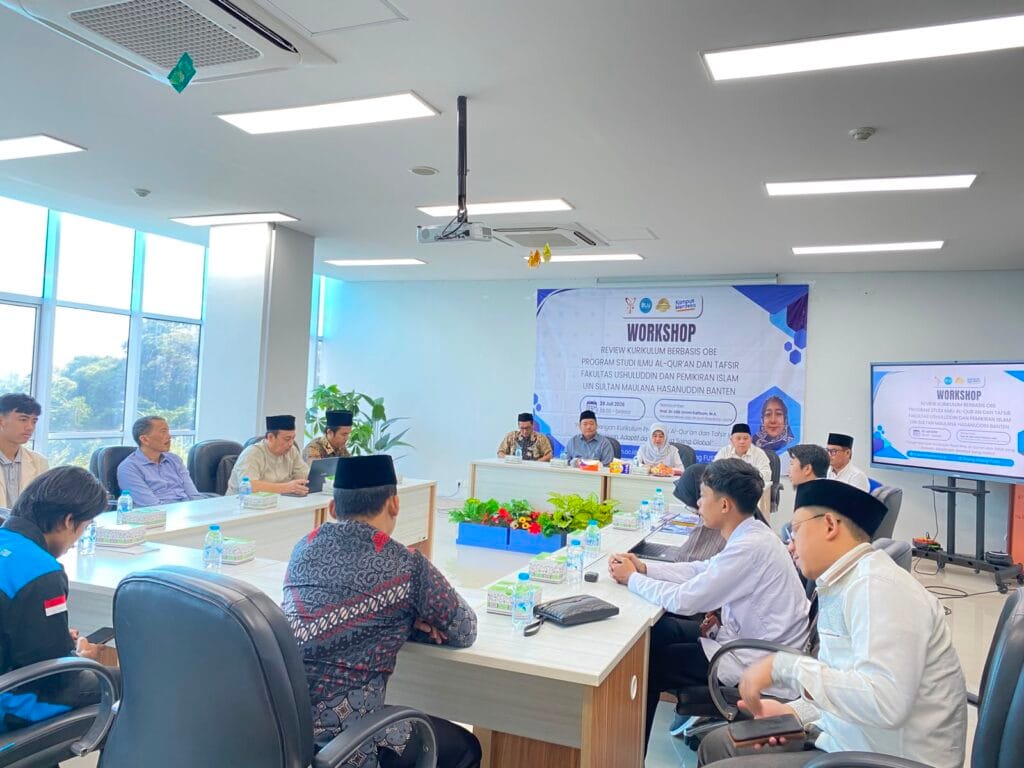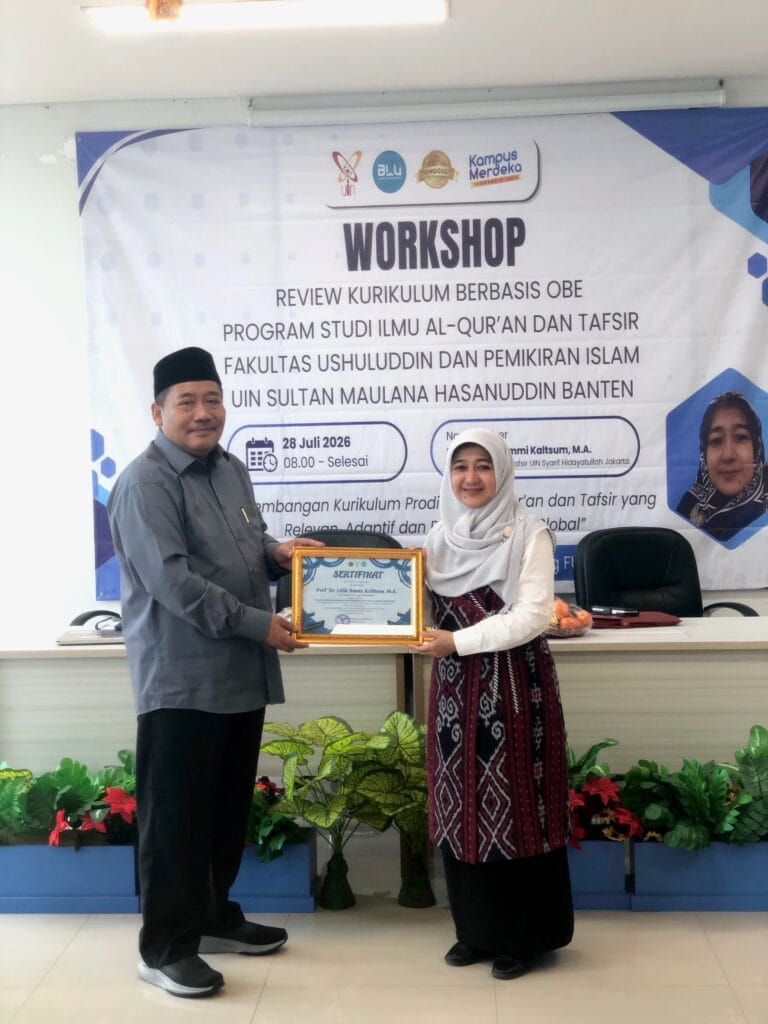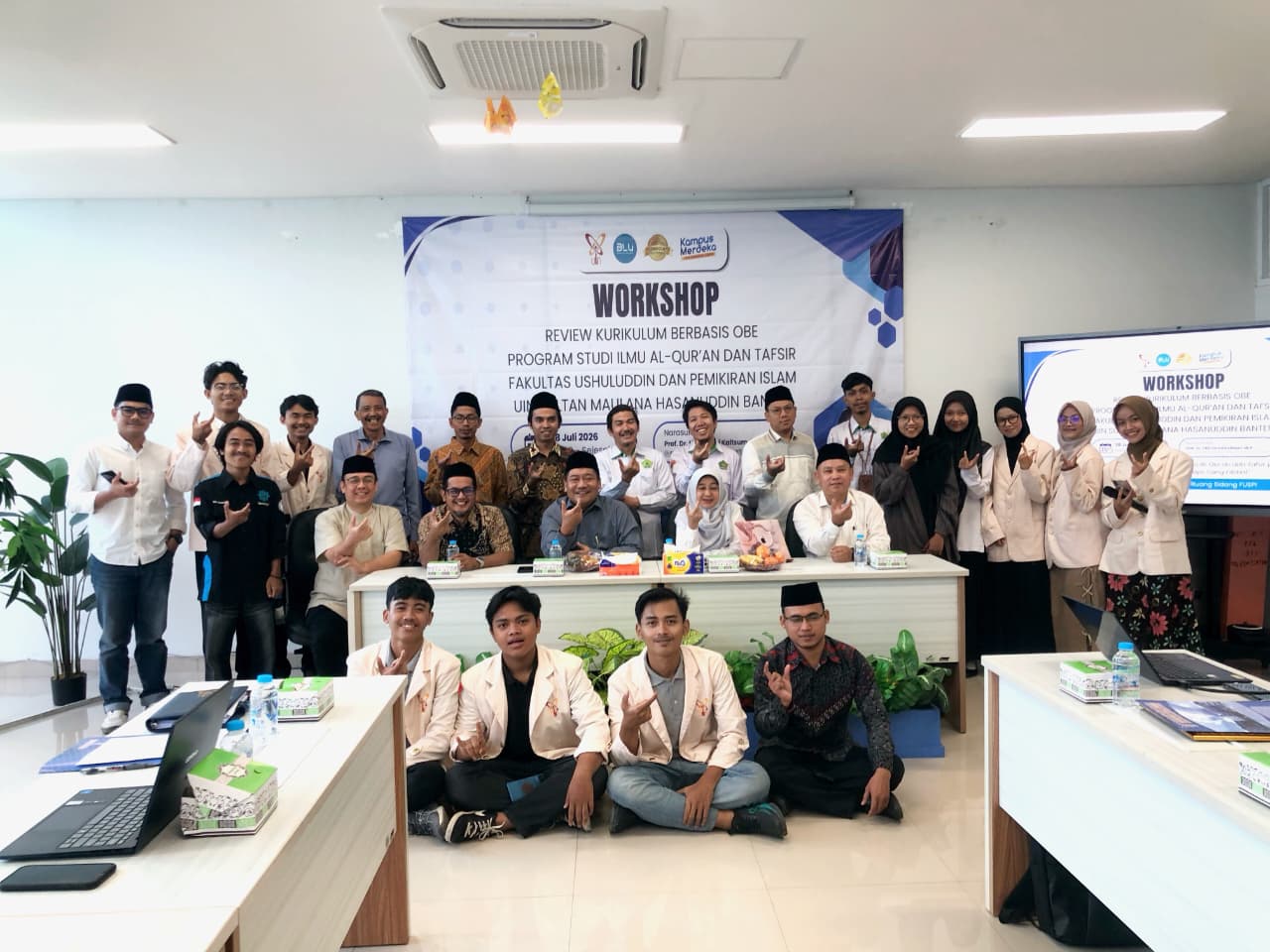
On the day Tuesday, July 28, 2026, located at Conference Room of the Faculty of Ushuluddin and Islamic Thought (FUSPI) at UIN Sultan Maulana Hasanuddin Banten, has been held Workshop on Reviewing the Outcome-Based Education (OBE) Curriculum initiated by the Al-Qur’an and Tafsir Studies Program as part of its commitment to improving academic quality, evaluating and refining the curriculum, and aligning the program’s development direction with advancements in knowledge, higher education regulations, community needs, and the demands of the workforce. This initiative aims to produce a curriculum that is relevant, adaptive, innovative, and focused on graduate learning outcomes, thereby producing graduates who possess academic and professional competencies and are competitive both nationally and globally, without compromising Islamic values and the scholarly traditions of the Qur’an and Tafsir.
The workshop begins at 8:00 a.m. WIB and attended by the First Associate Dean, Second Associate Dean, and Third Associate Dean; the Chair and Secretary of the Al-Qur’an and Tafsir Studies Program; the Chair of the Al-Qur’an and Tafsir Studies Student Association; faculty members, administrative staff, student representatives, alumni, and stakeholders (stakeholders). Appearing as a guest speaker Prof. Dr. Lilik Ummi Kaltsum, M.A., Professor of Exegesis Methods at UIN Syarif Hidayatullah Jakarta, with the moderator Hikmatul Luthfi, M.A. in Humanities.
The series of activities began with participant registration, opening remarks by the emcee, a recitation of verses from the Qur’an, the singing of the national anthem “Indonesia Raya” and the UIN Sultan Maulana Hasanuddin Banten anthem, and a prayer. The event then continued with welcome remarks and official opening by Dr. H. Masrukhin Muhsin, Lc., M.A. as First Vice Dean of the Faculty of Ushuluddin and Islamic Thought at UIN Sultan Maulana Hasanuddin Banten.
In his remarks, he expressed his appreciation to the Al-Qur’an and Tafsir Studies Program for organizing the Outcome-Based Education (OBE) Curriculum Review Workshop as a demonstration of its commitment to improving the quality of education, academic standards, and program governance. He emphasized that curriculum review is a necessity that must be conducted periodically to keep pace with developments in science, technology, higher education policy, community needs, and the ever-evolving dynamics of the workforce. According to him, the implementation Outcome-Based Education (OBE) It is not merely intended to meet accreditation requirements or government regulations, but rather to serve as a strategy for building an education system focused on graduate quality. The curriculum must be systematically designed—from the graduate profile, Graduate Learning Outcomes (GLOs), course structure, teaching methods, to the assessment system—so that it can produce graduates who possess academic competence, professional skills, and academic integrity, and who are capable of making tangible contributions to society.
He also emphasized that the Qur’anic Studies and Exegesis Program bears a great responsibility to produce graduates who not only possess an in-depth mastery of exegetical methodology and Qur’anic sciences, but also possess critical thinking skills, digital literacy, research capabilities, scientific communication skills, the ability to adapt to technological advancements, and a commitment to upholding the values of the Qur’an in social life. Therefore, curriculum development must be carried out collaboratively by involving faculty members, students, alumni, employers of graduates, and various stakeholders so that the resulting curriculum is truly capable of addressing current needs and future challenges. At the end of his remarks, he invited all participants to make the workshop a productive academic forum for generating the best recommendations for the curriculum development of the Qur’anic Studies and Exegesis Program, and then officially opened the event by saying In the name of Allah, the Most Gracious, the Most Merciful.
Following the official opening, the event moved on to the main session, which was led by Hikmatul Luthfi, M.A. in Humanities. as the moderator. He introduced the speakers and their academic backgrounds, explained the workshop procedures, and encouraged all participants to actively engage in the session by asking questions and offering constructive criticism and suggestions as part of the process of refining the curriculum for the Al-Qur’an and Tafsir Studies Program.
In his presentation, Prof. Dr. Lilik Ummi Kaltsum, M.A. explains that Outcome-Based Education (OBE) is an educational approach that focuses on learning outcomes (learning outcomes), so the entire learning process must be designed based on the competencies students are expected to possess upon completing their education. He emphasized that the implementation of OBE requires paradigm shift (paradigm shift) in the administration of higher education, namely a shift in focus from What the professor teaches become What can college students actually do after graduation?. The success of learning is no longer measured by the amount of material covered, but by graduates’ ability to apply their knowledge, demonstrate their skills, think critically, solve problems, collaborate, communicate scientifically, and provide solutions to various issues facing society.
He also emphasized that Outcome-Based Education is not merely a change in the format of the Semester Learning Plan (RPS) or making administrative changes to learning materials. OBE represents a fundamental shift in the way instructors think about designing the learning process. The learning paradigm must shift from focuses on what is taught (teaching-centered) become focuses on what students are actually capable of doing after graduation (student outcomes). Therefore, every learning activity, teaching method, assignment, project, lab exercise, and evaluation system must be designed to support the achievement of graduate competencies in a tangible and measurable way.
Furthermore, the source explained that the implementation of OBE is based on the principle of constructive alignment, namely the development of a curriculum that designed from the finish line (designing backward). Curriculum development does not begin with a list of courses, but rather with the graduate competencies to be achieved. The first step is Establishment of the Graduate Profile, namely defining the characteristics, competencies, and roles of graduates in society. The second stage is the development of Graduate Learning Outcomes (GLO) which translates the graduate profile into measurable competencies in the areas of attitude, knowledge, general skills, and specialized skills. The third stage is the development of Subject of Study, namely the academic scope required to support the achievement of CPL. Next, a plan was designed Course Structure and Credit Hours that systematically supports each learning outcome. The final step is the development of Semester Course Plan (RPS) which includes the CPMK, learning strategies, assessment methods, student learning experiences, and learning outcome indicators aligned with the Graduate Profile and CPL. With this approach, all curriculum components are interconnected, and each course makes a clear contribution to the achievement of graduate competencies.
The source also emphasized that the process Curriculum Review for the Study Program must be carried out comprehensively, taking into account developments in the disciplines of Qur’anic studies and exegesis and drawing on various national regulations, among others National Standards for Higher Education (SN-Dikti), Indonesian National Qualifications Framework (KKNI), policy Outcome-Based Education (OBE), as well as policies Freedom to Learn, Freedom for Universities (MBKM). In accordance with these regulations, the curriculum is expected to have a strong academic foundation, meet higher education quality standards, and support improvements in the quality of graduates and the accreditation of academic programs.
On the other hand, he emphasized that curricular innovation must not eliminate local identity which are the distinctive features of both the study program and the institution. The curriculum must continue to accommodate Islamic values, the local wisdom of Banten, the academic culture of UIN Sultan Maulana Hasanuddin Banten, and the traditions of Islamic scholarship that have developed within the community. Strengthening local identity is viewed as a crucial element so that graduates not only possess a global perspective but are also capable of preserving, developing, and actualizing local values as a form of contribution to the development of society and Islamic civilization.
Following the presentation of the material, the event continued with a discussion session led by a moderator. The participants—comprising faculty members, educational staff, students, alumni, and stakeholders—shared various perspectives and provided feedback on the implementation of OBE, the development of CPLs and CPMKs, the evaluation of the curriculum structure, and the application of constructive alignment, aligning the curriculum with national regulations, strengthening learning innovations, and strategies for preserving local identity amid the demands of globalization in higher education. The discussion was active, dynamic, and constructive, resulting in various recommendations that will serve as the basis for refining the curriculum of the Qur’anic Studies and Exegesis Program to make it more relevant, adaptive, innovative, and high-quality, as well as capable of producing outstanding graduates who embody Qur’anic values, are competitive, and ready to face the challenges posed by advancements in science and technology, as well as the needs of students in the Qur’anic Studies and Exegesis program.