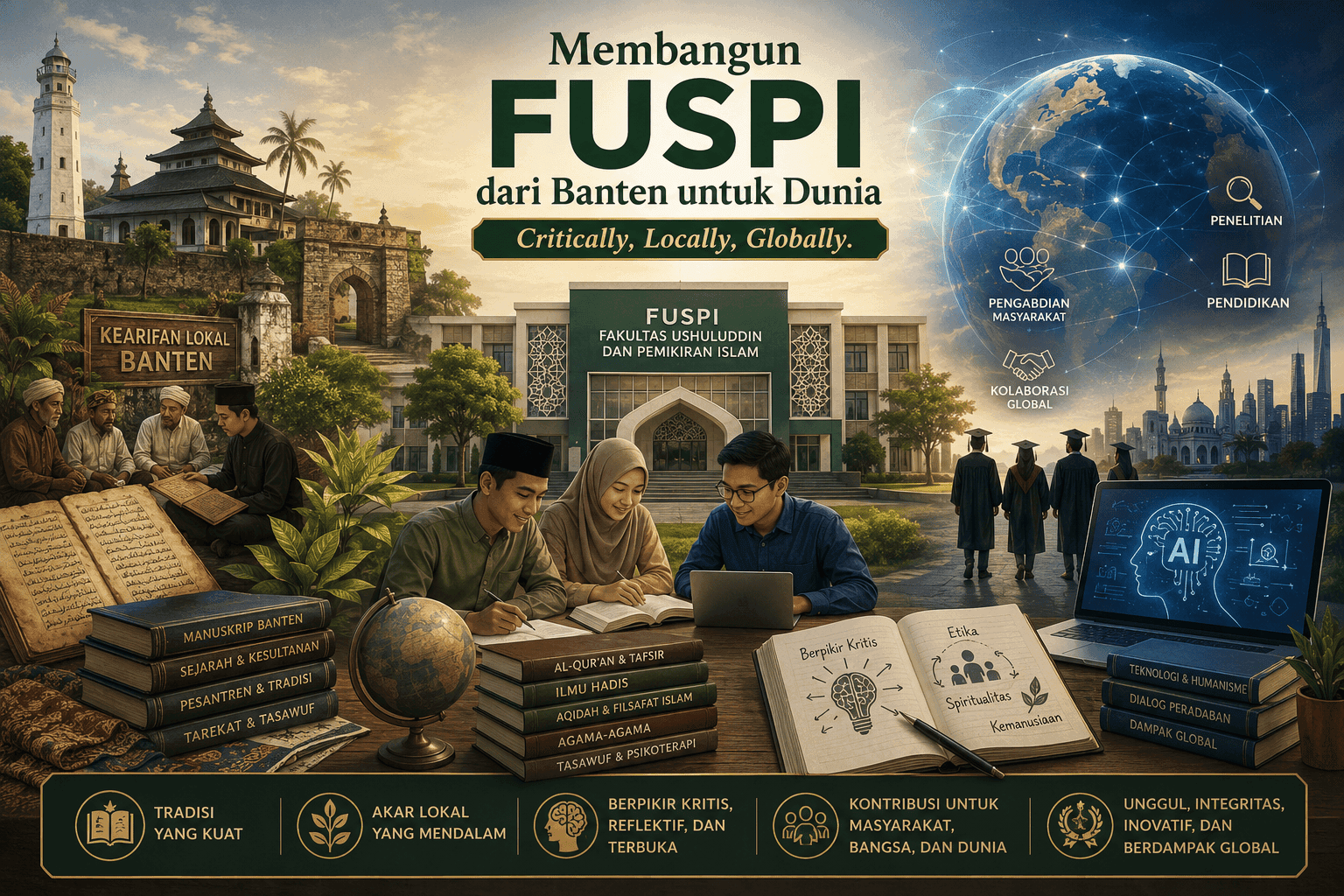
July 1, 2026, marked an important milestone in the institutional history of UIN Sultan Maulana Hasanuddin Banten. The inauguration of the Dean of the Faculty of Adab and Humanities by the Rector, Prof. Dr. H. Muhammad Ishom, M.A., also marked the beginning of a new chapter for the Faculty of Ushuluddin and Islamic Thought—hereinafter referred to as FUSPI—as an independent faculty.
The establishment of FUSPI is not merely a change in organizational structure or an administrative separation. The founding of this new faculty marks the emergence of intellectual, academic, and social responsibilities. FUSPI must serve as a hub for the development of Islamic studies and Islamic thought—one capable of preserving traditions, interpreting change, and providing ethical guidance for society.
That spirit is encapsulated in the slogan “Critically, Locally, Globally.” This slogan reflects FUSPI’s academic character and direction of development.
Critically means fostering a tradition of critical, reflective, methodological, and open-minded thinking.
Locally This means using Banten’s rich history, culture, religious traditions, and local wisdom as the foundation for the advancement of knowledge.
As for globally This means bringing FUSPI’s achievements in education, research, and community service into national and international academic discourse.
Addressing Local, National, and Global Challenges
FUSPI was established in Banten, a region with deep historical roots in Islam. The Sultanate of Banten, the network of Islamic scholars and Islamic boarding schools, Sufi traditions, religious manuscripts, indigenous communities, and the religious life of the people constitute an intellectual heritage that has not yet been fully developed into a center for the production of knowledge.
However, today’s Banten is not just the Banten of the past. Banten is also facing urbanization, industrialization, population migration, digital transformation, changes in religious authority, and the rise of popular culture among the younger generation. People live amid a rapid flow of information, but this is not always accompanied by deep knowledge and spiritual maturity.
In this local context, FUSPI must be able to bridge the gap between religious texts and the realities of society. Local wisdom must not remain merely a symbol or an institutional slogan. It needs to be researched, documented, critically examined, and developed into a resource for education, the strengthening of social harmony, environmental conservation, cultural development, and community empowerment.
At the national level, Islamic religious universities face demands to improve the quality of their graduates, accreditation, curriculum relevance, research productivity, institutional innovation, and tangible contributions to society.
The disciplines of usul al-din should not be perceived as fields that deal solely with issues of the past. The study of the Qur’an, hadith, creed, philosophy, Sufism, and religious studies must be present to address national issues, such as intolerance, moral crises, environmental degradation, religious disinformation, social polarization, and the weakening of the public’s critical thinking skills.
Global challenges are also becoming increasingly complex. Advances in artificial intelligence have transformed the way people search for information, read texts, write, conduct research, and establish knowledge authority.
Humanitarian conflicts, climate change, global inequality, identity crises, and international competition require an approach that is not only technological, but also philosophical, ethical, spiritual, and humanistic.
This is where FUSPI plays a strategic role. The world needs not only people who are skilled at using technology, but also people who are capable of assessing the purpose, impact, and moral responsibilities associated with the use of that technology.
FUSPI must produce graduates who possess a deep understanding of tradition, the courage to think critically, social awareness, and the ability to communicate in a global context.
Vision as a Guide for Development
FUSPI has established the following vision:
“To become a leading Faculty of Islamic Theology and Thought in the advancement of Islamic scholarship and Islamic thought through initiatives grounded in the local wisdom of Banten that have a global impact.”
This vision affirms that FUSPI’s excellence must be built through educational quality, academic integrity, research productivity, professionalism in service, and the ability to generate innovation.
Islamic scholarship and Islamic thought are not only inherited but also developed through dialogue with philosophy, psychology, culture, the social sciences, technology, ecology, and various humanitarian issues.
Banten’s local wisdom serves as an epistemological and social foundation. The traditions of the ulama, Islamic boarding schools, sultanates, indigenous communities, local languages, manuscripts, and the community’s religious experiences must serve as sources for research and learning.
However, being grounded in one’s local context does not mean being insular. A strong local identity is, in fact, an asset for building a dialogue of equals with the global academic community.
This vision is realized through education and teaching that are excellent, integrative, transformative, and focused on building national and international reputation.
The research is aimed at producing knowledge and studies in Islam, culture, language, history, philosophy, and the humanities based on the local wisdom of Banten.
Community service is fostered through recognition, collaboration, the dissemination of scientific knowledge, publications, academic networking, and impactful institutional innovation.
The entire process is supported by a faculty governance system that is professional, accountable, transparent, participatory, adaptive, and oriented toward sustainable quality and the principles of good university governance.
From Three to Five Academic Programs
Currently, FUSPI offers three degree programs, namely:
- Qur’anic Studies and Exegesis;
- The Science of Hadith; and
- Islamic Theology and Philosophy.
Under the strategic plan, these three academic programs will be expanded to five through the launch of:
- Religions Studies Program; and
- Sufism and Psychotherapy Program.
This development is not merely about increasing the number of degree programs. The study of religions is necessary to produce graduates who are capable of understanding diversity, managing differences, fostering dialogue, and strengthening peaceful social life.
Sufism and psychotherapy are necessary to address the needs of modern society, which is grappling with anxiety, alienation, a loss of meaning, and the pressures of life. Sufism needs to be developed in dialogue with psychology, counseling, mental health, and community support.
These five academic programs will form a single academic ecosystem.
- The Science of the Qur’an and Exegesis provides the foundation for understanding revelation;
- The science of Hadith strengthens our understanding of the prophetic tradition;
- Islamic Theology and Philosophy foster critical and reflective thinking;
- The Study of Religions develops dialogical competencies; whereas
- Sufism and psychotherapy deepen spiritual growth and promote human healing.
The Networks of Al-Jabbar and Al-Basith
Research and community service with a global impact will be developed through two networking initiatives: Al-Jabbar and Al-Basith.
Al-Jabbar
Al-Jabbar is a national collaborative network involving:
- Syarif Hidayatullah State Islamic University, Jakarta;
- PTIQ University, Jakarta;
- Sunan Gunung Djati State Islamic University, Bandung; and
- UIN Siber Syekh Nurjati Cirebon.
This network is focused on joint research, faculty exchanges, visiting lecturer, collaborative learning, publications, curriculum development, and cross-regional community service.
Al-Basith
Al-Basith is an international network of universities in:
- West Asia;
- South Asia;
- East Asia;
- Southeast Asia;
- Central Asia; and
- North Asia.
Through this network, FUSPI faculty and students are expected not only to be recipients of external theories, but also to be able to introduce Indonesian Islamic thought, the traditions of the Banten ulama, the experiences of Islam in the Nusantara, and the wisdom of local communities to the world.
This cooperation must move beyond ceremonial relations toward programs that produce measurable outcomes.
Every collaboration should result in research, publications, faculty and student mobility, conferences, books, research centers, or community service initiatives that benefit society.
From Strategy to Operational Plan
FUSPI’s vision and overarching strategy must be translated into operational plans.
In the initial phase, the faculty will:
- organizational consolidation;
- human resources mapping;
- strengthening the quality assurance system;
- development of operational standards;
- the development of digital services; and
- improvements in learning and research facilities.
Education Sector
In the field of education, each academic program is designed to develop a curriculum based on Outcome-Based Education.
Learning is not only focused on mastering the subject matter, but also on the ability to interpret texts, think critically, conduct research, use technology ethically, and solve societal problems.
Research Areas
In the field of research, FUSPI will develop the following research clusters:
- The Qur'an;
- hadith;
- Islamic philosophy and thought;
- religion and peace;
- Sufism and spiritual well-being; and
- Islam and Local Wisdom in Banten.
The research outcomes are focused on:
- reputable publications;
- textbook;
- manuscript documentation;
- Banten Islamic database; and
- policy recommendations.
Community Service Division
In the area of community service, Islamic boarding schools, schools, religious communities, indigenous communities, government agencies, and digital communities will serve as partners.
The program may include:
- religious literacy;
- prevention of disinformation;
- religious moderation;
- ecotheology;
- spiritual counseling;
- environmental education; and
- strengthening social harmony.
Putting Down Roots, Spreading Our Wings
As a new faculty, FUSPI naturally faces limitations in terms of institutional structure, resources, facilities, and organizational experience.
However, its youth also presents an opportunity to build an academic culture that is open, collaborative, adaptive, student-friendly, data-driven, and impact-oriented.
FUSPI must put down roots in Islamic intellectual traditions and the local wisdom of Banten, while spreading its wings toward the global academic arena.
Building on tradition, FUSPI fosters depth.
Through its critical stance, FUSPI has brought about renewal.
Through its local roots, FUSPI offers a sense of identity.
Through its global network, FUSPI is making an impact.
This is FUSPI’s vision: critical thinking, local roots, and global impact—Critically, Locally, Globally.