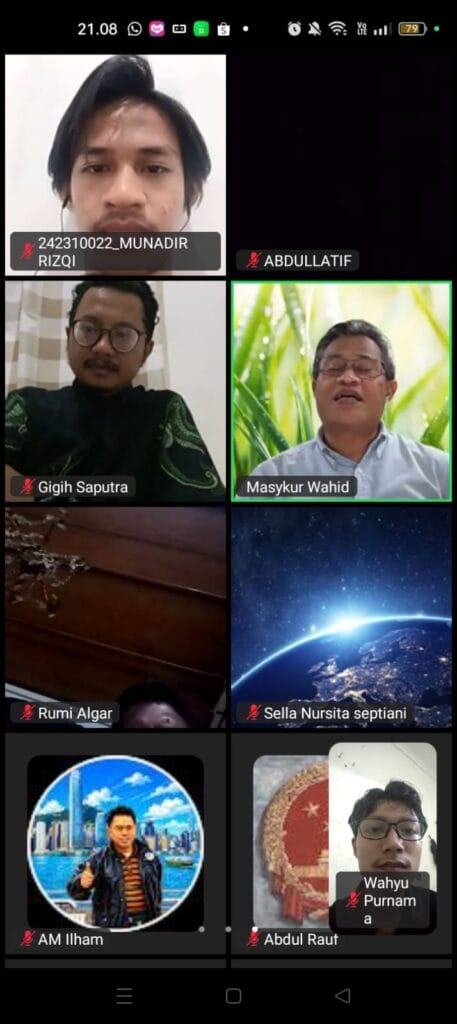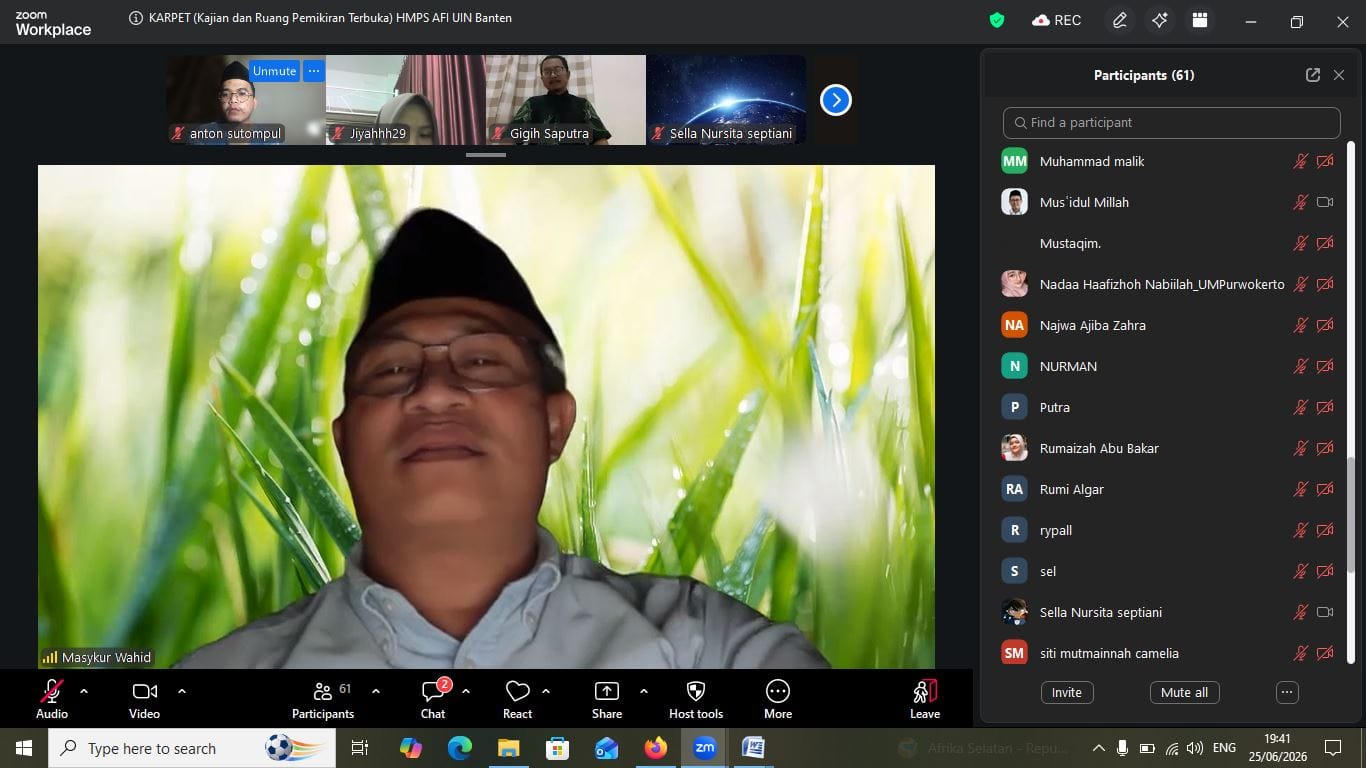
SERANG—The Student Association (HMPS) of the Islamic Creed and Philosophy Program at Sultan Maulana Hasannuddin (SMH) State Islamic University (UIN) in Banten successfully held an online seminar and open forum on Thursday, June 25, 2026. The seminar, specifically initiated by the Department of Studies and Research, was themed “Beyond Cosmological and Teleological Arguments: Is It Possible?”
The event was also attended by the Dean of the Faculty of Ushuluddin at UIN SMH Banten, Dr. Masykur, S.Ag., M.Hum., and the Head of the AFI Study Program at UIN SMH Banten Mus’idul Millah, S.Th.I., M.Ag., and HMPS President Afi Ajiba.
After that, the Head of the Program stated that this study was very beneficial in enlightening the students; hopefully, this activity will mark a good start for academic vibrancy, and the topic studied reflects AFI. “May the fact that our friends” academic term is coming to a successful conclusion serve as an inspiration to everyone,” he concluded.
Nazwa Ajiba Zahra, Chairperson of AFI UIN SMH Banten, hopes this inaugural seminar will run smoothly. According to her, the seminar serves as a space to foster more critical thinking, particularly among AFI students. Through this forum, many questions will arise, along with efforts to find their answers.
Dean of the Faculty of Islamic Studies (FUDA) at UIN Sultan Maulana Hasanuddin Banten, Dr. Masykur, S.Ag., M.Hum, expressed his appreciation for the event. In his view, events like this provide an important forum for deepening understanding of Islam through rational and philosophical approaches.
He explained that Allah is the Being who initiated the creation of all creatures. Human life on earth is not the ultimate goal, but rather part of the journey promised by Allah. “We were created by Allah, and to Him we will return. This life does not end in this world, but continues into the afterlife. That is Allah’s promise,” he said.
He went on to explain that, from a cosmological perspective, the universe is constantly in motion and undergoing change. This situation raises philosophical questions regarding the first cause (first cause), that is, the primary driving force behind all existing reality.
Meanwhile, from a teleological perspective, the universe exhibits a very clear order. Towering mountains, vast oceans, and various other natural phenomena reveal the existence of an orderly and purposeful structure. This order indicates that the universe did not come into being by chance, but is rather the design of the Creator.
According to him, the cosmological and teleological arguments ultimately lead humans to acknowledge God as The Necessarily Existent (The Inevitable Reality). Therefore, common sense should not be used to deny God’s existence, but rather to recognize the limitations of human beings as His servants.
“Faith does not stop at simply believing in the existence of God; it must be reflected in the way we think, the way we treat our fellow human beings, and how we care for life and the universe. That is where the cosmological and teleological arguments hold such great significance for a believer,” he concluded.
In his presentation, Dr. Gigih Saputra, S.Kom.I., M.Ag., introduced Cosmo-Teleological Systems Theory (TSKT) as a new approach to the study of the philosophy of God. According to him, various classical arguments regarding the existence of God—such as the cosmological, teleological, contingency, and kalam arguments—have thus far developed separately and have not yet formed a coherent system of thought.
“These circumstances underscore the need for a paradigm shift that can integrate these various approaches into a more comprehensive framework,” he said via Zoom on Thursday, June 25, 2026.
He explained that TSKT is built on three main pillars, namely causality, order, and chaos. These three elements are viewed as an integrated, interrelated system that explains the nature of reality. According to him, the universe exhibits universal cause-and-effect relationships, possesses an order that points toward a specific purpose, and at the same time experiences increasing entropy, which signifies the existence of existential limitations.
Furthermore, he asserts that the limitations of the universe lead to the conclusion that nature cannot have brought itself into existence. Based on this reasoning, TSKT concludes that there is an Absolute Existence that lies outside the natural causal system—namely, the Creator. However, this theory does not stop at the use of classical arguments; rather, it establishes a systemic relationship between causality, order, and chaos as the basis for reasoning toward the existence of God.
In his presentation, the speaker also emphasized that TSKT is not merely a synthesis of previous arguments, but rather the result of deconstruction and reconstruction which gave rise to a new paradigm. He compared his theory with various philosophical approaches to the nature of God, such as the contingency argument, the thought of Mulla Sadra, Mir Damad, William Lane Craig, Andrew Loke, and Romo Magnis Suseno. According to him, the fundamental difference of TSKT lies in its systemic approach, which not only focuses on the regularity of nature but also integrates the principle of causality and the phenomenon of chaos as part of its argumentative structure.
In closing his presentation, he stated that TSKT is expected to make a new contribution to cosmology, particularly in the development of arguments for the existence of God. He noted that the theory offers a different perspective from previous approaches because it is built on a deconstructive-reconstructive systemic paradigm, rather than simply combining existing theories.